
Process Partner AI Project
From a complex offer to a connected campaign
See how CampaignCompassAI turns ProcessPartner.AI’s AI-guided process-improvement platform into clear positioning, audience profiles, channel choices, budget allocations, content and a 30-day plan.
Generated campaign library
Open any of the 41 completed sections to see the campaign in detail.
Unique Selling Points
Unique Selling Points
-
AI-guided DMAIC process improvement in one governed workflow. ProcessPartner.AI brings mapping, measurement, root-cause analysis, improvement planning and control together so teams can improve before they automate.
-
Built for Lean Six Sigma discipline, not generic AI chat. The platform is structured around the proven DMAIC framework and supports practical tools like SIPOC, 5 Whys and monitoring plans.
-
Designed to help business users improve processes without specialist software or AI expertise. The website positions the product as usable by operational leaders, consultants and improvement teams who need guided execution rather than technical setup.
-
Turns process data into actionable improvement artefacts. Users can upload process data and use context-aware AI to accelerate analysis and documentation while validating outputs with real data and process knowledge.
-
Helps organisations standardise and scale improvement across the enterprise. The platform is aimed at consultants and internal teams that need a repeatable way to run process improvement across functions like logistics, healthcare, manufacturing, finance and HR.
-
Improvement-first approach reduces the risk of automating broken processes. The messaging repeatedly stresses “improve first,” helping teams fix root causes and control issues before moving to automation.
-
Enterprise-grade governance and security on Microsoft Azure. The site highlights encryption in transit and at rest, role-based access control, backups, recovery and ISO 27001-aligned development.
Strongest USP to lead with: AI-guided DMAIC process improvement in one governed workflow that helps teams improve first, then automate.
Value Proposition
Value Proposition
Headline:
Turn messy processes into measurable improvements with AI-guided DMAIC.

Sub-headline:
ProcessPartner.AI helps consultants, operational leaders, and improvement teams map workflows, measure performance, find root causes, and build governed improvement plans faster. Built on Microsoft Azure and grounded in Lean Six Sigma discipline, it creates practical artefacts you can trust before you automate.

Benefits:
- Reduce time lost to manual analysis and slide-building by generating structured DMAIC outputs that move improvement projects forward faster.
- Eliminate inconsistent problem-solving and weak root-cause work with a guided, disciplined workflow that keeps teams aligned from map to control.
- Improve confidence in transformation decisions by creating governed, context-aware artefacts that make it easier to sustain gains before automation.

Why now:
Most organisations are being pushed to improve faster, but automating broken processes only scales waste, ProcessPartner.AI helps teams fix the process first.
Target Customer Profile
Target Customer Profile
ProcessPartner.AI is best suited to organisations that already care about operational excellence, process discipline, and measurable improvement, but want to speed up the work without replacing it with generic AI chat.
Ideal target company
| Dimension | Best-fit profile |
|---|---|
| Industry | Consulting, healthcare, manufacturing, logistics, financial services, insurance, shared services, HR operations, public sector transformation |
| Company size | Mid-market to enterprise, typically 200+ employees; strongest fit for 1,000+ employees or multi-site organisations |
| Region | Global, with strongest early fit in North America, UK/Ireland, Western Europe, ANZ, Singapore, and other mature enterprise markets |
| Revenue | Typically $50M+ for operating companies; for consulting firms, small specialist boutiques through to global practices |
| Operating model | Multi-team, process-heavy, cross-functional environments with recurring improvement work and measurable service or operational KPIs |
Best-fit firmographics
ProcessPartner.AI is a strong match for:
- Consulting firms that deliver Lean Six Sigma, operational excellence, transformation, or business process improvement engagements
- Operationally complex enterprises with repeated process pain across departments, sites, or business units
- Regulated or high-accountability organisations where improvement artefacts, auditability, and governance matter
- Teams running continuous improvement, transformation, or process excellence programmes who need structured DMAIC execution
The strongest buyers are usually organisations that already have:
- a language of improvement
- recurring process problems
- pressure to show measurable outcomes
- teams that need standardised artefacts and not just brainstorming support
Technographic profile
ProcessPartner.AI is most attractive to companies with a modern but fragmented operations stack, especially where process work is still done in spreadsheets, slides, shared drives, and manual workshops.
Look for companies using:
- Microsoft 365 / Teams / SharePoint / OneDrive
- Azure or other Microsoft cloud services
- Power BI / Excel-heavy reporting environments
- CRM or ERP platforms such as Salesforce, Dynamics 365, SAP, Oracle, Workday, ServiceNow
- Process documentation tools like Visio, Miro, Lucidchart, Confluence, Notion, or SharePoint-based libraries
- Improvement or quality systems such as Lean Six Sigma toolkits, QMS platforms, or internal CI repositories
Best signal: they already use Microsoft infrastructure and are comfortable with governed enterprise software, but their process-improvement execution is still too manual.
Buying triggers
These are the events that create urgency and open the door to ProcessPartner.AI:
- A new operational excellence, transformation, or continuous improvement programme
- A mandate to reduce cycle time, cost, errors, or variation
- A push to standardise improvement methods across teams or regions
- A consulting engagement where the client expects faster delivery of analysis and artefacts
- Leadership pressure to do more with fewer resources
- An initiative to prepare for automation, but the team knows processes are not yet stable
- Audit findings, service failures, quality issues, or repeated root-cause investigations
- A need to scale Lean Six Sigma capability beyond a few experts
- A move to consolidate process knowledge in a governed, reusable workflow
- Frustration with slide-heavy workshops that do not convert into execution
Best buyer and user roles
ProcessPartner.AI usually needs multiple stakeholders, but the most relevant roles are:
- Head of Operational Excellence / Continuous Improvement
- Transformation Director / VP Transformation
- Process Improvement Manager
- Lean Six Sigma Black Belt / Master Black Belt
- Consulting Partner / Engagement Director
- Business Process Excellence Lead
- Operations Director / COO
- Shared Services Leader
- Quality or Compliance Leader
- Digital Transformation Manager who needs process readiness before automation
Primary users are often improvement practitioners and consultants; economic buyers are usually ops leaders, transformation leaders, or consulting firm partners.
Disqualifiers
ProcessPartner.AI is not the right fit when:
- The company is too small and has no structured improvement work
- Teams want a generic AI assistant rather than a governed DMAIC workflow
- The buyer is looking for full process automation first, not process improvement first
- There is no appetite for process discipline, documentation, or governance
- The organisation lacks access to real process data or has no clear KPI baseline
- The problem is purely a technical software issue rather than a business process issue
- The company wants an extremely lightweight tool for casual brainstorming only
Also deprioritise prospects that:
- have no Microsoft-based environment and strong security requirements that conflict with your current positioning
- are too early-stage in maturity to understand Lean Six Sigma or structured improvement
Where to find these companies
You can find the best prospects in places where process excellence, transformation, and operational improvement are already visible.
Company-level sources
- LinkedIn company pages for:
- consulting firms
- shared services centres
- manufacturers
- healthcare networks
- logistics providers
- financial institutions
- G2, Gartner, Capterra, and Microsoft partner ecosystems for adjacent operations and governance software users
- Microsoft Azure customer stories and Microsoft partner directories
- Lean Six Sigma, operational excellence, and transformation conference exhibitor/speaker lists
- Industry associations for quality, operations, and process excellence
Persona-level sources
- LinkedIn Sales Navigator searches for titles like:
- Operational Excellence
- Continuous Improvement
- Lean Six Sigma
- Transformation
- Process Improvement
- Business Process Management
- Shared Services
- Quality Improvement
- Webinar attendee lists and event registrations from:
- process improvement
- transformation
- operations leadership
- digital workplace
- AI in enterprise operations
- Consulting firms’ partner and practice pages
- Case study and thought leadership pages from organisations already publishing about improvement, standardisation, or automation readiness
High-intent signals to prioritise
- Recent hiring for CI, operational excellence, transformation, or automation roles
- Public posts about process redesign, efficiency, or standardisation
- Announcements of ERP, CRM, shared services, or automation programmes
- Job descriptions mentioning Lean Six Sigma, DMAIC, root cause analysis, or process mapping
- Mentions of Azure, Microsoft 365, or governed enterprise AI initiatives
Practical ICP summary
Primary ICP:
Mid-market to enterprise organisations with recurring process improvement needs, especially consulting firms and operationally complex businesses already using Microsoft tools. They are trying to standardise DMAIC work, reduce manual analysis, and improve processes before automating them.

Best-fit buyer intent:
They are actively investing in operational excellence, transformation, or process improvement and need a governed AI workflow that produces usable artefacts fast.

Why they buy:
To make improvement work faster, more consistent, and more scalable without sacrificing discipline, governance, or trust.
If you'd like, I can also turn this into a 1-page ICP table, a persona matrix, or a lead scoring framework for ProcessPartner.AI.
Buying Persona
Buying Persona
Persona 1: Decision Maker, Director of Operational Excellence
Job title
Director of Operational Excellence, Head of Continuous Improvement, VP Operations
What they are responsible for
Owning enterprise improvement programmes, prioritising process transformation initiatives, proving ROI, and ensuring methods are consistent across teams and functions.
Goals
- Deliver measurable performance improvements across critical processes.
- Standardise how improvement projects are run across the organisation.
- Reduce cycle time, defects, rework, and operational friction.
- Build a repeatable improvement capability that scales beyond individual experts.
- Avoid investing in automation before processes are stable and controlled.
Pains
- Improvement work is often slow, inconsistent, and heavily dependent on a few experts.
- Teams produce different-quality maps, root-cause analysis, and action plans.
- Too much time is spent preparing slides, documentation, and status updates instead of improving the process.
- Leadership wants faster transformation, but the underlying process data is incomplete or hard to interpret.
- There is pressure to adopt AI or automation tools, but governance and process discipline are not always in place.
- Existing tools either feel too generic or too complex for business teams to use consistently.
Objections
- “Will this actually improve process outcomes, or just create better-looking documents?”
- “Can my teams use this without a long implementation or specialist training?”
- “How do we know the AI outputs are reliable and governed?”
- “Will this fit our existing Lean Six Sigma or continuous improvement approach?”
- “How does this help us before automation, not just after the fact?”
Success metrics
- Reduction in process cycle time
- Fewer defects, handoff errors, and rework loops
- Faster completion of DMAIC projects
- Increased consistency in improvement methodology across teams
- More projects progressing from problem definition to sustained control
- Demonstrable ROI from improvement initiatives
- Adoption rate across business units
Preferred channels
- LinkedIn thought leadership and case-led posts
- Executive webinars and roundtables
- Industry conferences and peer events
- Direct outreach from credible advisors or consultants
- ROI-focused one-pagers and implementation briefs
- Analyst-style content and comparison guides
Quote in their voice
“We don’t need another AI tool that generates ideas in a vacuum. We need a disciplined way to improve real processes, prove the root causes, and sustain the gains before we even think about automating.”
Persona 2: Champion, Continuous Improvement Manager
Job title
Continuous Improvement Manager, Process Improvement Lead, Lean Six Sigma Black Belt, Operational Excellence Consultant
What they are responsible for
Running improvement workshops, mapping processes, analysing performance data, identifying root causes, building action plans, and coaching teams through DMAIC projects.
Goals
- Run more improvement projects with less manual effort.
- Produce high-quality DMAIC artefacts faster.
- Help business teams engage in improvement work without needing deep expert support.
- Keep projects moving from analysis to action without losing rigour.
- Make process improvement more accessible and repeatable across departments.
- Show visible progress and credibility with operational leaders.
Pains
- A lot of time goes into gathering inputs, formatting deliverables, and chasing stakeholders.
- It is difficult to keep project documentation consistent across teams and sites.
- Root-cause analysis can become subjective or stall when data is messy.
- Business users often need heavy coaching to contribute meaningfully.
- Improvement work gets interrupted by urgent operational issues.
- It is hard to maintain control plans after the project ends.
Objections
- “I already have templates and spreadsheets, why change?”
- “Will this save time, or just add another system to manage?”
- “Will it reduce my control over the quality of the analysis?”
- “Can it handle the variation in how different teams run projects?”
- “Will stakeholders trust AI-generated outputs?”
Success metrics
- Number of DMAIC projects completed per quarter
- Time saved on mapping, analysis, and documentation
- Percentage of projects with complete control plans
- Stakeholder participation in workshops and reviews
- Consistency of outputs across projects
- Faster movement from problem definition to implementation
- Reduced dependence on manual slide-building and formatting
Preferred channels
- LinkedIn posts and practitioner communities
- Lean Six Sigma and process improvement forums
- Webinars with practical demonstrations
- Product walkthroughs and hands-on trials
- Email nurture with templates, playbooks, and use cases
- Peer recommendations from consultants and improvement leaders
Quote in their voice
“If I can get teams from process map to root cause to control plan faster, without losing the discipline of DMAIC, that’s a real win. I don’t need more theory, I need something that helps people do the work properly.”
Customer Journey Stages
Customer Journey Stages
ProcessPartner.AI’s buyers are usually trying to solve a practical problem: they know a process is slow, inconsistent, expensive, or hard to control, and they need a disciplined way to improve it before anyone talks about automation.
The journey below maps how consultants, operational leaders, and improvement teams typically move from first recognition of the problem to adoption and advocacy.
| Stage | Buyer questions | Content to offer | Channel | Conversion action |
|---|---|---|---|---|
| Awareness | - Why is this process still broken?<br>- Where are the bottlenecks, delays, rework, or handoff failures?<br>- How do we improve before we automate?<br>- Is there a better way than spreadsheets, whiteboards, and slide decks? | - Process improvement thought leadership articles<br>- “Improve first, automate later” guidance<br>- Short explainer video on AI-guided DMAIC<br>- Checklists: “Signs your process is not ready for automation”<br>- Lean Six Sigma problem-framing content | - LinkedIn<br>- SEO blog content<br>- YouTube / short demo clips<br>- Newsletter<br>- Partner webinars | - Visit the website<br>- Download a checklist or guide<br>- Subscribe to email updates<br>- Watch a demo overview |
| Consideration | - How does ProcessPartner.AI actually support DMAIC?<br>- Can it help with SIPOC, root cause analysis, and control plans?<br>- Will it work for my industry and process type?<br>- Is the AI trustworthy and governed?<br>- How is this different from generic AI tools? | - Product comparison page<br>- DMAIC workflow overview<br>- Use-case pages by function or industry<br>- Sample outputs: SIPOC, 5 Whys, monitoring plan<br>- Webinar or live demo<br>- ROI / time-saved worksheet | - Website product pages<br>- Email nurture sequence<br>- Live demo sessions<br>- LinkedIn retargeting<br>- Sales conversations | - Book a demo<br>- Request a guided walkthrough<br>- Start a pilot<br>- Share a process improvement challenge with the team |
| Decision | - Can we trust the outputs?<br>- What security and governance controls are in place?<br>- How quickly can we get value from a pilot?<br>- What does implementation require from our team?<br>- Is this worth replacing our current approach? | - Security and governance brief<br>- Pilot plan template<br>- Implementation checklist<br>- Customer case study or proof point<br>- FAQ addressing AI, data handling, and adoption<br>- Pricing / packaging overview if applicable | - Sales calls<br>- Procurement / stakeholder reviews<br>- Follow-up email<br>- Proposal deck<br>- Security review meetings | - Approve pilot or purchase<br>- Complete procurement steps<br>- Sign agreement<br>- Confirm rollout scope |
| Onboarding / Advocacy | - How do we get teams using it consistently?<br>- How do we apply it to more processes?<br>- How do we show results to leadership?<br>- How do we make this part of our standard improvement method?<br>- Can we share our success internally? | - Onboarding guide<br>- First-project playbook<br>- Training session or admin enablement<br>- Best-practice templates for repeated DMAIC work<br>- Internal launch kit for champions<br>- Expansion roadmap / advanced use cases | - Customer success calls<br>- In-app guidance<br>- Training webinars<br>- Email enablement<br>- Community / customer updates | - Complete first project<br>- Expand to another team or process<br>- Recommend internally<br>- Provide testimonial or referral<br>- Join a reference call |
Practical journey logic for ProcessPartner.AI
- Awareness content should educate on the risk of automating broken processes. The goal is to create urgency around improvement first, not to lead with features.
- Consideration content should show the governed DMAIC workflow in action. Buyers need to see how the platform structures mapping, measurement, root-cause analysis, and control.
- Decision content should reduce trust barriers. Security, governance, implementation effort, and pilot feasibility are usually the key objections.
- Onboarding content should help teams repeat the method. Adoption grows when the first project produces a practical improvement artefact and an easy path to the next one.
If you want, I can write the next section as a full funnel content plan or turn this journey into specific campaign assets by stage for ProcessPartner.AI.
Selected Theme/Slogan/Message
Less Admin. More Improvement.
Spend less time documenting, more time improving.
Stance: Lead with the everyday burden of spreadsheets, slide decks and manual analysis. Show how context-aware AI supports structured DMAIC artefacts while teams retain responsibility for validating findings and decisions.
Why it fits: Time-constrained consultants and improvement teams have an immediate reason to start a free project when the message addresses work that slows their delivery.
Competitive Analysis
Competitive Analysis
ProcessPartner.AI competes against three main alternatives:
- Generic AI tools that help draft content but don’t enforce DMAIC discipline
- Process mapping / documentation platforms that capture workflows but don’t drive improvement
- Doing nothing and continuing with spreadsheets, slide decks, workshops, and manual analysis
Below are the most likely alternatives buyers will compare you against.
| Competitor / alternative | Positioning | Pricing signal | Strengths | Gaps | How ProcessPartner.AI wins |
|---|---|---|---|---|---|
| Microsoft Copilot / ChatGPT / generic AI assistants | Broad productivity and content generation | Often low entry cost or bundled; enterprise tiers vary | Familiar, fast, flexible, already in the buyer’s ecosystem | Not purpose-built for DMAIC; outputs can be inconsistent; no governed improvement workflow; no built-in SIPOC, 5 Whys, control planning discipline | Position ProcessPartner.AI as improvement software, not chat. Emphasise that teams keep control, validate findings, and get structured DMAIC artefacts instead of ad hoc prompts and disconnected drafts |
| Minitab / JMP / statistical analysis tools | Data analysis and quality improvement for specialists | Typically mid-to-high subscription pricing | Strong credibility in quality and statistical work; trusted by experienced practitioners | Better for analysis than end-to-end improvement execution; often requires specialist skill; doesn’t unify mapping, root cause, action planning, and control in one guided flow | Win by stressing guided, practical execution for consultants and ops teams. ProcessPartner.AI is easier to use for broader teams and helps build the whole improvement pack, not just analyse data |
| Lucidchart / Visio / Miro / general process mapping tools | Diagramming and workshop collaboration | Often low-to-mid subscription pricing | Good for visual mapping and team collaboration | Maps are static unless people manually do the analysis; doesn’t help teams move from process map to measurement, root cause, and control | Position ProcessPartner.AI as map-to-improve, not map-and-stop. Show that it turns process understanding into measurable, governed improvement artefacts |
| Consulting-led manual improvement using spreadsheets, decks, and templates | “We’ll do it ourselves” or “our consultants will handle it manually” | Hidden labour cost; software spend may be near zero | Familiar, flexible, no new system to buy | Slow, inconsistent, hard to scale, knowledge trapped in slides and personal files; difficult to standardise across teams | Win with speed, consistency, and repeatability. Show how ProcessPartner.AI reduces admin, shortens analysis cycles, and creates reusable artefacts the team can trust and share |
| Doing nothing | Keep current way of working | No software cost, but high time cost | No change management effort; no procurement | Ongoing admin burden, repeated root-cause mistakes, weak sustainment, low visibility, and slow improvement delivery | Use the strongest contrast: the real cost is time lost to admin and rework. Message the risk of continuing to document improvements manually while pressure to improve faster keeps rising |
How to win against each alternative
1) Against Microsoft Copilot, ChatGPT, and generic AI
Generic AI is the most dangerous competitor because it is easy to try. Buyers will assume they can “just use AI” for improvement work.
Win strategy:
- Position ProcessPartner.AI as a governed DMAIC workflow built for improvement, not a chatbot
- Repeat that it helps teams improve first, then automate
- Stress that users can generate outputs faster, but they still validate data, root causes, and decisions
- Highlight practical artefacts like SIPOC, measurement plans, root-cause analysis, and control plans
Message to use:
Generic AI can draft ideas. ProcessPartner.AI helps teams run disciplined improvement.
2) Against Minitab, JMP, and specialist analytics tools
These tools are credible, but they can feel too technical or too narrow for broader improvement teams.
Win strategy:
- Lead with workflow, not statistics
- Emphasise that ProcessPartner.AI is for consultants, operational leaders, and improvement teams, not only analysts
- Show how it reduces the friction between analysis and execution by keeping everything in one structured process
- Position it as ideal when the goal is not just analysis, but actionable, governed improvement artefacts
Message to use:
Powerful analysis is useful. But if the team still has to stitch together the map, the analysis, the action plan, and the control plan manually, the work slows down.
3) Against Lucidchart, Visio, and Miro
These tools are common because they are easy to understand and already in use.
Win strategy:
- Acknowledge that mapping matters, then show that mapping alone does not improve the process
- Use the theme “Less Admin. More Improvement.”
- Demonstrate how ProcessPartner.AI turns a process map into a structured improvement workflow
- Make the contrast clear: others help teams document processes; ProcessPartner.AI helps them improve the process and sustain the gains
Message to use:
A process map is only the starting point. The value is in what happens next.
4) Against manual spreadsheets, slide decks, and templates
This is the default competitor in most organisations, especially in mid-market teams.
Win strategy:
- Talk about the hidden cost of manual work: repeated formatting, version control problems, inconsistent analysis, and duplicated effort
- Show how ProcessPartner.AI reduces the admin burden without removing human judgment
- Position the product as a way to standardise improvement delivery across teams
- Make it easy for buyers to imagine faster workshops, cleaner artefacts, and less time rebuilding the same document in PowerPoint
Message to use:
Stop spending half the project on documenting the project.
5) Against doing nothing
This is often the real decision. Buyers may like the idea, but inertia is strong.
Win strategy:
- Quantify the problem carefully without inventing stats: call out estimated time lost to admin, rework, and duplicated analysis
- Tie the cost of delay to leadership priorities: cycle time, quality, service, and readiness for automation
- Create urgency around the risk of improving slowly while competitors move faster
- Frame ProcessPartner.AI as a practical way to start with one team or one process, not a massive transformation programme
Message to use:
If the process keeps getting documented manually, the business keeps paying for the same friction every time.
Recommended competitive positioning
The cleanest market position for ProcessPartner.AI is:
- Not a generic AI assistant
- Not just a diagramming tool
- Not a heavy analytics package
- Not a consulting substitute
- A governed AI-guided DMAIC workflow that helps teams improve before they automate
That positioning is strongest because it aligns directly with the campaign theme:
Less Admin. More Improvement. Spend less time documenting, more time improving.
If you want, I can also write the next section as:
- Competitor-specific ad angles
- Objection handling / battlecards
- Landing page messaging to beat each competitor
Market Research
Market Research
ProcessPartner.AI sits in a strong demand pocket: mid-market and enterprise teams are under pressure to improve processes faster, but most of the work is still done manually in spreadsheets, slide decks, workshops, and shared drives. That creates a clear opening for AI-guided DMAIC software that speeds up improvement without removing governance or discipline.
Market size signals
There is no single clean market number for “AI-guided DMAIC process improvement software,” so the best way to size the opportunity is through adjacent market signals and buyer behaviour.
| Signal | What it suggests for ProcessPartner.AI |
|---|---|
| Global AI software adoption continues to expand across business functions | Buyers are increasingly open to AI-assisted workflow tools, especially where the output is structured and business-critical |
| Process improvement, operational excellence, and transformation programmes remain active in mid-market and enterprise organisations | There is ongoing demand for repeatable ways to map, analyse, improve, and control processes |
| Microsoft-centric environments are common in the target segment | A Microsoft Azure foundation is a strong trust and deployment signal for governed enterprise buyers |
| Lean Six Sigma and continuous improvement methods are still widely used in operations-heavy industries | There is an established language and methodology to anchor the product |
| Many organisations are trying to prepare processes for automation and AI | “Improve first, automate later” aligns to a growing governance concern |
Estimate: A realistic near-term serviceable market for ProcessPartner.AI is likely concentrated in organisations with active continuous improvement, transformation, or process excellence teams in the mid-market and enterprise segments globally. The exact number will vary by region and industry mix, but the presence of Microsoft-heavy knowledge work environments and recurring process-improvement work indicates a substantial addressable audience.
Buyer demand drivers
The campaign should lean into the operational pain and delivery pressure that creates urgency.
1) Improvement work is still too manual
Teams spend a large amount of time:
- documenting processes in PowerPoint or Visio
- cleaning data in Excel
- writing workshop notes into formal artefacts
- chasing alignment across stakeholders
- rebuilding analysis for every new project
This makes “Less Admin. More Improvement.” highly credible because it reflects a real, repeated frustration.
2) Leaders want faster outcomes without sacrificing rigour
Operational leaders and consultants are being asked to:
- reduce cycle times
- improve quality and service levels
- standardise delivery across teams
- show measurable results faster
- do more with fewer resources
That creates demand for tools that accelerate analysis while preserving disciplined DMAIC thinking.
3) Automation pressure is exposing weak process foundations
Many organisations want AI and automation, but they are realising their processes are not stable enough yet. This creates a strong opening for the “improve first, automate later” message, which is more credible than automation-first messaging.
4) Governance and trust matter more in enterprise buying
The target buyer is unlikely to trust a generic chatbot for process improvement. They want:
- traceable outputs
- governed artefacts
- role-based access
- security and auditability
- structured methodology
ProcessPartner.AI’s Azure-based positioning and DMAIC structure directly supports this demand.
Buying committee dynamics
ProcessPartner.AI will usually sell into a multi-stakeholder buying group. The campaign should speak to different motivations in the same deal.
| Role | Likely priority | What they care about |
|---|---|---|
| Head of Operational Excellence / CI Leader | Faster, repeatable improvement delivery | Standardisation, method discipline, scalability |
| Transformation Director / VP Transformation | Business impact and speed | Time-to-value, change execution, measurable outcomes |
| Lean Six Sigma Black Belt / Improvement Manager | Better analysis and artefacts | Structured tools, root-cause discipline, quality of outputs |
| Operations Director / COO | Throughput, cost, service performance | Reduced admin, faster fixes, sustained gains |
| Consulting Partner / Engagement Director | Delivery efficiency and margin | Faster engagements, reusable workflows, client confidence |
| Digital Transformation Manager | Readiness for automation | Process stability, governance, pre-automation improvement |
| IT / Security / Compliance stakeholder | Risk and control | Azure security, access control, data handling, governance |
Buying committee dynamic to expect
The most common friction is between:
- practitioners, who want something that helps them do better improvement work faster
- leaders, who want measurable results and standardisation
- security/IT, who want trustworthy deployment and data controls
That means the campaign should not position ProcessPartner.AI as “AI for everyone.” It should position it as governed AI for disciplined improvement teams.
3 insights the campaign should exploit
1) The real enemy is not just bad process, it is improvement waste
A lot of process-improvement time is lost before any fix is made. Teams are buried in admin:
- mapping
- formatting
- note-taking
- consolidating data
- preparing workshop outputs
Campaign implication: Lead with the everyday burden of administrative work, not abstract AI capability. “Less Admin. More Improvement.” should feel like relief.
2) Buyers want AI support, but only inside a structured method
The market is increasingly skeptical of generic AI outputs. In process improvement, the buyer wants:
- a guided workflow
- context-aware assistance
- human validation
- disciplined artefacts
- governance
Campaign implication: Emphasise that ProcessPartner.AI supports DMAIC rather than replacing judgement. The AI accelerates work; the team retains responsibility for findings and decisions.
3) “Improve first, automate later” is a strong wedge
Many transformation initiatives fail because automation is applied to unstable processes. This is a powerful strategic insight because it reframes the product from a productivity tool into a risk-reduction tool.
Campaign implication: Use messaging that connects improvement with safer transformation:
- fix root causes
- stabilise performance
- create control plans
- then automate with confidence
Practical campaign takeaway
The strongest market message for ProcessPartner.AI is not “AI process software.” It is:
- a faster way to produce governed improvement artefacts
- a way to reduce the admin burden of DMAIC work
- a disciplined path to better decisions before automation
That positioning matches how buyers already think, what they fear losing with generic AI, and what they need most right now: speed without chaos.
Current Trends
Current Trends
ProcessPartner.AI is selling into a market where teams are under pressure to improve faster, prove outcomes, and do more with fewer specialist resources. The campaign should use these five trends directly in messaging, creative, and lead magnets.
| Trend | What’s happening in the market | How the campaign should use it |
|---|---|---|
| AI is being adopted, but trust is still the blocker | Many operations and improvement leaders are interested in AI, but they do not want generic chatbots making unsupported recommendations in regulated or high-accountability environments. | Position ProcessPartner.AI as context-aware AI inside a governed DMAIC workflow. Lead with “AI that supports structured improvement artefacts, while your team validates the findings.” This reduces fear and increases credibility. |
| Organisations are pushing for faster operational improvement | Leaders want visible productivity gains, cycle-time reduction, and lower cost, but internal teams are already overloaded with workshops, analysis, and reporting. | Use the theme “Less Admin. More Improvement.” Show that the platform removes time lost to spreadsheets, slide decks, and manual analysis so teams can spend more time solving root causes and implementing changes. |
| Process automation is being prioritised, but process readiness is often weak | Many companies are rushing toward automation and workflow tools before stabilising and improving the underlying process. That creates rework and wasted spend. | Make improve first, then automate a core campaign proof point. Use content that highlights the risk of automating broken processes and explain how ProcessPartner.AI helps teams map, measure, and stabilise before automation decisions are made. |
| Improvement teams need standardisation, not just brainstorming support | Lean Six Sigma, operational excellence, and transformation teams need repeatable artefacts and consistent problem-solving methods across projects and functions. | Emphasise that ProcessPartner.AI is built on DMAIC discipline, with support for SIPOC, 5 Whys, monitoring plans, and practical improvement outputs. This differentiates it from generic AI tools and collaboration apps. |
| Mid-market teams are expected to do enterprise-level work with leaner teams | Medium-sized businesses and consulting firms often need the same quality of analysis and governance as larger enterprises, but with fewer experts and less time. | Target messaging at consultants, operational leaders, and improvement teams who need a repeatable way to produce high-quality artefacts faster. Use copy that speaks to lean teams delivering more projects without adding headcount. |
How to apply these trends in the campaign
- Lead with the burden, not the technology. Open ads and landing pages with the everyday pain: manual analysis, scattered spreadsheets, slide-heavy reporting, and too much documentation.
- Use trust language everywhere. Reinforce that teams retain responsibility for validating findings and decisions. This is especially important for regulated industries and enterprise buyers.
- Frame AI as an accelerator, not a replacement. The strongest message is not “AI does your improvement work.” It is “AI helps your team do disciplined improvement work faster.”
- Anchor claims in process outcomes. Focus on mapping, measuring, root-cause analysis, improvement planning, and control, not vague productivity claims.
- Offer a low-friction next step. Since buyers are cautious, the lead magnet should be practical: a DMAIC workflow demo, a sample improvement artefact pack, or a quick assessment of how much admin time their current process improvement work is consuming.
Recommended campaign angle by trend
1. AI trust concerns
Angle: “AI-guided, but always governed.”
Message: ProcessPartner.AI supports your improvement work with context-aware AI, while your team validates every finding and decision.

2. Pressure to improve faster
Angle: “Spend less time documenting, more time improving.”
Message: Replace manual admin and slide-building with structured DMAIC outputs that move projects forward faster.

3. Automation readiness
Angle: “Improve first, then automate.”
Message: Fix root causes and stabilise the process before investing in automation or workflow redesign.

4. Need for standardisation
Angle: “A repeatable DMAIC workflow for every improvement project.”
Message: Build consistent artefacts across teams with support for SIPOC, 5 Whys, and control plans.

5. Lean teams, heavy workloads
Angle: “Enterprise-grade improvement without enterprise-level overhead.”
Message: Help consultants and operational teams deliver better work faster, without needing more specialist resource.
Channel Budget Breakdown
Investment plan and payback threshold
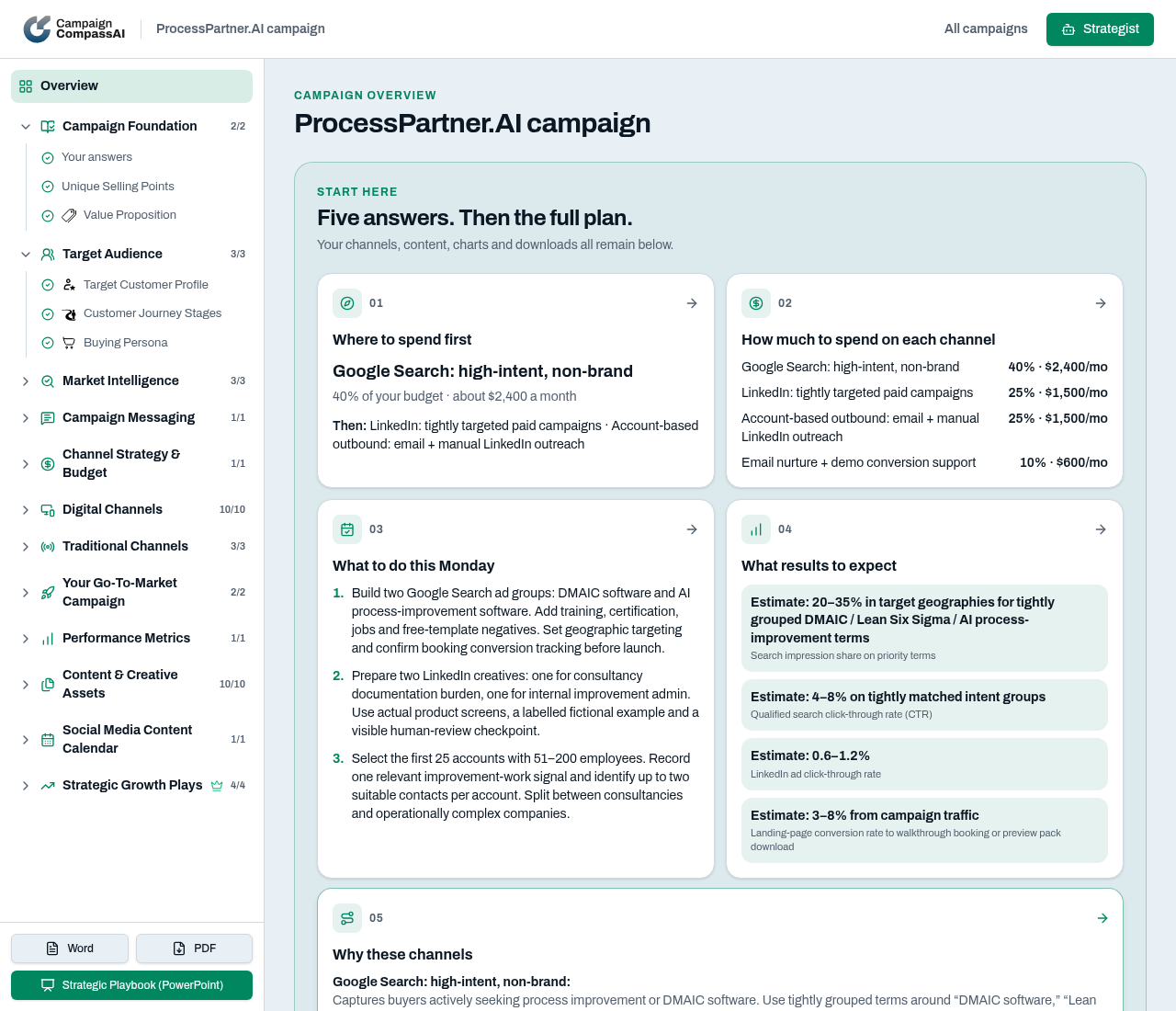
Allocate ProcessPartner.AI’s $6,000 monthly budget across four channels, for $18,000 over 90 days. Prioritise high-intent prospects and targeted conversations, not inexpensive downloads with weak buying intent.
Target companies with 51–200 employees, correcting the enterprise-heavy targeting in earlier sections. Focus on operationally complex businesses and improvement consultancies with recurring DMAIC work.
Economics to use before scaling
Actual retention, gross margin and close rates are not provided. Use this conservative planning model until real cohort data is available:
| Metric | Planning assumption |
|---|---|
| Initial contract revenue | $37,500 estimate, the midpoint of the supplied deal range |
| Gross margin | 80% estimate; replace with actual margin, including AI/cloud and delivery costs |
| Gross-profit value of initial contract | $30,000 estimate; no renewals or expansion assumed |
| Target gross-profit LTV:CAC | At least 3:1 |
| Maximum fully loaded CAC under this model | $10,000 |
| Qualified opportunity-to-customer rate | 20% estimate |
| Maximum fully loaded cost per opportunity | $2,000 estimate |
Campaign target: at least three attributable customers as the pipeline matures. That produces a $6,000 campaign-only CAC, leaving up to $4,000 per customer for sales effort and other acquisition costs before reaching the modeled ceiling.
Two customers would produce a $9,000 campaign-only CAC, leaving little room for those additional costs. Do not claim a healthy LTV:CAC ratio using media spend alone.
Monthly channel allocation
All costs and outcomes below are planning estimates, not benchmarks or guarantees. Amounts include channel-specific execution costs; subtract management fees from each allocation rather than adding them above the budget.
| Channel | % | Monthly amount | Why it fits ProcessPartner.AI | Expected monthly outcome |
|---|---|---|---|---|
| Google Search: high-intent, non-brand | 40% | $2,400 | Captures buyers actively seeking process improvement or DMAIC software. Use tightly grouped terms around “DMAIC software,” “Lean Six Sigma software” and “AI process improvement software.” | 8–12 qualified leads, at $200–$300 CPL; 2–3 opportunities, at $800–$1,200 CPO |
| LinkedIn: tightly targeted paid campaigns | 25% | $1,500 | Reaches CI managers, operations leaders and consulting partners at selected companies. Demonstrate structured artefacts and human validation, rather than broad AI claims. | 5–8 qualified leads, at approximately $190–$300 CPL; 1–2 opportunities, at $750–$1,500 CPO |
| Account-based outbound: email + manual LinkedIn outreach | 25% | $1,500 | Supports research-led conversations with buyers whose recurring improvement workload could justify a $25,001–$50,000 purchase. Budget covers data, verification, tools and limited execution support. | 8–12 qualified positive responses, at $125–$190 each; 2–3 opportunities, at $500–$750 CPO |
| Email nurture + demo conversion support | 10% | $600 | Helps cautious buyers progress through artefact examples, validation guidance and a scoped project discussion. Covers lightweight email tooling, follow-up content and booking-page improvements. | 1–2 influenced opportunities from existing leads; $300–$600 per influenced opportunity. Do not count these again as newly sourced opportunities. |
| Total | 100% | $6,000 | Intent capture, precise prospecting and follow-through | 5–8 newly sourced opportunities per month, plus nurture influence |
Definitions: A qualified lead fits the company-size and role criteria and has a relevant improvement need. An opportunity requires a held discovery meeting, a specific process challenge, plausible budget and an agreed next step. Downloads and booked-but-unattended meetings do not qualify.
How to deploy over 90 days
- Days 1–30: Start paid campaigns in the US, UK/Ireland and ANZ, with English-language assets. Keep inbound availability global, but avoid spreading this budget across every market. Build a researched outbound list of 100–150 accounts per month, an execution estimate.
- Days 31–60: Shift spending toward the segment producing held, qualified meetings. Separate consulting-firm results from operating-company results. Add LinkedIn retargeting only when the eligible audience meets platform requirements.
- Days 61–90: Concentrate on proven search terms, account segments and offers. Use nurture to secure stakeholder meetings and define a first-project scope.
The modeled funnel yields 15–24 sourced opportunities over 90 days. At the assumed 20% win rate, that implies 3–5 eventual customers, not necessarily contracts signed within the campaign window. Track the cohort through day 180 to assess delayed conversions.
Channels to cut from this campaign
These are exclusions for this $18,000 test, not claims that the channels never work.
| Cut | Payback problem |
|---|---|
| Broad display, programmatic and cold YouTube advertising | Too much low-intent reach; insufficient budget to establish qualified opportunity economics. |
| Broad Meta prospecting | Difficult to isolate DMAIC buyers at 51–200-employee companies without substantial testing waste. |
| Trade-show sponsorships and exhibition booths | Upfront costs could consume the campaign budget before producing a measurable pipeline. |
| Generic lead-list purchases or content syndication | Cheap contacts can conceal expensive qualification and weak purchase intent. |
| Broad paid SEO programmes | Unlikely to prove payback within 90 days. Publish a small number of useful pages internally instead. |
Weekly decision rule: optimise toward held meetings, accepted opportunities and fully loaded CAC, not CPL alone. Pause segments with no credible buying conversations after reviewing lead quality, tracking and follow-up. Scale only when conservative close-rate assumptions still support LTV:CAC ≥3:1.
Key Performance Indicators (KPIs)
Key Performance Indicators (KPIs)
The campaign should be measured on a mix of leading indicators (whether the workflow message is landing and driving interest) and lagging indicators (whether that interest turns into qualified walkthroughs and commercial conversations).
Leading indicators
| KPI | Target | How to measure | Review cadence |
|---|---|---|---|
| Search impression share on priority terms | Estimate: 20–35% in target geographies for tightly grouped DMAIC / Lean Six Sigma / AI process-improvement terms | Google Ads impression share and top-of-page rate for approved keyword groups | Weekly |
| Qualified search click-through rate (CTR) | Estimate: 4–8% on tightly matched intent groups | Google Ads CTR, segmented by keyword theme and geography | Weekly |
| LinkedIn ad click-through rate | Estimate: 0.6–1.2% | LinkedIn campaign analytics by audience angle and creative | Weekly |
| Landing-page conversion rate to walkthrough booking or preview pack download | Estimate: 3–8% from campaign traffic | Website analytics and form submissions; track by source/medium and campaign variant | Weekly |
| Email open rate on nurture sequences | Estimate: 30–45% | Email platform reporting, segmented by lead source and sequence step | Weekly |
| Email click-through rate to walkthrough or preview pack | Estimate: 2–6% | Email platform click reporting and booked-meeting attribution | Weekly |
| Outbound response rate | Estimate: 5–12% positive or engaged replies from contacted accounts | Sales/outreach CRM logging: replies, acceptances, meeting requests, and objections | Weekly |
Lagging indicators
| KPI | Target | How to measure | Review cadence |
|---|---|---|---|
| Held DMAIC Workflow Walkthroughs | Estimate: 12–24 per month | Calendar bookings minus no-shows; attribute to channel and audience segment | Weekly and monthly |
| Qualified opportunity creation | Estimate: 4–10 per month with fit to the $25,001–$50,000 solution range | CRM opportunities created from walkthroughs, outbound replies, and nurture conversions | Monthly |
| Meeting-to-opportunity conversion rate | Estimate: 25–40% | CRM funnel tracking from held walkthrough to sales-qualified next step | Monthly |
| Cost per qualified walkthrough | Target: within campaign CAC guardrails set by ProcessPartner.AI | Total channel spend divided by held qualified walkthroughs, by channel and region | Monthly |
How to use these KPIs
- Leading indicators tell you whether the campaign is earning attention from the right buyers and whether the “Less Admin. More Improvement.” message is resonating.
- Lagging indicators tell you whether the campaign is creating commercially useful conversations and scoped next steps.
- Review weekly for channel optimisation and monthly for budget reallocation, messaging refinement and qualification quality.
If you want, I can also write the next section in the same format: Measurement plan and attribution.
Your Marketing Campaign
Campaign concept: turn improvement admin into improvement momentum
ProcessPartner.AI’s 90-day campaign will make one practical contrast visible: the time teams spend assembling improvement documentation versus the work needed to improve the process itself.
The big idea is to show the journey from scattered spreadsheets, workshop notes and slide decks to structured DMAIC artefacts, supported by context-aware AI and validated by the people responsible for the process.
Campaign theme: Less Admin. More Improvement.
Commercial objective: Generate qualified conversations with consultants and operational leaders at 51–200-employee companies who have recurring improvement work and a credible need for a $25,001–$50,000 solution.
Campaign investment: $6,000 per month; $18,000 over 90 days.
Keep inbound access global, but concentrate initial paid activity in the US, UK/Ireland and ANZ. With this budget, global availability should not mean fragmented global advertising.
Core message and creative direction
Lead with administrative friction, demonstrate the structured workflow, then explain the role of human validation.
Master campaign message
Less Admin. More Improvement.

Spend less time documenting, more time improving.

ProcessPartner.AI helps consultants, operational leaders and improvement teams move from scattered spreadsheets and workshop notes to structured DMAIC artefacts.

Use context-aware AI to support process mapping, measurement, root-cause analysis, improvement planning and control, while your team validates the findings and owns the decisions.

Improve the process first. Then decide what to automate.

Book a DMAIC Workflow Walkthrough.
Two audience angles
| Audience | Pain to lead with | What to demonstrate | Commercial qualification |
|---|---|---|---|
| Improvement consultancies with 51–200 employees | Practitioners repeatedly assemble project documentation and client deliverables | A repeatable workflow for preparing and reviewing structured improvement artefacts | Recurring client engagements, multiple practitioners and a delivery-standardisation need |
| Operationally complex companies with 51–200 employees | Lean teams juggle process improvement alongside daily operations | How one process challenge moves through mapping, measurement, analysis, improvement and control | A named process owner, measurable operational problem and leadership sponsorship |
Creative format: Use actual product screens alongside a clearly labelled fictional process example. Show a workshop-input view, a structured artefact and a human-review checkpoint.
Avoid “AI fixes your process” messaging, fabricated results or unsupported time-saving percentages. The proof is the workflow, not a productivity promise.
Offer: a practical walkthrough built around one process
Use a 30-minute DMAIC Workflow Walkthrough as the primary conversion offer. It is more commercially useful than a broad AI webinar and less demanding than asking an unfamiliar buyer to commit immediately to a pilot.
What the prospect receives
- A demonstration using a fictional process relevant to their work.
- Examples of supported DMAIC artefacts, such as SIPOC, root-cause analysis and control planning.
- An explanation of what the AI supports and what practitioners must validate.
- A discussion of whether one of their current projects is suitable for a scoped evaluation.
Ask prospects to bring a non-confidential description of one process challenge, not operational datasets. Discuss data requirements and handling before any real-data evaluation.
Offer copy
Bring one process challenge. See a more structured way to work through it.

In a 30-minute ProcessPartner.AI walkthrough, we’ll demonstrate how context-aware AI supports DMAIC artefacts, from process understanding to root-cause analysis and control planning.

You’ll see where AI assists, where your team validates, and whether the workflow fits your improvement work.

Use a non-confidential process description. No operational data is needed for the introductory session.

Book your DMAIC Workflow Walkthrough.
Supporting conversion asset
Create a DMAIC Artefact Preview Pack for prospects who are interested but not ready to meet.
Include:
- A fictional process scenario.
- Sample SIPOC, root-cause and control-planning artefacts.
- Validation questions beside each example.
- A link to book the walkthrough.
Label examples as illustrative. Do not imply that suggested root causes are confirmed findings.
Do not advertise a free project or free pilot unless ProcessPartner.AI has approved the scope, terms and delivery capacity.
Channel mix and the role of each channel
Maintain the allocation established in the budget plan. Each channel has a distinct job; all lead toward the same walkthrough offer.
| Channel | Monthly budget | Campaign role | Execution |
|---|---|---|---|
| Google Search | $2,400 | Capture existing buying intent | Start with tightly grouped DMAIC, Lean Six Sigma and AI process-improvement software terms. Exclude irrelevant training, certification, jobs and template searches. |
| LinkedIn paid | $1,500 | Make the administrative pain and workflow visible to selected buyers | Run two creative angles: consulting delivery and internal improvement teams. Use company-size and role targeting; avoid excessive audience fragmentation. |
| Account-based outbound | $1,500 | Start conversations with high-fit accounts | Research an estimated 100–150 accounts monthly. Contact relevant practitioners and leaders with a specific process-improvement reason for reaching out. |
| Email nurture and conversion support | $600 | Turn interest into held meetings and scoped next steps | Deliver the preview pack, explain human validation, share a workflow example and invite a walkthrough. Improve booking and follow-up friction. |
| Total | $6,000 | $18,000 over 90 days |
Channel allocations include their execution costs. If contractor fees reduce the available media spend, update forecasts accordingly.
Supporting founder activity
Publish two founder LinkedIn posts per week and one short product demonstration every two weeks. These are execution targets, not performance forecasts.
Content should rotate through:
- The administrative burden of improvement work.
- One DMAIC artefact and how to validate it.
- Why a suggested root cause is not a proven root cause.
- What must be understood before automation.
Use manual, relevant outreach rather than automated mass messaging. Apply appropriate regional outreach rules, opt-outs and suppression lists.
Conversion path and sales handoff
Ad, post or outreach → campaign landing page → walkthrough booking → held meeting → qualified opportunity → scoped evaluation or proposal.
Landing-page requirements
Keep one primary CTA: Book a DMAIC Workflow Walkthrough.
The page should contain:
- The campaign message.
- The administrative problem for the selected audience.
- Actual product visuals and labelled sample artefacts.
- A concise explanation of AI assistance and human validation.
- Verified information about Azure hosting and available governance controls.
- The walkthrough agenda and booking form.
Capture name, work email, company, role, company size and a short process challenge. Ask about timing and stakeholder involvement during the meeting rather than making the initial form lengthy.
Opportunity acceptance criteria
Count a lead as an opportunity only after a held meeting confirms:
- A relevant process challenge.
- Recurring improvement work.
- A plausible commercial fit.
- An identifiable owner or sponsor.
- An agreed next step.
Follow up within one business day. Log the original source, audience segment, process challenge and next action in the CRM.
Phased rollout
| Timing | Priority | Deliverables and actions |
|---|---|---|
| Weeks 1–2: Build and launch | Establish a credible conversion path | Finalise the offer; build the landing page and preview pack; record the product demo; configure CRM, UTMs and conversion tracking; launch search and small LinkedIn tests; begin researched outreach. |
| Weeks 3–4: Test relevance | Find the strongest audience–message combination | Review search terms, booking quality and meeting attendance. Compare consultants with operating companies. Test administrative-pain creative against structured-artefact creative. |
| Weeks 5–6: Improve conversion | Remove friction between interest and meetings | Refine the landing page using objections heard in calls. Add validation guidance to nurture. Publish a focused demo addressing the most common process challenge. |
| Weeks 7–8: Concentrate spend | Back the segments producing opportunities | Reallocate within the $6,000 monthly cap toward stronger terms and audiences. Add LinkedIn retargeting only if audience eligibility permits. Stop weak segments rather than broadening reach. |
| Weeks 9–10: Support buying groups | Turn practitioner interest into commercial progress | Invite operational sponsors to follow-up sessions. Share verified governance information. Define evaluation scope, success measures and responsibilities. |
| Weeks 11–13: Advance and assess | Progress pipeline and decide what to continue | Follow up on active opportunities, issue appropriate proposals and review source-level economics. Document the winning offer, audience and creative for the next campaign. |
Continue tracking the campaign cohort through day 180. A 90-day lead-generation campaign should not assume every high-value software purchase closes within its advertising window.
Resources needed to execute
This plan assumes the founder provides product expertise and leads sales conversations. Founder time is not additional cash spend, but it should be included when calculating fully loaded acquisition cost.
| Resource | Responsibilities | Planning requirement |
|---|---|---|
| Founder / product expert | Demonstrations, discovery, claim approval and proposals | Estimated 6–8 hours weekly initially, adjusted to meeting volume |
| Campaign operator | Paid campaigns, landing-page optimisation, tracking and reporting | Fractional support paid from channel allocations |
| Research and outreach support | Account selection, contact verification, personalisation and suppression management | Paid from the $1,500 outbound allocation |
| Content/design support | Preview pack, product clips and creative variations | Reuse one fictional process example across assets; fund from relevant allocations |
| Lightweight technology stack | CRM, booking, email, analytics and contact verification | Use existing tools where possible; avoid adding an expensive platform for this test |
Minimum launch kit
- One reusable landing-page template with audience-specific messaging.
- One DMAIC Artefact Preview Pack.
- One short product demo and a repeatable live-demo agenda.
- Two LinkedIn creative concepts with audience variants.
- Three tightly grouped search-ad sets.
- One researched outreach sequence.
- One four-touch nurture sequence.
- One discovery checklist and scoped-evaluation template.
- One weekly dashboard.
Measurement and decision rules
The earlier funnel model provides a planning estimate of 15–24 newly sourced opportunities over 90 days, potentially producing 3–5 eventual customers at an assumed 20% opportunity-to-customer win rate. These are hypotheses to validate, not promised results.
Review weekly:
- Spend and leads by source.
- Booked versus held walkthroughs.
- Accepted opportunities and rejection reasons.
- Cost per accepted opportunity.
- Pipeline stage, agreed next step and attributable revenue.
- Founder, contractor and tooling costs alongside media spend.
Primary optimisation rule: favour channels that produce held, commercially relevant conversations, not the lowest-cost downloads.
Use the earlier $2,000 estimated fully loaded cost-per-opportunity ceiling as a provisional economic guardrail. Treat nurture as influence, not an additional sourced opportunity.
The campaign succeeds when ProcessPartner.AI becomes associated with a specific, credible benefit: less effort assembling improvement artefacts, with structured DMAIC work and human responsibility preserved.
Content Marketing
Content marketing strategy
Content’s job in this campaign is not to “educate the market” broadly. It is to make the admin burden visible, show the workflow difference, and convert interest into a booked DMAIC Workflow Walkthrough for ProcessPartner.AI.
With a $600/month content and nurture support budget, keep content lean, practical, and conversion-oriented. That budget is best used on:
- One strong cornerstone asset per month
- Repurposed snippets for email, LinkedIn, and outbound follow-up
- One clear CTA throughout: Book a DMAIC Workflow Walkthrough
The content should do three things:
-
Name the pain
“We spend too much time assembling spreadsheets, slides, and workshop notes.” -
Show the mechanism
“ProcessPartner.AI helps structure DMAIC artefacts with context-aware AI.” -
Protect credibility
“Your team validates findings and owns decisions.”
What content should not do
- Do not promise productivity miracles.
- Do not claim AI can replace process expertise.
- Do not talk about “digital transformation” in abstract terms.
- Do not publish generic thought leadership with no workflow or artefact example.
Content pillars for ProcessPartner.AI
Use these four pillars across blogs, LinkedIn posts, email nurture, and sales follow-up.
| Pillar | What it covers | Why it works |
|---|---|---|
| Admin friction | Spreadsheets, slide decks, meeting notes, manual analysis, document chasing | Creates immediate recognition in improvement teams and consultancies |
| Structured DMAIC workflow | SIPOC, measurement framing, root cause, improvement planning, control planning | Shows the concrete value of the platform |
| Human validation | What AI can draft, what practitioners must review, where responsibility stays | Builds trust and reduces objection risk |
| Practical use cases | One process challenge, one fictional example, one artefact journey | Makes the product feel usable now, not theoretical |
Monthly content plan tied to budget
Use the $600/month to support one monthly content package, then reuse it across channels.
| Asset | Purpose | Frequency | Budget focus |
|---|---|---|---|
| Cornerstone article or guide | Explain the workflow and anchor all repurposing | 1 per month | Primary content spend |
| DMAIC Artefact Preview Pack | Convert interest into meetings | 1 per month or refresh monthly | Primary conversion asset |
| 4–6 LinkedIn posts | Distribute the idea and drive clicks | Weekly | Repurposed from cornerstone content |
| 2 nurture emails | Move readers toward a walkthrough | Monthly | Email support |
| 1 outbound follow-up note | Personalize account outreach | As needed | Sales enablement |
Recommended monthly content themes
Rotate around the same commercial problem so the message compounds instead of scattering.
- Month 1: Less admin, more improvement
- Month 2: From workshop notes to structured DMAIC artefacts
- Month 3: Where AI helps and where teams must validate
- Month 4: How to review root cause analysis without losing time to document assembly
- Month 5: Control plans that are practical, not theoretical
- Month 6: A repeatable workflow for consultancies and operational teams
Cornerstone content ideas
These are the best-fit content pieces for ProcessPartner.AI’s budget and audience.
1) Blog article: “Less Admin. More Improvement.”
This is the main campaign article and should mirror the master message.
Goal: Make the admin burden concrete and introduce the DMAIC workflow.
Outline:
- The real problem: improvement work gets slowed by documentation overhead
- What teams are actually assembling: notes, spreadsheets, decks, versions
- How context-aware AI supports a structured DMAIC process
- Where human validation stays essential
- CTA: Book a DMAIC Workflow Walkthrough
2) Blog article: “What a DMAIC workflow looks like when AI supports the structure”
Goal: Show the workflow, not the hype.
Outline:
- Start with one fictional process challenge
- Walk through SIPOC, measurement, root cause, improvement planning, control planning
- Show a “draft by AI / validate by team” pattern
- End with the offer to see it applied to a non-confidential process challenge
3) Blog article: “Why improvement teams lose time to documentation”
Goal: Speak directly to frustration without sounding generic.
Outline:
- Rework caused by inconsistent notes and fragmented tools
- Time spent turning workshop output into client-ready or leadership-ready artefacts
- How structured artefact support reduces the friction
- Human review prevents false confidence
Execution-ready content assets
1) Cornerstone article draft intro
Less Admin. More Improvement.

Improvement teams rarely lose time because they lack ideas. They lose time because the work around improvement becomes a documentation exercise.

Workshop notes live in one place. Spreadsheets live in another. Findings end up in slide decks. Root cause discussions get rebuilt from scratch. By the time the team is ready to act, a large part of the effort has gone into assembling the record of the work rather than improving the process itself.

ProcessPartner.AI is designed to reduce that friction.

It supports structured DMAIC artefacts using context-aware AI so teams can move from scattered inputs to a clearer workflow across process understanding, measurement, root cause analysis, improvement planning and control planning. But the team still validates the findings, makes the decisions and owns the process.

That distinction matters. The goal is not to automate responsibility. The goal is to spend less time documenting and more time improving.
2) LinkedIn post set
Post 1: Admin burden
Most improvement work does not stall because teams lack methods.

It stalls because the method gets buried under admin.

Spreadsheets. Workshop notes. Slide decks. Reworked summaries. Manual analysis.

ProcessPartner.AI is built to help teams move from scattered inputs to structured DMAIC artefacts, while keeping human validation in the loop.

Less Admin. More Improvement.

If you want to see the workflow, book a DMAIC Workflow Walkthrough.
Post 2: Human validation
AI should not replace process expertise.

It should reduce the time spent assembling the working documents around it.

That is the design principle behind ProcessPartner.AI:
- AI supports structure
- Practitioners validate findings
- Teams own decisions

A better workflow is more useful than a bigger promise.

Book a DMAIC Workflow Walkthrough if you want to see the artefact flow in practice.
Post 3: Workflow example
A good improvement workflow is not a deck.

It is a sequence:
1. Understand the process
2. Frame the measure
3. Test root causes
4. Plan improvements
5. Define control

ProcessPartner.AI helps structure the artefacts at each step, so teams can spend less time recreating the record of the work.

Less Admin. More Improvement.

Book your DMAIC Workflow Walkthrough.
Post 4: Consultancy angle
For consultancies, the challenge is not finding improvement work.

It is delivering it repeatedly without rebuilding every artefact from scratch.

ProcessPartner.AI helps standardise the DMAIC workflow across engagements, with AI supporting structure and your team validating the work.

That means less time chasing slides, more time moving the project forward.

If that sounds familiar, book a DMAIC Workflow Walkthrough.
3) Email nurture sequence
Use this sequence for people who download the preview pack or engage with content but have not booked a meeting.
Email 1: Deliver the preview pack
Subject: Your DMAIC Artefact Preview Pack

Hi {{first_name}},

Thanks for your interest in ProcessPartner.AI.

As promised, here is the DMAIC Artefact Preview Pack. It includes:
- A fictional process scenario
- Illustrative SIPOC, root-cause and control-planning artefacts
- Validation questions beside each example
- A link to book a DMAIC Workflow Walkthrough

The examples are illustrative, not confirmed findings. The point is to show how context-aware AI can support the workflow while your team validates the output and owns the decisions.

If you have one non-confidential process challenge in mind, we can walk through it in 30 minutes.

Book your walkthrough here: {{booking_link}}

Best,
{{sender_name}}
ProcessPartner.AI
Email 2: Reinforce the workflow
Subject: Less time documenting, more time improving

Hi {{first_name}},

A lot of improvement effort gets lost in the work around the work.

Teams spend time pulling together workshop notes, spreadsheets and slide decks before they can even start validating the real issue.

ProcessPartner.AI is designed to reduce that friction by supporting structured DMAIC artefacts with context-aware AI. Your team still reviews the findings, makes the decisions and owns the process.

If you want to see the workflow applied to one process challenge, book a 30-minute DMAIC Workflow Walkthrough.

{{booking_link}}

Best,
{{sender_name}}
Email 3: Consultancy version
Subject: A faster way to standardise improvement delivery

Hi {{first_name}},

If your team delivers repeated improvement work, you may know the pattern:
- every project starts from scattered inputs
- every artefact is rebuilt
- every review cycle takes longer than it should

ProcessPartner.AI helps structure the DMAIC workflow so practitioners can move faster without losing control of the analysis.

If useful, I’d be happy to show you a fictional example and explain where the team validates the output.

Book a DMAIC Workflow Walkthrough: {{booking_link}}

Best,
{{sender_name}}
DMAIC Artefact Preview Pack structure
This should be the main conversion-support asset. Keep it short, practical and visually clear.
Recommended structure
-
Cover page
- Title: DMAIC Artefact Preview Pack
- Subtitle: Illustrative examples showing how ProcessPartner.AI supports structured improvement work
- Disclaimer: Illustrative only; findings require validation
-
Scenario page
- Fictional process example
- Short description of the process issue
- What team would normally need to assemble manually
-
SIPOC example
- Supplier, Input, Process, Output, Customer
- Validation questions beside each section
-
Root cause example
- Example cause map or analysis summary
- Validation questions such as “What evidence supports this?”
- Note: not a confirmed finding
-
Control planning example
- Example control checks, owner, frequency, escalation
- Validation questions such as “Who monitors this?” and “What threshold matters?”
-
CTA page
- “Bring one process challenge. See a more structured way to work through it.”
- Booking link
Ready-to-paste copy for the cover page
DMAIC Artefact Preview Pack

Illustrative examples showing how ProcessPartner.AI supports structured improvement work.

This pack uses a fictional process scenario to demonstrate how context-aware AI can help structure DMAIC artefacts. All examples are illustrative. Findings and decisions must be validated by the people responsible for the process.
Content ideas by audience
For improvement consultancies
Focus on repeatability, delivery consistency and practitioner efficiency.
Content angles:
- Standardising client delivery without turning every project into a template
- Reducing time spent recreating artefacts from scratch
- Human review as the quality gate
Best CTA: Book a workflow walkthrough using a client-like fictional scenario.
For operational leaders
Focus on moving one real process problem through a structured method.
Content angles:
- Too many process issues, not enough time
- The burden of documenting the problem before improving it
- Keeping ownership with the process team
Best CTA: Bring one non-confidential process challenge to the walkthrough.
Content distribution plan
Use each asset multiple times so the budget goes further.
| Asset | Repurpose into |
|---|---|
| Cornerstone article | LinkedIn posts, outbound opener, email nurture, website landing page intro |
| Preview pack | Follow-up email, sales enablement, LinkedIn DM attachment, retargeting CTA |
| Workflow example | Short post series, carousel, outreach personalization |
| FAQ content | Objection handling in emails and calls |
High-performing content formats for this campaign
These are the most practical formats for the budget.
-
Short LinkedIn text posts
- Easy to produce
- Strong for pain-led messaging
- Good for repeated exposure
-
One-page process workflow graphic
- Visually explains “AI supports, humans validate”
- Useful in ads, posts and sales follow-up
-
2–4 page preview pack
- Best conversion-support asset
- Low friction for prospects who are not ready for a meeting
-
FAQ / objection post
- Answers: What does AI do? What do we validate? Do we need data? Is this for consultants or internal teams?
Practical content calendar example
Week 1
- Publish cornerstone article
- Post LinkedIn admin-friction post
- Email preview pack to engaged leads
Week 2
- Post human-validation message
- Send outbound follow-up note with article link
- Update landing page with article snippet
Week 3
- Publish workflow example post
- Share artefact preview pack CTA
- Send nurture email about structured DMAIC
Week 4
- Publish consultancy-specific post
- Re-share the strongest post with a different hook
- Review which CTA drove the most walkthrough bookings
Sales-enablement snippets
These are useful for outbound and follow-up messages.
We help teams spend less time assembling improvement documentation and more time improving the process itself.

ProcessPartner.AI supports structured DMAIC artefacts with context-aware AI, while your team validates the findings and owns the decisions.
If you have one non-confidential process challenge, we can show how the workflow works using a fictional example in a 30-minute walkthrough.
This is not about replacing process expertise. It is about reducing the admin around improvement work.
Measurement for content marketing
At this budget level, measure content by movement toward conversations, not vanity metrics.
Track:
- Preview pack downloads
- Walkthrough bookings
- Email reply rate
- LinkedIn comment and click quality
- Which content themes generate the most sales conversations
Best next move for ProcessPartner.AI
If you only produce three things this month, make them these:
- One cornerstone article on admin friction and structured DMAIC
- One DMAIC Artefact Preview Pack
- Four LinkedIn posts repurposed from the article and pack
That combination is enough to support paid, outbound and nurture while keeping the campaign message consistent: Less Admin. More Improvement.
Linkedin Marketing and Ad Ideas
LinkedIn marketing and ad ideas for ProcessPartner.AI
LinkedIn should do one job clearly for ProcessPartner.AI: make the admin burden visible, then show the structured DMAIC workflow and the human validation checkpoint.
Keep the creative practical. Show real product screens, a fictional process example, and the difference between:
- messy inputs: spreadsheets, workshop notes, slide decks
- structured outputs: SIPOC, root-cause analysis, control planning
- human responsibility: review, validation, and decision-making
Paid ad variations
Ad variation 1: consultancy delivery standardisation
Headline
Less Admin. More Improvement.
Body
If your team keeps rebuilding DMAIC artefacts from spreadsheets, notes and decks, the work becomes documentation-heavy fast.
ProcessPartner.AI helps improvement consultancies structure process mapping, measurement, analysis and control planning from a workshop or process description, while practitioners validate the findings and own the decisions.
See how a single workflow can support repeatable client delivery without turning AI into the decision-maker.
Targeting filters
- Geography: US, UK, Ireland, Australia, New Zealand
- Company size: 51–200 employees
- Industries: Management consulting, business consulting, operations consulting, industrial engineering, professional services
- Job titles: Managing Director, Partner, Principal Consultant, Operations Director, Process Improvement Manager, Lean Six Sigma Consultant, Continuous Improvement Lead
- Seniority: Manager, Director, VP, Owner, Partner
- Skills / interests: Lean Six Sigma, DMAIC, process improvement, continuous improvement, operational excellence
CTA
Book a DMAIC Workflow Walkthrough
Ad variation 2: internal operational improvement teams
Headline
Spend less time documenting. More time improving.
Body
Operational teams often lose momentum in the handoff between workshop notes, spreadsheets and the final improvement pack.
ProcessPartner.AI supports a more structured DMAIC workflow: from process understanding and root-cause analysis to improvement planning and control artefacts. Your team reviews, validates and decides what happens next.
Bring one non-confidential process challenge and see the workflow in action.
Targeting filters
- Geography: US, UK, Ireland, Australia, New Zealand
- Company size: 51–200 employees
- Industries: Manufacturing, logistics and supply chain, healthcare services, SaaS, B2B services, facilities management, finance and insurance
- Job titles: COO, Operations Manager, Head of Operations, Continuous Improvement Manager, Process Owner, Business Transformation Lead
- Seniority: Manager, Director, VP, Head
- Skills / interests: operational excellence, business process management, Lean, Six Sigma, process mapping
CTA
Get the DMAIC Workflow Walkthrough
Ad variation 3: workflow clarity and human validation
Headline
AI can support the artefacts. Your team owns the judgment.
Body
Improvement work still needs people who understand the process.
ProcessPartner.AI uses context-aware AI to help build structured DMAIC artefacts from a fictional or real process description, then pauses for human validation before anything is treated as a finding or decision.
That means less time assembling slides and spreadsheets, and more time improving the process itself.
Targeting filters
- Geography: US, UK, Ireland, Australia, New Zealand
- Company size: 51–200 employees
- Industries: Business consulting, IT services, financial services, healthcare, manufacturing, logistics
- Job titles: Process Improvement Lead, Operational Excellence Manager, Business Analyst, Program Manager, Transformation Manager, Consultant
- Seniority: Manager, Director, Senior
- Skills / interests: process excellence, Lean Six Sigma, business analysis, transformation, workflow automation
CTA
Download the DMAIC Artefact Preview Pack
Organic post ideas
1) The “admin tax” post
Focus on the hidden cost of improvement work.
Most improvement teams don’t lose time in analysis.

They lose time assembling the analysis.

Spreadsheets. Workshop notes. Slide decks. Version control. Rewriting the same process story for the fifth stakeholder.

That’s why we built ProcessPartner.AI around a simple idea:

Less Admin. More Improvement.

Use AI to help structure DMAIC artefacts.
Keep people responsible for validating findings and decisions.
Improve the process first. Then decide what to automate.

If you’re curious, we’re running 30-minute DMAIC Workflow Walkthroughs using a non-confidential process challenge.
2) The “what AI supports vs what humans own” post
Clarify the boundary.
A useful rule for process improvement AI:

AI can support the artefact.
Your team owns the judgment.

That means:
- AI helps organise workshop input
- AI helps draft structured DMAIC outputs
- People validate the logic, evidence and decisions

This matters because improvement work is not just documentation.
It is interpretation, prioritisation and accountability.

At ProcessPartner.AI, we focus on supporting the workflow without pretending the software replaces the practitioner.

Less Admin. More Improvement.
3) The fictional process example post
Use a simple example without claiming results.
Here’s a simple example of how a DMAIC workflow can be structured in ProcessPartner.AI.

Fictional scenario:
A service team is seeing repeated delays in onboarding new customers.

Instead of starting with a blank slide deck, the team works from:
- a short process description
- workshop notes
- a few spreadsheet fields
- a structured artefact flow

The output is not “AI says the answer.”
The output is a clearer set of DMAIC artefacts for the team to review and validate.

That is the difference between AI-generated text and a process-improvement workflow.

If you want to see the format, we can walk you through a fictional example in 30 minutes.
4) The “DMAIC artefact preview” post
Offer the preview pack as a soft conversion asset.
Not ready for a walkthrough yet?

We’ve created a DMAIC Artefact Preview Pack for ProcessPartner.AI prospects.

It includes:
- a fictional process scenario
- sample SIPOC output
- root-cause analysis example
- control-planning example
- validation questions beside each artefact

Everything is labelled illustrative.
No operational data is needed.

If you want a practical look at how context-aware AI can support improvement work without taking over decision-making, the preview pack is a good place to start.
5) The “from notes to workflow” post
Show the transformation from messy inputs to structured artefacts.
Improvement work often starts like this:

- a workshop whiteboard
- email threads
- three spreadsheets
- a slide deck draft
- a few competing opinions

Then the team has to turn that into a usable DMAIC pack.

ProcessPartner.AI is designed to help with that transition:
from scattered inputs to structured artefacts,
from drafting to reviewing,
from documenting to improving.

The point is not to automate judgment.
The point is to reduce the admin burden around the work that already needs expert review.

Less Admin. More Improvement.
If you want, I can also write:
- 3 LinkedIn sponsored message variations
- a full 2-week organic posting calendar
- matching image concepts for each ad variation
Search Engine Optimization
Search Engine Optimization
SEO should support the same commercial job as the rest of the campaign: capture people already looking for a better way to run improvement work and move them toward the 30-minute DMAIC Workflow Walkthrough.
With a $6,000/month campaign, SEO should not try to out-muscle giant generic AI or Lean Six Sigma publishers. ProcessPartner.AI should win by being specific, practical, and workflow-led:
- target high-intent searches around DMAIC, process improvement, root cause analysis, SIPOC, control plans, and AI-assisted improvement workflows
- make the human-validation point explicit
- publish pages that feel useful to consultants and operational leaders in 51–200 employee organisations
- connect every relevant page to the walkthrough offer or the DMAIC Artefact Preview Pack
SEO strategy tied to budget and goal
SEO’s role in this campaign is demand capture plus conversion support.
That means three things:
-
Build pages for problem-aware searches People searching for terms like “DMAIC template,” “root cause analysis tool,” or “process improvement workflow” often already have an active project. They are closer to action than a top-of-funnel reader.
-
Own the “AI + structured improvement workflow” angle Generic AI pages will not differentiate ProcessPartner.AI. The SEO opportunity is to rank for combinations of:
- process improvement
- DMAIC
- Lean Six Sigma
- structured artefacts
- workflow support
- human validation
-
Use SEO assets to support conversion A page should not just inform. It should move the visitor to one of two next steps:
- book the DMAIC Workflow Walkthrough
- download the DMAIC Artefact Preview Pack
Priority keyword themes
Focus on search themes that show active need, not curiosity.
| Theme | Example keywords | Intent |
|---|---|---|
| DMAIC workflow | DMAIC workflow, DMAIC process, DMAIC software, DMAIC AI | High |
| Artefact support | SIPOC template, root cause analysis template, control plan template, process map template | High |
| Improvement operations | process improvement software, continuous improvement workflow, Lean Six Sigma software | High |
| AI-assisted improvement | AI for process improvement, AI workflow for DMAIC, AI for Lean Six Sigma | High |
| Consultancy delivery | client improvement delivery, standardise improvement projects, consulting workflow templates | Medium to high |
| Operational improvement teams | operational excellence workflow, process improvement toolkit, continuous improvement documentation | Medium to high |
Avoid spending time on low-value traffic such as:
- certification searches
- training-only searches
- job searches
- generic AI content searches
- templates with no process-improvement context if they cannot be meaningfully matched to the product
SEO content structure that fits the offer
Build the site around a small number of high-converting pages rather than many thin blog posts.
| Page type | Purpose | Primary CTA |
|---|---|---|
| Home / product page | Explain the workflow and the human-validation model | Book walkthrough |
| DMAIC Workflow page | Show how ProcessPartner.AI supports each DMAIC stage | Book walkthrough |
| Artefact pages | Explain SIPOC, root cause analysis, control planning with examples | Download preview pack / book walkthrough |
| Use-case pages | For consultancies and operational leaders | Book walkthrough |
| Comparison page | Explain how the workflow differs from templates or generic AI tools | Book walkthrough |
| Resources page | Capture informational traffic with useful, practical content | Download preview pack |
Execution plan for the next 30 days
1) Build a keyword-to-page map
Use one primary intent per page. Do not make one page try to rank for everything.
| Page | Primary keyword theme | Secondary themes |
|---|---|---|
| Home page | process improvement workflow | AI-assisted improvement, structured DMAIC artefacts |
| DMAIC Workflow page | DMAIC workflow | DMAIC software, DMAIC process support |
| SIPOC page | SIPOC template | process mapping, process definition |
| Root cause analysis page | root cause analysis template | 5 Whys, cause-and-effect, investigation workflow |
| Control plan page | control plan template | process control, sustainment, improvement handoff |
| Consultancy use-case page | improvement consultancy workflow | client deliverables, standardise delivery |
| Operations use-case page | operational excellence workflow | process owner, continuous improvement |
2) Write pages for commercial intent first
For each page, use this structure:
- clear promise in the H1
- short explanation of the problem
- how ProcessPartner.AI supports the workflow
- where human validation is required
- 1 fictional example
- CTA to walkthrough or preview pack
- FAQ section answering objections
3) Add schema and internal links
Use:
- FAQ schema on key pages
- Product schema where appropriate
- strong internal linking from artefact pages to the DMAIC Workflow page
- links from every page to the walkthrough booking page
4) Publish one useful lead magnet
Create the DMAIC Artefact Preview Pack and place it behind a simple form.
This improves SEO conversion because people arriving from search often need a lighter next step before a call.
5) Track the right metrics
Do not over-focus on rankings alone.
Track:
- non-branded organic clicks
- organic visits to commercial pages
- preview pack downloads
- walkthrough bookings from organic traffic
- assisted conversions from SEO pages
Ready-to-paste SEO page ideas
1) Homepage hero copy
Less Admin. More Improvement.

ProcessPartner.AI helps consultants and operational leaders turn scattered notes, spreadsheets and slides into structured DMAIC artefacts.

Use context-aware AI to support process mapping, measurement, root-cause analysis, improvement planning and control, while your team validates the findings and owns the decisions.

Book a DMAIC Workflow Walkthrough.
2) DMAIC workflow page outline
H1: DMAIC workflow support for process improvement teams

Intro:
Improvement work often stalls in the handoff between workshop notes, spreadsheets and the artefacts needed to move a project forward. ProcessPartner.AI helps structure that work across DMAIC, while your team reviews and validates every output.

Sections:
- Define: capture the problem statement and process context
- Measure: organise the inputs needed for analysis
- Analyse: support root-cause exploration
- Improve: structure solution options and implementation plans
- Control: prepare control artefacts for handover and sustainment

CTA:
See the workflow in a 30-minute DMAIC Workflow Walkthrough.
3) SIPOC page copy
H1: SIPOC support for clearer process definition

A SIPOC is most useful when teams need a fast, shared view of a process before moving into measurement and analysis. ProcessPartner.AI helps turn workshop notes into a structured SIPOC draft that your team can review and refine.

What this page should cover:
- what SIPOC is used for
- common mistakes in workshop-based SIPOCs
- how AI can help organise inputs, not replace judgment
- why validation still matters

CTA:
Download the DMAIC Artefact Preview Pack.
4) Root cause analysis page copy
H1: Root cause analysis support for DMAIC teams

When the team has too many notes and not enough structure, root cause analysis becomes harder to manage. ProcessPartner.AI helps organise workshop input into a clearer analysis draft so practitioners can test, validate and decide what matters.

This page should explain:
- 5 Whys and cause-and-effect analysis
- how to separate observations from conclusions
- where human review is required
- how to move from analysis to action

CTA:
Book a DMAIC Workflow Walkthrough.
5) Control plan page copy
H1: Control plan support that helps teams sustain improvement

Improvement work does not end with a solution. Teams still need a practical control plan that names measures, owners, triggers and review routines. ProcessPartner.AI helps structure that plan so practitioners can validate and finalise it.

This page should cover:
- what belongs in a control plan
- how to avoid overly complex handover documents
- how to keep the plan usable for operators and managers
- why the team remains responsible for sign-off

CTA:
See the control planning workflow in action.
Ready-to-paste meta titles and descriptions
Use these as starting points. Keep them natural and aligned to the exact page content.
| Page | Meta title | Meta description |
|---|---|---|
| Home | ProcessPartner.AI | Less Admin. More Improvement |
| DMAIC workflow | DMAIC Workflow Support for Improvement Teams | See how ProcessPartner.AI supports DMAIC artefacts from Define to Control while your team validates findings and decisions. |
| SIPOC | SIPOC Support for Process Improvement Teams | Create clearer SIPOC drafts from workshop input and validate them with your team before moving into analysis. |
| Root cause analysis | Root Cause Analysis Support for DMAIC Work | Organise workshop notes into structured analysis support while your team reviews and validates the conclusions. |
| Control plan | Control Plan Support for Continuous Improvement | Structure control plans that are practical to use and validated by the people responsible for the process. |
Internal linking plan
Use internal links intentionally so commercial pages support one another.
| From page | Link to | Anchor text |
|---|---|---|
| Home | DMAIC Workflow page | DMAIC workflow support |
| Home | Preview Pack | DMAIC Artefact Preview Pack |
| SIPOC page | DMAIC Workflow page | see the full DMAIC workflow |
| RCA page | Walkthrough booking | book a DMAIC Workflow Walkthrough |
| Control plan page | Preview Pack | download the Artefact Preview Pack |
| Consultancy use-case page | Walkthrough booking | see how delivery can be standardised |
| Operations use-case page | Walkthrough booking | review a process challenge together |
Concrete blog and resource topics
These are the most commercially useful SEO articles for this campaign. Each should be practical, example-led, and linked to a CTA.
| Topic | Why it matters | CTA |
|---|---|---|
| DMAIC workflow: how to move from workshop notes to structured artefacts | Directly matches the campaign message | Book walkthrough |
| SIPOC example for a process improvement project | Captures template-like intent | Download preview pack |
| What AI should and should not do in root cause analysis | Differentiates the product | Book walkthrough |
| How to create a practical control plan after process improvement | Strong bottom-funnel support | Download preview pack |
| Process improvement documentation without the admin burden | Matches the campaign theme | Book walkthrough |
| How consultancies can standardise improvement deliverables | Good fit for the consultancy audience | Book walkthrough |
| Human validation in AI-assisted improvement workflows | Addresses trust objections | Book walkthrough |
| A simple DMAIC checklist for small teams | Useful lead-in content | Download preview pack |
Customer-ready copy they can use today
Website section copy
Stop spending so much time assembling improvement documents.

ProcessPartner.AI helps teams turn workshop notes, spreadsheets and slide decks into structured DMAIC artefacts, so the work can move forward faster.

It supports the workflow. Your team validates the findings and makes the decisions.

If you run recurring improvement projects, book a DMAIC Workflow Walkthrough.
CTA block
Bring one process challenge.

See how context-aware AI can support DMAIC artefacts from process definition through control planning.

No operational data required for the introductory session.

Book your DMAIC Workflow Walkthrough.
FAQ copy for SEO pages
Q: Does ProcessPartner.AI replace the practitioner?
A: No. It supports the workflow by organising and structuring improvement artefacts. Your team validates the findings and owns the decisions.

Q: Do we need to share operational data for the first walkthrough?
A: No. Bring a non-confidential description of one process challenge. Data requirements can be discussed later if a scoped evaluation is appropriate.

Q: Is this only for consultants?
A: No. It is also useful for operational leaders and internal improvement teams that need to manage recurring process-improvement work.

Q: What kind of processes are a good fit?
A: Repeated, visible processes where teams already do improvement work and need a better way to structure the documentation and analysis.
SEO priorities by quarter of the 90-day campaign
Days 1–30
- publish the home/product page and DMAIC Workflow page
- create SIPOC, RCA and control plan pages
- launch the Preview Pack
- add FAQ schema and internal links
Days 31–60
- publish consultancy and operations use-case pages
- publish one comparison page
- add 2–3 practical articles tied to commercial keywords
Days 61–90
- refresh pages based on query data
- expand the best-performing theme
- improve conversion paths from organic traffic to walkthrough booking
Practical SEO guardrails
- Do not write generic “what is AI” content unless it is clearly tied to process improvement workflows.
- Do not chase broad keywords where the searcher is still at an educational stage with no buying signal.
- Do not claim time savings or productivity results without evidence.
- Keep every page aligned to the campaign’s central proof: structured workflow + human validation.
Recommended SEO KPI focus
For this campaign, success should look like:
- more qualified organic visits to DMAIC and artefact pages
- more Preview Pack downloads
- more walkthrough bookings from organic traffic
- stronger branded search over time as paid channels create familiarity
If you want, I can also write the full SEO page copy for the home page, DMAIC workflow page, and one artefact page in ready-to-publish form.
Email Marketing
Email Marketing
ProcessPartner.AI’s email program should do one job: turn early interest into a booked DMAIC Workflow Walkthrough by making the workflow tangible before asking for a meeting.
The email strategy should support the broader campaign message:
- lead with the daily burden of documentation
- show how context-aware AI helps structure DMAIC artefacts
- make human validation explicit
- keep the ask simple: bring one non-confidential process challenge
This is not a “let AI run improvement” sequence. It is a workflow demonstration sequence for consultants and operational leaders who need better structure, not more generic automation promises.
Audience approach
Use the same sequence for both core audiences, but keep the framing relevant:
- Improvement consultancies: emphasize repeatable delivery, consistent artefacts, faster review cycles, and standardised client-facing documentation
- Operational leaders: emphasize reducing admin load around one process issue, creating clearer DMAIC artefacts, and keeping ownership with the process team
Sending and conversion logic
- Day 1: establish relevance and the core burden
- Day 4: show what the workflow looks like in practice
- Day 8: explain validation and human oversight
- Day 14: offer the preview pack for lower-friction engagement
- Day 21: create urgency with a simple, low-risk meeting ask
Email rules
- Keep each email focused on one idea
- Mention ProcessPartner.AI in every email
- Avoid unsupported time-savings claims
- Do not claim AI identifies root causes or fixes processes on its own
- Use a direct CTA to book the 30-minute DMAIC Workflow Walkthrough
- If using the preview pack, label all examples as illustrative
5-email cold outreach sequence
Email 1, Day 1
Subject: Less admin. More improvement.
Hi {{FirstName}},

If your team spends too much time turning workshop notes, spreadsheets and slide decks into DMAIC deliverables, ProcessPartner.AI may be useful.

We help improvement teams move from scattered inputs to structured artefacts for process mapping, measurement, root-cause analysis, improvement planning and control.

The key difference: the AI supports the workflow, but your team validates the findings and owns the decisions.

If you’re working on a process challenge now, you can bring a non-confidential example to a 30-minute DMAIC Workflow Walkthrough. We’ll show one fictional process example, how the artefacts are assembled, and where human review sits in the process.

Book your walkthrough here: {{CalendarLink}}

Best,
{{SenderName}}
ProcessPartner.AI
Email 2, Day 4
Subject: What the workflow looks like
Hi {{FirstName}},

Following up with a more concrete example.

A typical improvement effort often starts with scattered inputs:
- workshop notes
- process maps in slides
- measurement data in spreadsheets
- assumptions captured in email or chat

ProcessPartner.AI helps structure those inputs into DMAIC artefacts, including:
- SIPOC
- problem definition and process framing
- root-cause analysis
- improvement actions
- control planning

This is not about replacing practitioner judgment. It is about reducing the admin burden of assembling the working documents so the team can focus on the process itself.

If you’d like to see it in action, book a 30-minute DMAIC Workflow Walkthrough here: {{CalendarLink}}

Best,
{{SenderName}}
ProcessPartner.AI
Email 3, Day 8
Subject: Where AI helps, and where your team decides
Hi {{FirstName}},

One question we’re often asked is where the AI stops.

With ProcessPartner.AI:
- the system helps organise process-improvement inputs
- it supports the creation of structured DMAIC artefacts
- it can surface candidate issues, themes and follow-up questions
- your team reviews, validates and decides what is correct and actionable

That validation step matters. Improvement work still depends on people who know the process, the context and the operational constraints.

If that workflow sounds relevant, I’d be happy to show you a fictional example in a short walkthrough.

Book here: {{CalendarLink}}

Best,
{{SenderName}}
ProcessPartner.AI
Email 4, Day 14
Subject: Want the artefact preview pack?
Hi {{FirstName}},

If you’re not ready for a meeting yet, we can send a DMAIC Artefact Preview Pack.

It includes:
- a fictional process scenario
- sample SIPOC, root-cause and control-planning artefacts
- validation questions beside each example
- a link to book a DMAIC Workflow Walkthrough

The examples are illustrative only. They’re designed to show how ProcessPartner.AI structures improvement work, not to imply any confirmed findings.

If you’d like the pack, reply with “preview” and I’ll send it over, or book the walkthrough directly here: {{CalendarLink}}

Best,
{{SenderName}}
ProcessPartner.AI
Email 5, Day 21
Subject: Should I close the loop?
Hi {{FirstName}},

I don’t want to keep sending irrelevant emails.

ProcessPartner.AI is a fit when a team:
- has recurring improvement work
- needs a more structured way to produce DMAIC artefacts
- wants AI support without losing human responsibility for validation and decision-making

If that’s current for you, the next step is simple: bring one non-confidential process challenge to a 30-minute walkthrough.

If not, just reply with “not a fit” and I’ll stop reaching out.

Book here if helpful: {{CalendarLink}}

Best,
{{SenderName}}
ProcessPartner.AI
Recommended follow-up handling
If they open but do not reply
Send a short manual follow-up 3–5 business days after Email 5 referencing the most relevant point:
- workflow structure
- validation and human review
- preview pack
- a specific process-improvement use case
If they reply with interest
Respond with:
- a confirmation that no operational data is needed for the intro call
- a request for a non-confidential description of one process challenge
- the booking link for the walkthrough
If they ask “Is this an AI tool or consultancy support?”
Use this positioning:
- ProcessPartner.AI is for supporting structured improvement workflows
- it helps organise DMAIC artefacts and workflow steps
- the improvement team remains responsible for interpretation, validation and decisions
If you want, I can also write:
- a shorter 2-email follow-up sequence for non-responders, or
- a matched landing page lead-in and thank-you email for the DMAIC Workflow Walkthrough.
Referral Marketing
Referral marketing
Referral marketing should work as the highest-trust conversion lever in this campaign: not for generating broad awareness, but for turning existing relationships into qualified DMAIC Workflow Walkthrough bookings.
For ProcessPartner.AI, the referral motion should support the same core message as the rest of the campaign:
Less Admin. More Improvement.
The referral ask is simple: encourage existing customers, consultants, advisors and implementation partners to introduce ProcessPartner.AI to colleagues or clients who are already feeling the burden of documentation, workshop notes, spreadsheets and manual analysis.
Role in the campaign
Referral marketing should do three things:
-
Reduce trust friction
A warm introduction makes it easier to discuss AI support, human validation and workflow fit without sounding abstract. -
Increase meeting quality
Referred prospects are more likely to bring a real process challenge and be open to a structured walkthrough. -
Lower acquisition cost pressure
With only $6,000/month total campaign spend, referral-driven meetings can improve the efficiency of the overall lead mix.
Budget recommendation
Referral marketing does not need a large standalone media budget. It needs light operational spend and consistent execution.
Suggested monthly allocation within the existing plan:
| Item | Suggested monthly spend | Purpose |
|---|---|---|
| Referral assets and setup | $150 | Create email templates, short landing page copy, tracking links |
| Customer / partner outreach time | $250 | Manual follow-up, coordination, thank-you messages |
| Referral thank-you budget | $200 | Modest gift cards, donation options or appreciation tokens where permitted |
| Total | $600 | Keep referral marketing lean and relationship-led |
If ProcessPartner.AI already has a strong customer base or consultancy network, this can be run even more simply as an internal sales and customer-success activity with minimal cash outlay.
Referral strategy
Who to ask
Focus on people who already understand the value of structured improvement work:
- Current customers with one or more active improvement projects
- Past prospects who did not buy immediately but showed strong interest
- Consulting partners, fractional ops leaders and implementation advisors
- Existing clients who have benefited from the workflow approach
- Process improvement practitioners in adjacent teams or accounts
What to ask for
Ask for a specific introduction, not a vague recommendation.
Best referral targets:
- Another consultant delivering DMAIC or operational excellence work
- An operations leader struggling to keep improvement work moving
- A process owner with a recurring issue and too much manual documentation
- A team using spreadsheets and slide decks to manage improvement projects
What makes a good referral
A good referral should include at least one of these:
- A named process challenge
- A process owner or team leader
- A current improvement project
- A reason they need to reduce admin burden
- A willingness to join a 30-minute walkthrough
Referral motion to run
Use a simple three-step referral flow:
-
Identify advocates
Select 10–20 customers, champions, consultants or partners who already trust the product. -
Equip them with a short, specific ask
Give them ready-to-send copy they can forward in 30 seconds. -
Close the loop quickly
When an intro happens, respond within one business day and keep the first meeting tightly focused on the workflow demo.
Concrete referral offers
Keep the offer aligned with the campaign and avoid overpromising.
Use one of these referral calls to action:
- Book a DMAIC Workflow Walkthrough
- Send us one process challenge
- Introduce a colleague who is buried in improvement admin
- Share the preview pack with a team that needs structure
Referral incentive guidance
Use modest, compliant incentives where appropriate:
- Gift card
- Coffee voucher
- Donation to a charity
- Partner co-marketing recognition
Do not make the incentive the headline. The primary reason to refer should be that the workflow is genuinely useful.
Ready-to-use referral assets
1) Customer referral email
Subject: Know someone spending too much time on improvement admin?

Hi [First Name],

We’re running a campaign around a very familiar problem: too much time spent documenting improvement work, and not enough time improving the process itself.

ProcessPartner.AI helps teams move from spreadsheets, workshop notes and slide decks to structured DMAIC artefacts, with human validation built in.

If you know someone who is dealing with that kind of work, especially an operations leader or improvement practitioner at a 51–200 employee company, would you be willing to introduce us?

The easiest way is to forward this note:

“ProcessPartner.AI helps teams reduce the admin around DMAIC work. They show how context-aware AI can support process mapping, root-cause analysis and control planning, while the team validates the findings and decisions. If you’re dealing with a process that needs structure, their 30-minute walkthrough may be useful.”

If helpful, I can also send you a short preview pack to forward.

Thanks,
[Your Name]
ProcessPartner.AI
2) Partner referral email
Subject: A practical referral for your clients or colleagues

Hi [First Name],

I’m reaching out with a specific referral idea.

ProcessPartner.AI is offering 30-minute DMAIC Workflow Walkthroughs for consultants and operational leaders who are spending too much time assembling improvement documentation.

The walkthrough shows how context-aware AI can support structured DMAIC artefacts, such as SIPOC, root-cause analysis and control planning, while the team keeps responsibility for validating the findings and decisions.

If you work with clients or colleagues who are:
- juggling repeated improvement projects,
- buried in spreadsheets and slide decks, or
- looking for a more structured way to run DMAIC work,

we’d be happy to take a warm introduction.

If useful, I can send you a short referral blurb and preview pack you can forward directly.

Best,
[Your Name]
ProcessPartner.AI
3) Short LinkedIn message for advocates
Hi [First Name], quick ask.

We’re looking to speak with consultants and operational leaders who are spending too much time on improvement admin and not enough time on improvement itself.

If you know someone dealing with DMAIC work, spreadsheets, workshop notes and manual analysis, would you be open to introducing us?

We’re offering a 30-minute DMAIC Workflow Walkthrough and a preview pack that shows how the workflow works.

Happy to send a forwardable note.
4) Internal referral request to customers
Subject: One introduction could help a team reduce improvement admin

Hi [First Name],

You’ve seen how ProcessPartner.AI helps structure improvement work without replacing the team’s judgement.

We’re now inviting a small number of customers to introduce us to one colleague, peer or partner who is dealing with a process improvement challenge.

Ideal fits are people who:
- are managing DMAIC or Lean Six Sigma work,
- want less time spent on documentation,
- need a clearer workflow from problem to control planning.

If someone comes to mind, simply reply with their name and I’ll take it from there.

Thanks,
[Your Name]
ProcessPartner.AI
Referral landing page copy
Use a simple page for people who want to forward a link instead of writing their own message.
Less Admin. More Improvement.

Know someone buried in spreadsheets, workshop notes and slide decks?

ProcessPartner.AI helps consultants and operational teams move through structured DMAIC work with context-aware AI support and human validation.

What they’ll see in a 30-minute walkthrough:
- how workflow inputs become structured artefacts
- examples of SIPOC, root-cause analysis and control planning
- where AI supports the process and where people validate the findings

This is for non-confidential process challenges only. No operational data is needed for the introductory session.

Refer a colleague or book a walkthrough.
Simple referral system to implement now
Step 1: Build a target list
Create a list of:
- 20 current customers
- 20 strong prospects who did not convert
- 20 partners / advisors / consultants
Step 2: Segment by likely referral value
Tag each contact as:
- Customer advocate
- Consultant / partner
- Warm prospect
- Strategic account influencer
Step 3: Use one clear ask
Ask for:
- one introduction, or
- permission to send a forwardable note
Step 4: Track referral source
Use a simple CRM field for:
- referrer name
- referrer type
- source message
- meeting booked yes/no
- outcome
Step 5: Thank quickly
Send a thank-you within 24 hours of a booked meeting or completed intro.
Best-practice referral guardrails
- Keep the ask specific and low effort
- Do not ask for “anyone who might be interested”
- Do not lead with incentives
- Do not imply guaranteed results
- Make it easy to forward
- Keep the walkthrough offer consistent with the broader campaign
- Ensure any incentive complies with customer, partner and employer policies
Recommended referral KPI targets
Use these as operating targets, not guarantees:
| Metric | Target |
|---|---|
| Advocates contacted per month | 20–40 |
| Referral introductions per month | 5–10 |
| Meetings booked from referrals | 3–6 |
| Referral-to-meeting conversion | Estimate: 50%+ if the intro is warm and relevant |
Short version for immediate use
We’re looking for one warm introduction.

If you know a consultant, operations leader or improvement practitioner who is spending too much time on DMAIC documentation and manual analysis, please introduce us.

ProcessPartner.AI offers a 30-minute DMAIC Workflow Walkthrough showing how context-aware AI can support structured improvement artefacts while the team validates the findings and decisions.

If helpful, I can send a short forwardable note.
If you want, I can also write the referral landing page, a customer success email sequence, or a partner referral kit for ProcessPartner.AI.
Online PR
Online PR
Online PR should do one job in this campaign: make ProcessPartner.AI look like the practical answer to a very familiar problem, improvement teams drowning in documentation, not analysis.
For this campaign, PR is not about broad brand awareness or generic thought leadership. It is about placing the “Less Admin. More Improvement.” message in front of the right audience in places they already trust: industry newsletters, association blogs, Lean Six Sigma publications, operations communities, and practitioner podcasts.
With the overall budget at $6,000/month, online PR should stay lean, targeted, and repeatable. A realistic approach is to reserve a small share of effort for PR rather than paid distribution:
- Budget assumption: roughly $500–$1,000/month equivalent effort if you are using in-house time, a contractor, or low-cost placement support.
- Focus on earned or low-cost placements, not expensive sponsored campaigns.
- Prioritize outlets and communities that reach:
- improvement consultancies with 51–200 employees
- operational leaders in 51–200-employee companies
- Lean, continuous improvement, operational excellence, and process transformation audiences
The PR goal is not immediate direct response. It is to:
- create credibility,
- reinforce the campaign theme,
- support search and LinkedIn performance,
- and increase the likelihood of booked DMAIC Workflow Walkthroughs.
PR strategy: what to pitch and why it works
The strongest PR angle is not “AI in operations” in the abstract. It is the tension between:
- the repeated burden of spreadsheets, slide decks, workshop notes and manual analysis, and
- the need for improvement teams to spend time on the actual process.
Primary PR narrative
Process teams do not need more AI hype. They need less admin.

ProcessPartner.AI helps consultants and operational leaders turn workshop notes, spreadsheets and scattered process knowledge into structured DMAIC artefacts, while keeping human validation where it belongs.

The message is simple: use AI to support the workflow, not replace the practitioner.
PR positioning angles to rotate
| Angle | Best use | Core hook |
|---|---|---|
| The admin burden angle | Trade articles, newsletters, LinkedIn posts, podcasts | Improvement work is too often slowed down by documentation overhead |
| The workflow angle | Product-led articles, guest posts, webinars | Show how a process challenge moves through DMAIC with AI support and human review |
| The practitioner control angle | Credibility-focused PR | Clarify that teams validate findings and own decisions |
| The delivery standardisation angle | Consultancy audience | Show how firms can create more consistent project artefacts across practitioners |
| The operational leadership angle | Internal improvement audience | Show how lean teams can keep momentum on a real process issue without losing structure |
Where to place PR effort
Use PR to seed the message in channels that already speak to process improvement and operations buyers:
- Lean Six Sigma and continuous improvement publications
- Operations and operational excellence newsletters
- Consultancy-focused blogs and partner ecosystems
- Process improvement podcasts
- LinkedIn thought leadership posts and article reposts
- Association newsletters and chapter updates
- Niche communities for quality, process excellence and transformation leaders
Do not chase broad business media unless there is a strong product news hook. This campaign is too specific for generic startup press.
Recommended PR cadence for 90 days
Month 1: establish the problem
- Publish one bylined article or founder post on the cost of improvement admin.
- Pitch 5–10 niche outlets or newsletters.
- Post 2–3 LinkedIn-native articles or short posts that can be reposted by team members.
Month 2: show the workflow
- Publish a practical piece showing a fictional DMAIC example.
- Offer one podcast or webinar appearance.
- Share a downloadable preview pack as a media-friendly resource.
Month 3: reinforce the call to action
- Publish a comparison piece: manual documentation vs structured workflow support.
- Pitch a “how teams are using AI without losing control” angle.
- Recycle the best-performing quote, diagram, or workflow into a short contributed article.
What to pitch: concrete PR story ideas
1) “The hidden admin cost of improvement work”
A short article or founder commentary on how much time improvement teams lose assembling workshop notes into usable artefacts.
Best for: newsletters, blogs, LinkedIn articles
Why it works: It speaks directly to the frustration your audience already feels, without overclaiming ROI.
2) “Why AI should support DMAIC, not replace it”
A credibility piece about how ProcessPartner.AI is built around structured artefacts and human validation.
Best for: trade press, podcasts, association content
Why it works: It addresses the biggest objection head-on: fear of black-box automation.
3) “A better way to move from workshop notes to root cause”
A practical workflow article using a fictional process example.
Best for: guest posts, product-led editorial placements
Why it works: It demonstrates the product by showing the method.
4) “How consultancies standardise delivery without flattening expertise”
A consultancy-specific article on repeatable artefacts and delivery consistency.
Best for: consultancy blogs, partner publications
Why it works: It makes the commercial value obvious to firms selling process improvement services.
5) “What improvement leaders should ask before using AI in process work”
A list-style article that frames validation, governance and data handling.
Best for: LinkedIn, webinars, professional communities
Why it works: It creates trust and positions ProcessPartner.AI as responsible, not hype-driven.
Ready-to-use PR pitch angles
Pitch angle 1: problem-first
Subject: Story idea: process improvement teams are spending too much time on documentation

Hi [Name],

I’m reaching out with a practical story idea for your audience.

Across Lean and continuous improvement teams, a recurring frustration is that far too much time goes into assembling spreadsheets, workshop notes and slide decks before the real improvement work even begins.

ProcessPartner.AI is built around that problem: it helps teams turn scattered inputs into structured DMAIC artefacts, while keeping human validation and decision-making with the practitioner.

If useful, I can share a short piece on:
- why improvement admin slows delivery
- where AI can support DMAIC workflows
- why human review still matters

Happy to tailor it for your audience.

Best,
[Name]
[Title]
ProcessPartner.AI
Pitch angle 2: workflow-first
Subject: Guest article idea: moving from workshop notes to DMAIC artefacts

Hi [Name],

Would you be open to a practical guest article for your readers?

The piece would show a simple, fictional process example of how workshop notes, spreadsheet inputs and meeting outputs can be turned into structured DMAIC artefacts using context-aware AI support.

The focus would be on workflow, not hype:
- process mapping
- root-cause analysis
- control planning
- where practitioners validate the output

The headline message is simple: less admin, more improvement.

If that’s of interest, I can send a draft outline.

Best,
[Name]
ProcessPartner.AI
Pitch angle 3: consultancy delivery
Subject: Article idea for your consultancy audience: standardising improvement delivery

Hi [Name],

I wanted to share an article idea relevant to improvement consultancies working across multiple practitioners and client projects.

The topic: how teams can standardise the documentation side of DMAIC work without reducing the quality of practitioner judgment.

The article would explain how ProcessPartner.AI supports structured artefacts from process understanding through control planning, while consultants remain responsible for validating findings and decisions.

This is intended as a practical piece for delivery leaders and practitioners, not a product announcement.

Would that be useful for your audience?

Best,
[Name]
ProcessPartner.AI
Ready-to-paste bylined article outline
Use this for a guest post, founder article or LinkedIn long-form post.
Title: Less Admin. More Improvement: Why process teams need better workflow support, not more dashboards

Intro:
Improvement work often stalls for an unglamorous reason: too much time is spent assembling documentation. Workshop notes become slide decks. Spreadsheets become summaries. Root-cause discussions become manual write-ups. By the time the artefacts are ready, the momentum has already faded.

Section 1: The real friction
Most practitioners are not struggling because they lack ideas. They are struggling because process improvement still requires a lot of manual assembly before analysis can move forward.

Section 2: What AI should actually do
AI should not “fix the process” or make decisions for the team. It should help structure the work:
- organise workshop inputs
- draft DMAIC artefacts
- surface possible patterns
- support root-cause exploration
- prepare control planning materials

Section 3: Where human validation stays essential
Practitioners need to review context, test assumptions and decide what is valid. AI can support the workflow, but it should not replace accountability.

Section 4: Why this matters for consultancies and operational teams
For consultancies, the benefit is more consistent delivery. For operational teams, the benefit is less admin and more time spent improving the process itself.

Close:
The best use of AI in improvement work is not to remove the practitioner. It is to remove unnecessary friction. Less admin. More improvement.
LinkedIn PR support copy
Use this to amplify PR placements when they go live.
Improvement teams do not need more documentation burden.

They need a way to move from workshop notes, spreadsheets and scattered inputs to structured DMAIC artefacts faster, while keeping human validation where it belongs.

That is the idea behind ProcessPartner.AI:
Less Admin. More Improvement.

If you work in process improvement, consultancy delivery or operational excellence, I’d be interested in your view:
Where does the admin load slow your team down most?
Press release-style announcement copy
If you need a lightweight announcement for a partner newsletter, website news post or distribution to niche communities, use this:
ProcessPartner.AI launches campaign to reduce improvement admin and support structured DMAIC workflows

ProcessPartner.AI has launched a new campaign, “Less Admin. More Improvement.”, designed to help consultants and operational leaders spend less time assembling documentation and more time improving processes.

The campaign highlights how context-aware AI can support structured DMAIC artefacts, including process mapping, root-cause analysis and control planning, while keeping practitioners responsible for validation and decision-making.

Rather than promising automation without oversight, the campaign focuses on workflow support: turning workshop notes, spreadsheets and manual inputs into clearer improvement artefacts that teams can review and use.

A key conversion offer, the 30-minute DMAIC Workflow Walkthrough, gives prospects a practical demonstration using a fictional process example. Attendees can see where AI supports the work, where human validation is required, and whether their own improvement project may be suitable for a scoped evaluation.

ProcessPartner.AI is targeting improvement consultancies and operational teams in the US, UK/Ireland and ANZ as part of a 90-day campaign.
Online PR execution plan tied to budget
Recommended monthly effort split
| Activity | Estimated monthly effort | Purpose |
|---|---|---|
| Founder/article writing | 4–6 hours | Create one strong POV asset per month |
| Pitching outlets and podcasts | 3–5 hours | Secure niche placements |
| Partner/community posting | 2–3 hours | Repost and amplify coverage |
| Media follow-up and asset prep | 2–3 hours | Keep the pipeline moving |
| Total equivalent effort | 11–17 hours | Lean, repeatable PR motion |
If outsourcing, this is best handled by:
- a fractional PR specialist with B2B SaaS/process background, or
- an in-house marketer who can write targeted pitches and repurpose content
The best PR assets to create once and reuse
1) One-page media brief
Include:
- campaign theme
- product description
- target audience
- 3 story angles
- founder bio
- screenshot links
- walkthrough offer
2) Illustrative workflow diagram
Show:
- workshop inputs
- AI-supported artefact drafting
- practitioner validation
- final DMAIC output
3) Mini proof pack
Include:
- fictional process example
- sample SIPOC
- sample root-cause artefact
- sample control plan
- validation notes
4) Quote bank
Create 8–10 short quotes for press, podcast intros and LinkedIn use.
“We are not trying to remove the practitioner. We are trying to remove unnecessary admin.”

“The proof is in the workflow, not in a productivity claim.”

“AI should support structured improvement work, not replace judgment.”

“Less time formatting. More time improving.”
What not to do in online PR
- Do not pitch “AI will transform your business” stories.
- Do not claim time savings unless you can support them.
- Do not imply AI-generated findings are confirmed.
- Do not run broad press outreach with no process-improvement relevance.
- Do not lead with a technical product release unless it solves a business problem the audience already cares about.
PR success indicators to watch
Track PR by downstream quality, not vanity reach.
| Metric | What good looks like |
|---|---|
| Relevant placements | Mentions in Lean, ops, CI, consultancy or quality channels |
| Referral traffic quality | Visitors who view the walkthrough offer or preview pack |
| Assisted conversions | Bookings after reading a PR article or hearing a podcast |
| LinkedIn engagement from target roles | Comments or reposts from consultants, ops managers, CI leaders |
| Email capture from PR traffic | Preview pack downloads and walkthrough requests |
Short version: the PR job to be done
Online PR for ProcessPartner.AI should make one idea feel obvious:

Improvement teams do not need more dashboards, more slide decks or more manual assembly.

They need a structured workflow that helps them move faster from inputs to DMAIC artefacts, while keeping human validation and accountability in place.

Use PR to make that message credible, practical and easy to repeat.
If you want, I can next turn this into:
- a 90-day PR outreach list and pitch calendar, or
- a media kit pack with bio, boilerplate, FAQ and boilerplate pitch emails.
Display Advertising
Display Advertising
Display ads should play a supporting role in this campaign, not a broad awareness role. With a $6,000/month total budget and only $1,500/month assigned to LinkedIn paid, display works best as a highly focused reminder channel that reinforces the core message after someone has already shown interest in improvement, operations, consulting, or process software.
For ProcessPartner.AI, the display goal is simple: keep “Less Admin. More Improvement.” visible to the right people until they book the 30-minute DMAIC Workflow Walkthrough. Display should not try to educate from scratch. It should repeat the pain, show the workflow promise, and move people back to the walkthrough offer.
Strategy for the channel
What display should do
- Re-engage visitors who viewed the site, preview pack, or walkthrough page.
- Reinforce the campaign theme with short, friction-led messaging.
- Support LinkedIn by extending reach to similar buyers across sites and apps where professional display inventory is available.
- Keep the offer narrow: one process challenge, one walkthrough, one clear next step.
What display should not do
- It should not promise transformation or measurable time savings.
- It should not position AI as replacing process experts.
- It should not target broad “operations” audiences without qualification.
- It should not become a generic brand-awareness campaign.
Budget approach
Given the overall budget, display should be modest and controlled. A practical share is:
| Use | Monthly allocation | Purpose |
|---|---|---|
| Retargeting ads | $500–$700 | Bring back site visitors and preview pack downloaders |
| LinkedIn display / audience network support | $300–$500 | Reinforce messaging for selected decision-makers |
| Optional test budget for contextual placements | $200–$300 | Test narrowly relevant process, ops, consulting, and improvement contexts |
This keeps display from spreading too thin and preserves budget for higher-intent channels like search and outbound.
Audience approach
Focus display on two groups already defined in the campaign:
| Audience | Display message angle | Ideal CTA |
|---|---|---|
| Improvement consultancies with 51–200 employees | “Reduce the admin around each client project.” | Book the DMAIC Workflow Walkthrough |
| Operationally complex companies with 51–200 employees | “Keep improvement moving without drowning in documentation.” | See the workflow example |
Retargeting segments to build
- Visitors to the main campaign landing page.
- Visitors to the DMAIC Workflow Walkthrough page.
- Downloaders of the DMAIC Artefact Preview Pack.
- People who spent time on process mapping, root cause, or control planning content.
- LinkedIn ad engagers who clicked but did not convert.
Creative rules
Use the same visual logic across every ad:
- A real product screen in the ad.
- A clearly labelled fictional process example.
- One simple message about admin burden.
- One message about AI support plus human validation.
- One CTA to book the walkthrough.
Recommended visual formula
Headline image:
A split-screen or layered layout showing:
- messy workshop notes / spreadsheets / slide deck fragments on one side
- a structured DMAIC artefact screen on the other
Supporting label:
“Fictional example. Illustrative only.”
Brand cue:
ProcessPartner.AI logo and campaign line:
“Less Admin. More Improvement.”
Messaging architecture
Use three creative angles in rotation:
-
Admin burden angle
Lead with the frustration of assembling documentation. -
Workflow angle
Show how context-aware AI helps structure DMAIC artefacts. -
Validation angle
Reinforce that practitioners own the findings and decisions.
Core display messages to test
- Less admin. More improvement.
- Stop wrestling spreadsheets. Start improving the process.
- Turn workshop notes into structured DMAIC artefacts.
- AI supports the workflow. Your team validates the decisions.
- Spend less time documenting, more time improving.
Ready-to-use display ad copy
Variant 1: Admin burden
Headline: Less Admin. More Improvement.

Primary text: Spend less time building slide decks and spreadsheets. Use ProcessPartner.AI to support structured DMAIC artefacts and keep improvement work moving.

CTA: Book Walkthrough
Variant 2: Workflow support
Headline: Turn Notes Into DMAIC Artefacts

Primary text: See how context-aware AI helps structure process mapping, root-cause analysis and control planning, while your team validates every finding.

CTA: See the Workflow
Variant 3: Human validation
Headline: AI Supports. Your Team Decides.

Primary text: Improve the process first. Then decide what to automate. Explore a practical DMAIC walkthrough built around one real-world-style process challenge.

CTA: Book Walkthrough
Variant 4: Consultancy angle
Headline: Less Delivery Admin for Improvement Teams

Primary text: Standardise how improvement projects move from workshop input to validated DMAIC artefacts. Designed for consultancies delivering repeat process work.

CTA: Preview the Workflow
Variant 5: Operations angle
Headline: Keep Improvement Moving

Primary text: When operations teams are already busy, documentation can slow progress. See a structured way to move from process challenge to improvement plan.

CTA: Get the Example
Responsive display copy set
Use these as asset groups for programmatic or LinkedIn audience network placements.
Short headlines
Less Admin. More Improvement.
Turn Notes Into DMAIC Artefacts.
AI Supports. Your Team Decides.
Spend Less Time Documenting.
Book a DMAIC Workflow Walkthrough.
Short descriptions
See how ProcessPartner.AI supports structured improvement work without taking validation out of your hands.
Move from workshop notes and spreadsheets to a clearer DMAIC workflow.
Explore a practical example built around one process challenge.
Improve the process first. Then decide what to automate.
Retargeting sequence
Use a simple three-step sequence so display feels relevant instead of repetitive.
Step 1: First visit reminder
Show within 1–3 days of site visit.
Headline: Still Thinking About the Workflow?

Primary text: See how ProcessPartner.AI helps structure DMAIC artefacts from process mapping through control planning.

CTA: View Example
Step 2: Validation reminder
Show to engaged visitors who did not book.
Headline: AI Can Support the Work. You Own the Decision.

Primary text: The walkthrough shows where AI helps, where practitioners validate, and how the workflow fits real improvement work.

CTA: Book Walkthrough
Step 3: Offer reminder
Show to preview pack downloaders and repeated visitors.
Headline: Bring One Process Challenge

Primary text: In 30 minutes, see a structured way to move from process issue to DMAIC artefacts using a non-confidential example.

CTA: Book Now
Execution plan by placement type
1. LinkedIn display and audience network
Best for:
- consultants
- operations directors
- continuous improvement leaders
- process improvement practitioners
Use:
- 2–3 ad variants per audience
- company size filters where available
- single CTA: Book the DMAIC Workflow Walkthrough
2. Retargeting on professional and business sites
Best for:
- site visitors who have already shown intent
- preview pack downloaders
- walkthrough page viewers
Use:
- short messages
- one visual
- one CTA
- frequency cap to avoid fatigue
3. Contextual placements
Best for:
- improvement, operations, consulting, quality, and business transformation content
Use:
- only if the placement quality is strong
- avoid low-quality template, certification, or training-heavy inventory
- prioritize contextual relevance over volume
Recommended landing page alignment
Display works only if the landing page matches the ad promise. The landing page should carry:
- the same campaign theme
- one fictional process example
- a clear explanation of AI support versus human validation
- one action: book the walkthrough or download the preview pack
If the ad says “turn notes into DMAIC artefacts,” the landing page must immediately show that workflow.
Practical creative set to launch first
Launch with these three ads:
- Less Admin. More Improvement.
- Turn Notes Into DMAIC Artefacts
- AI Supports. Your Team Decides.
That gives you:
- one pain-led ad
- one workflow-led ad
- one validation-led ad
Simple production brief for design
Create 3 display ad variants for ProcessPartner.AI.

Brand theme: Less Admin. More Improvement.
Audience 1: Improvement consultancies with 51–200 employees.
Audience 2: Operationally complex companies with 51–200 employees.

Visual direction:
- Use real product screens.
- Add a clearly labelled fictional process example.
- Show messy workshop inputs on one side and a structured DMAIC artefact on the other.
- Keep it clean, professional, and practical.

Copy direction:
- Lead with administrative friction.
- Show that AI supports DMAIC artefacts.
- Make human validation explicit.
- CTA should be “Book Walkthrough” or “See the Workflow.”

Do not use claims about guaranteed time savings or AI replacing practitioners.
Simple optimisation plan
Track display performance around these actions:
- landing page view
- preview pack download
- walkthrough booking
- return visits from retargeted users
Optimise in this order:
- CTR by message angle
- landing page conversion by audience
- frequency cap and placement quality
- retargeting segment refinement
If one message outperforms, keep the structure and change only the first line. For this campaign, the strongest likely theme is the one that makes the burden tangible:
“Less time documenting, more time improving.”
If you want, I can next write:
- the full display ad set in Google/LinkedIn-ready character limits, or
- a retargeting sequence with 7-day and 30-day variants.
Trades Shows and Conferences
Trades Shows and Conferences
For ProcessPartner.AI, trade shows and conferences should not be treated as a broad “brand awareness” play. With a $6,000/month total campaign budget, the goal is to use events to create a small number of high-fit conversations that can convert into DMAIC Workflow Walkthroughs and, later, scoped evaluations.
The best event strategy is to show up where improvement leaders, operations leaders, and consultancies already gather, then use a simple, proof-oriented message:
Less Admin. More Improvement.
Bring one process challenge. See a more structured way to work through it.
What this channel should do
Trade shows and conferences should support three jobs:
-
Start conversations with qualified buyers
- Consultants who deliver repeatable improvement work
- Operational leaders with recurring process problems
- Improvement managers who are stuck in documentation overhead
-
Demonstrate the workflow, not a promise
- Show a fictional process example
- Show how AI supports DMAIC artefacts
- Show the validation step where people remain responsible
-
Move interested people into a next step
- Book a 30-minute DMAIC Workflow Walkthrough
- Capture non-confidential process challenges
- Follow up with the DMAIC Artefact Preview Pack
Budget approach for this channel
Because event costs can escalate quickly, keep this channel selective and lightweight:
| Event activity | Suggested monthly spend | Purpose |
|---|---|---|
| Small sponsorships or exhibit add-ons | $1,000–$2,000 | Put ProcessPartner.AI in front of the right audience without overcommitting |
| Attendee passes / travel / local attendance | $500–$1,500 | Send a founder, consultant, or sales lead to the best-fit events |
| Lead capture and follow-up materials | $300–$700 | Printed one-pagers, QR landing page, preview pack access |
| Post-event outreach support | $200–$500 | Email follow-up, LinkedIn messages, meeting-setting activity |
If no event clearly matches the target audience in a given month, do not force spend. In that case, use the budget for one strong local event plus pre-booked meetings, rather than several weak appearances.
Event types to prioritise
Focus on events where attendees are likely to recognise the language of DMAIC, Lean, Six Sigma, continuous improvement, operational excellence, or process transformation.
Prioritise:
- Lean Six Sigma / continuous improvement conferences
- Operational excellence events
- Process transformation and business excellence summits
- Consulting and advisory events where delivery standardisation matters
- Industry-specific operations events in manufacturing, logistics, healthcare, professional services, or shared services
- Regional association events with strong practitioner attendance
Avoid:
- Broad “digital transformation” expos with weak fit
- Pure AI conferences where the audience expects model demos, not improvement workflows
- General SMB expos with little process-improvement relevance
Recommended event strategy by audience
| Audience | What to say | What to show | Primary CTA |
|---|---|---|---|
| Improvement consultancies | “Reduce the time spent assembling client deliverables.” | A structured DMAIC workflow built from workshop notes and spreadsheets | Book a workflow walkthrough |
| Operational leaders | “Spend less time documenting and more time improving the process.” | One real-world process example moving through mapping, analysis and control | Share one process challenge |
| Improvement teams | “Make the documentation step less manual, while keeping human validation in place.” | A before/after view of artefacts and review checkpoints | Request the preview pack |
How to use conferences before, during and after the event
1) Before the event: book meetings, don’t just hope for traffic
The most effective conference play is a pre-booked meeting strategy.
Pre-event actions
- Identify attendees, speakers, sponsors and exhibitors from the event agenda
- Build a target list of 20–50 accounts or individuals
- Reach out 2–4 weeks in advance with a reason tied to their role
- Offer a short walkthrough, not a generic demo
- Ask them to bring one non-confidential process challenge
Pre-event outreach message
Subject: Quick question ahead of [Event Name]

Hi [First Name],

I’m reaching out because you’re attending [Event Name] and your role at [Company] looks close to the kind of improvement work we support.

ProcessPartner.AI helps teams move from spreadsheets, workshop notes and slide decks to structured DMAIC artefacts, while the team still validates the findings and owns the decisions.

If useful, I’d be glad to set aside 20–30 minutes at the event for a quick workflow walkthrough using one non-confidential process challenge.

No data needed for the first conversation.

Would you be open to a short meeting at [Event Name]?

Best,
[Your Name]
[Title]
ProcessPartner.AI
2) During the event: use one clear message and one clear demo
Do not try to explain the whole product architecture on the booth floor. Lead with one sentence:
Less Admin. More Improvement.
Then use the following conversation structure:
- Ask what process they are improving
- Ask where the admin burden appears
- Show the relevant artefact workflow
- Explain where AI helps and where humans validate
- Offer the walkthrough or preview pack
30-second booth pitch
ProcessPartner.AI helps improvement teams spend less time assembling DMAIC documentation and more time improving the process.

We support the workflow from process understanding through root-cause analysis and control planning, but your team still validates the findings and owns the decisions.

If you have one process challenge in mind, we can show you the workflow in 30 minutes.
90-second booth pitch
A lot of improvement work gets slowed down by the documentation burden, spreadsheets, workshop notes, slide decks, and repeated reformatting across DMAIC stages.

ProcessPartner.AI is built to make that work more structured. It uses context-aware AI to help assemble and organise DMAIC artefacts like SIPOC, root-cause analysis and control planning, while the practitioner remains responsible for checking the output and deciding what to act on.

We’re not claiming AI fixes your process. We’re showing a workflow that reduces admin friction and keeps human validation in place.

If you’ve got one process challenge you’re working on, I can show you a relevant example and you can decide whether it’s worth a deeper conversation.```

### 3) After the event: follow up with a useful asset

Every meaningful conversation should receive one of two follow-ups:

- A link to the **DMAIC Artefact Preview Pack**
- A booking link for the **DMAIC Workflow Walkthrough**

#### Post-event follow-up email

```text
Subject: Great speaking at [Event Name]

Hi [First Name],

Good to meet you at [Event Name].

As promised, here’s the ProcessPartner.AI preview pack. It includes an illustrative DMAIC example showing:
- a fictional process scenario,
- sample SIPOC, root-cause and control-planning artefacts,
- and validation questions beside each example.

As a reminder, the workflow is designed to support improvement teams, not replace their judgment. The team still validates findings and owns the decisions.

If you’d like, we can also book a 30-minute DMAIC Workflow Walkthrough using one non-confidential process challenge from your work.

Book here: [Link]

Best,
[Your Name]
ProcessPartner.AI
Booth and table assets you can use now
Tabletop banner copy
Less Admin. More Improvement.

Spend less time documenting, more time improving.

See how ProcessPartner.AI supports DMAIC artefacts from process understanding to control planning, while your team validates the findings.
One-page handout headline options
Option 1:
Turn Improvement Admin into Improvement Momentum

Option 2:
Spend Less Time Assembling DMAIC Artefacts

Option 3:
Bring One Process Challenge. See a Better Workflow.
One-page handout body copy
ProcessPartner.AI helps consultants and operational teams move from scattered spreadsheets, workshop notes and slide decks to structured DMAIC artefacts.

Use context-aware AI to support:
- process mapping
- measurement framing
- root-cause analysis
- improvement planning
- control planning

Your team stays in charge of validation and decisions.

If you have one process challenge in mind, we can show you the workflow in a 30-minute DMAIC Workflow Walkthrough.
QR code destination copy
Scan to see:
- the DMAIC Artefact Preview Pack
- a sample workflow walkthrough
- the booking page for a 30-minute session

No operational data needed for the introductory conversation.
Lead capture rules for events
To make the channel commercially useful, every contact should be tagged immediately with:
- Event name
- Audience type: consultancy / operational leader / improvement team
- Process type discussed
- Immediate interest level: booth scan / follow-up requested / meeting booked
- Next step: preview pack / walkthrough / no fit
A simple tagging system will make post-event follow-up much more effective than a generic event list.
Recommended qualification questions
Use these at the booth or in meetings:
- “What process are you improving right now?”
- “Where does the admin burden show up most?”
- “Do you have repeated improvement work or a one-off project?”
- “Who validates the final findings today?”
- “Would a walkthrough using a non-confidential process be useful?”
Best-fit event plays
Play 1: Small exhibit + pre-booked meetings
Best when:
- the event has a strong practitioner audience
- you can contact attendees in advance
- you want a mix of visibility and meetings
Execution:
- book 8–15 meetings in advance
- use a small booth or shared stand
- run the same simple walkthrough every time
- follow up with preview pack and booking link
Play 2: Speaking slot or panel participation
Best when:
- speaking opportunities are available at low cost
- the audience is already improvement-oriented
- the event organiser will support promotion
Talk title option:
Less Admin. More Improvement:
How to Reduce DMAIC Documentation Friction Without Losing Human Validation
Talk outline:
- The burden of improvement documentation
- Why structured artefacts matter
- Where context-aware AI can assist
- Why practitioners still own the validation step
- What a practical workflow looks like
Play 3: Attendee-only networking
Best when:
- the event is high quality but booth space is expensive
- you have limited budget
- you can book meetings around the conference
Execution:
- attend with a clear list of target people
- schedule coffee meetings, breakfast meetings or end-of-day conversations
- use the preview pack as the follow-up asset
Social posts for event promotion
Pre-event LinkedIn post
Going to [Event Name] next month.

We’ll be talking about one practical question:
How do you spend less time assembling DMAIC documentation and more time improving the process?

ProcessPartner.AI supports structured improvement workflows, from process understanding to root-cause analysis and control planning, while your team still validates the findings and owns the decisions.

If you’ll be there and want to compare notes on a real process challenge, send me a message.

#processimprovement #leansixsigma #operationalexcellence #DMAIC #continuousimprovement
Day-of-event LinkedIn post
At [Event Name] today.

The most common pain point we’re hearing is not a lack of improvement ideas, it’s the admin work around them:
spreadsheets, slide decks, workshop notes and repeated formatting across DMAIC stages.

That’s why ProcessPartner.AI focuses on structured support for improvement artefacts, with human validation built in.

If you’re here too, happy to compare notes on one process challenge.
Post-event LinkedIn post
Good conversations at [Event Name] about a familiar problem: too much time spent documenting, not enough time spent improving.

That’s the gap ProcessPartner.AI is built to address, helping teams move from scattered notes and spreadsheets to structured DMAIC artefacts, while keeping practitioners in control of the review and decision-making.

If you’d like to see the workflow with one non-confidential process challenge, I’m happy to share the preview pack or book a walkthrough.
Simple event success targets
Because the overall budget is modest, success should be judged on quality of conversations, not foot traffic.
Use these working targets as estimates, not guarantees:
- 1–2 event appearances per month
- 10–20 meaningful conversations per event
- 3–8 preview pack requests per event
- 2–5 walkthrough bookings per event
- 1–3 qualified opportunities from a strong event, depending on fit
What not to do at events
- Do not lead with “AI automation” language
- Do not promise time savings you cannot prove
- Do not demo on confidential customer data
- Do not hand out generic brochures with no CTA
- Do not attend events without a pre-booking plan
- Do not target a broad audience if the event is not improvement-specific
Best next step for this channel
For ProcessPartner.AI, trade shows and conferences should be used as conversation accelerators, not as standalone lead engines.
The strongest execution is:
- Choose one or two tightly relevant events
- Pre-book meetings with likely-fit attendees
- Use the workshop-style walkthrough pitch
- Follow up with the preview pack and booking link
- Track every conversation by process type and audience type
If done this way, conferences can become a reliable source of qualified DMAIC Workflow Walkthroughs instead of just scanned badges and vague interest.
Event Sponsorship
Event Sponsorship
ProcessPartner.AI should treat event sponsorship as a selective credibility channel, not a broad awareness play. With a $6,000/month total campaign budget and a primary goal of generating qualified walkthroughs, sponsorship only makes sense when it can do one of three things:
- Put the brand in front of a concentrated group of improvement practitioners or operational leaders.
- Create a speaking, demo, or workshop moment that proves the workflow.
- Feed the DMAIC Workflow Walkthrough offer with warm follow-up.
The right sponsorships are small, relevant, and local-to-regional, not expensive logo buys.
Strategy for this channel
Primary job of event sponsorship
Use sponsored events to show that ProcessPartner.AI helps teams reduce documentation burden inside real improvement work.
The sponsorship should support the campaign theme:
- Less Admin. More Improvement.
- Spend less time documenting, more time improving.
- Context-aware AI supports DMAIC artefacts; people still validate findings and decisions.
Best-fit event types
Prioritize events where the audience already cares about improvement execution:
- Lean / Six Sigma meetups
- Operational excellence forums
- Continuous improvement roundtables
- Consulting delivery / transformation events
- Regional manufacturing, service operations, or quality events
- Local chapters of improvement associations
- Practitioner conferences with workshop slots
What to avoid
Do not sponsor events that are too broad or too academic unless there is a strong attendance match.
Avoid:
- generic AI conferences
- “future of work” events with weak operational relevance
- very large expos where sponsorship is mostly branding
- events that only offer a passive booth with no speaking or workshop opportunity
Budget approach
Given the budget constraints, use event sponsorship as a test-and-learn channel, not a fixed monthly spend sink.
A practical monthly allocation inside the existing campaign might be:
| Sponsorship type | Estimated monthly spend | Purpose |
|---|---|---|
| One local/regional practitioner meetup sponsorship | $500–$1,000 | Targeted visibility and conversation starts |
| One virtual event sponsorship or partner webinar slot | $250–$750 | Lower-cost reach with a clear CTA |
| One workshop/demo contribution at a niche event | $1,000–$2,000 | Stronger credibility and qualified follow-up |
| Event travel / materials / attendee follow-up | $250–$750 | Convert interest into booked walkthroughs |
If a sponsorship cannot include at least one of these, it is probably not worth doing:
- a speaking slot
- attendee data or opt-ins
- a demo opportunity
- a co-marketing email send
- a post-event follow-up list
- a branded content placement tied to the walkthrough offer
Event sponsorship goal
Every sponsorship should aim to generate one of these outcomes:
- booked DMAIC Workflow Walkthrough meetings
- hand-raisers requesting the Artefact Preview Pack
- direct introductions to operational leaders or CI consultants
- qualified conversations with accounts already in the market
Execution plan
Sponsorship selection criteria
Score opportunities against these questions:
| Criterion | What to look for |
|---|---|
| Audience fit | 51–200 employee firms, improvement consultants, ops leaders, quality/process practitioners |
| Topic relevance | DMAIC, Lean, process improvement, operational excellence, workflow standardisation |
| Access | Speaking slot, sponsor email, attendee list opt-in, workshop, or demo time |
| Cost | Small enough to fit the test budget without crowding out search, LinkedIn, or outbound |
| Follow-up value | Clear post-event route to booked meetings |
| Geographic fit | US, UK/Ireland, ANZ first, unless a global event has a strong relevant attendee mix |
Recommended event formats
Use one or more of these formats:
-
30-minute workshop
- Title: “Less Admin. More Improvement: Using AI to Structure DMAIC Work Without Losing Human Judgment”
- Best for: practitioner events and roundtables
-
15-minute sponsor demo
- Title: “From workshop notes to structured DMAIC artefacts”
- Best for: hybrid events and conferences with multiple sponsor slots
-
Co-hosted webinar with an association or community
- Best for: low-cost reach and a warmer handoff to meetings
-
Panel participation
- Best for: credibility, but only if the panel is tightly tied to process improvement execution
Concrete event ideas
Idea 1: Practitioner meetup sponsorship
Sponsor a Lean / CI / process excellence meetup in a target city or region.
Why it fits:
These audiences already understand the burden of documenting improvement work, and they are likely to appreciate a structured workflow demonstration.
Execution:
- Sponsor at the lowest meaningful tier
- Offer a short live demo or 10-minute talk
- Bring a one-page handout with a QR code to the DMAIC Workflow Walkthrough
- Follow up within 24 hours with attendees who opted in
Idea 2: Association chapter workshop
Partner with a local chapter of an improvement or quality association.
Why it fits:
You get trust transfer from an established community while keeping the audience relevant.
Execution:
- Offer an educational workshop, not a sales pitch
- Show one fictional process example from SIPOC through control planning
- Include a human-validation checkpoint on every artefact
- End with a CTA to download the Artefact Preview Pack or book the walkthrough
Idea 3: Virtual roundtable sponsorship
Support a small invite-only virtual roundtable for consultants or operations leaders.
Why it fits:
This is efficient for the budget and easier to convert into meetings than a broad virtual event.
Execution:
- Keep the attendee list small and role-specific
- Ask the host for a post-event attendee list or co-branded follow-up email
- Use the session to show before/after workflow structure, not ROI claims
- Follow with a short email sequence and meeting invite
Idea 4: Niche conference sponsor with a workshop slot
Only do this if the event has a very specific improvement audience and a practical content slot.
Why it fits:
A good niche conference can create several warm conversations quickly.
Execution:
- Choose a conference with practitioner-heavy attendance
- Secure a workshop or demo slot instead of only a logo placement
- Bring a fictional example relevant to the audience’s context
- Offer the preview pack at the end of the session
Sponsorship message angle
Lead with the workflow burden, not AI novelty.
Core sponsorship message
Less Admin. More Improvement.

Spend less time assembling spreadsheets, slide decks and manual analysis.
See how context-aware AI can help structure DMAIC artefacts while your team validates the findings and decisions.

Join ProcessPartner.AI for a practical walkthrough of a real improvement workflow.

Book a DMAIC Workflow Walkthrough or request the Artefact Preview Pack.
Short sponsor blurb
ProcessPartner.AI helps improvement teams move from scattered notes and spreadsheets to structured DMAIC artefacts, with human validation built into every step.

See the workflow in a 30-minute DMAIC Workflow Walkthrough.
Booth or event banner copy
Less Admin. More Improvement.

Turn workshop notes into structured DMAIC artefacts.
AI supports the workflow. Your team validates the decisions.
Ready-to-use sponsorship assets
1) Speaker proposal
Subject: Speaker/workshop proposal for [Event Name]

Hi [Name],

I’d like to propose a practical session for [Event Name]:

Less Admin. More Improvement:
How improvement teams can use context-aware AI to structure DMAIC artefacts without removing human validation.

The session would show a fictional but realistic process example moving from workshop notes and spreadsheets to:
- SIPOC
- root-cause analysis
- improvement planning
- control planning

The emphasis is on workflow structure, not AI hype:
- where AI supports the work
- where practitioners validate the findings
- how teams keep ownership of decisions

This should be a strong fit for your audience of [quality / CI / operations / consulting] practitioners.

If useful, I can send a 3-bullet abstract and a short speaker bio.

Best,
[Name]
ProcessPartner.AI
2) Sponsorship outreach email to event organiser
Subject: Sponsorship idea for [Event Name], practical DMAIC workflow session

Hi [Name],

ProcessPartner.AI would be interested in supporting [Event Name] with a practical, education-led sponsorship.

Our focus is “Less Admin. More Improvement.” We help improvement teams move from scattered notes and spreadsheets to structured DMAIC artefacts, with human validation built into the workflow.

We’d be interested in one of the following:
- a short workshop or sponsor talk
- a co-branded virtual session
- a sponsor email to attendees
- a small exhibition or roundtable presence with a clear meeting CTA

If relevant, we can also provide a session on:
“How context-aware AI can support DMAIC work without replacing practitioner judgment.”

If this is a fit, I’d be glad to discuss formats and pricing.

Best,
[Name]
ProcessPartner.AI
3) LinkedIn post promoting an event appearance
Less Admin. More Improvement.

We’re sponsoring [Event Name] because improvement teams still spend too much time turning workshop notes, spreadsheets and slide decks into usable DMAIC artefacts.

At the event, we’ll show a practical workflow:
- how AI can help structure the work
- where human review stays essential
- what a better improvement documentation flow looks like

If you’ll be there, come say hello.

Or book a DMAIC Workflow Walkthrough here: [link]
4) Post-event follow-up email
Subject: Great to meet you at [Event Name]

Hi [First Name],

Thanks for connecting at [Event Name].

As promised, here’s the simplest summary of what we showed:
- context-aware AI can help structure DMAIC artefacts
- your team still validates the analysis and decisions
- the goal is less documentation friction and more time improving the process

If it would help, we can do a 30-minute DMAIC Workflow Walkthrough using one non-confidential process challenge from your work.

You do not need to bring operational data for the introductory session.

Book here: [link]
Or reply with the process you’d like to explore.

Best,
[Name]
ProcessPartner.AI
5) Event handout copy
Less Admin. More Improvement.

ProcessPartner.AI helps consultants and operational teams move from:
- workshop notes
- spreadsheets
- slide decks
- manual analysis

to structured DMAIC artefacts supported by context-aware AI.

What AI supports:
- process understanding
- SIPOC and artefact drafting
- root-cause exploration
- improvement planning
- control planning

What your team owns:
- validation
- judgment
- decision-making
- implementation

Book a DMAIC Workflow Walkthrough
[QR code]
Suggested event funnel
Use a simple three-step flow for every sponsored event:
| Step | Action | Goal |
|---|---|---|
| Before the event | Promote attendance and book meetings in advance | Create scheduled conversations |
| During the event | Show the workflow and collect opt-ins | Turn interest into leads |
| After the event | Follow up with the preview pack and meeting invite | Convert attention into walkthroughs |
Follow-up sequence after an event
Day 0
Send the follow-up email with the walkthrough link and preview pack.
Day 2
Send a short reminder to non-responders.
Subject: Want the artefact examples from [Event Name]?

Hi [First Name],

Just sharing this again in case it got buried.

We demonstrated how ProcessPartner.AI supports DMAIC artefacts while your team validates findings and decisions.

If you’d like the illustrative artefact examples or want to walk through one of your current process challenges, here’s the booking link:
[link]

Best,
[Name]
ProcessPartner.AI
Day 5
Send a value-first note with one concrete artefact example.
Subject: One example from the [Event Name] session

Hi [First Name],

One of the examples from our session was a simple SIPOC-to-root-cause workflow built around a fictional process.

The point wasn’t to “let AI decide.”
It was to reduce the time spent assembling the draft artefacts so the team could spend more time improving the process.

If useful, I can send the Artefact Preview Pack or set up a 30-minute walkthrough.

Best,
[Name]
ProcessPartner.AI
Measurement
Measure sponsorships by business outcomes, not impressions.
Track:
- meetings booked from event leads
- Artefact Preview Pack requests
- opt-ins collected at the event
- reply rate to follow-up
- cost per qualified conversation
- number of sponsor/host follow-up assets secured
A sponsorship is working if it produces warm, relevant conversations that lead to walkthroughs or scoped evaluation discussions.
Recommended operating rule
Only sponsor events where ProcessPartner.AI can do at least one of the following:
- speak
- demo
- co-host
- collect opt-ins
- follow up with a targeted attendee list
If it is just a logo on a slide, skip it.
30-day event sponsorship action plan
| Week | Action |
|---|---|
| Week 1 | Build a list of 10–15 target events in US, UK/Ireland, and ANZ |
| Week 2 | Score each event by audience fit, access and cost |
| Week 3 | Outreach to 3–5 organisers with the speaker proposal and sponsor email |
| Week 4 | Confirm one low-risk sponsorship and prepare the workshop, handout and follow-up sequence |
Recommended next move
For this campaign, the strongest event sponsorship play is:
- one practitioner-heavy local or regional event
- one co-hosted webinar or virtual roundtable
- one post-event follow-up sequence pushing the DMAIC Workflow Walkthrough
That combination stays within budget, keeps the audience relevant, and supports the campaign’s core commercial goal: qualified conversations, not vanity reach.
Whitepaper ideas
Whitepaper ideas
ProcessPartner.AI should treat whitepapers as mid-funnel conversion assets, not brand thought pieces. With this campaign, the whitepaper’s job is to turn interest in “Less Admin. More Improvement.” into a credible reason to book a DMAIC Workflow Walkthrough.
Given the $600/month allocation for email nurture and conversion support, the whitepaper should be:
- short enough to read quickly
- practical enough to feel useful
- specific enough to show the workflow
- structured enough to support AI-assisted DMAIC without overclaiming
The best role for whitepapers here is to bridge paid traffic, outbound replies, and LinkedIn interest into a tangible next step. They should not try to “teach AI” broadly. They should show how ProcessPartner.AI helps teams move from messy process-improvement admin to structured artefacts with human validation.
Whitepaper strategy for this campaign
Use whitepapers as proof assets for the campaign promise:
Less Admin. More Improvement.
Each whitepaper should demonstrate:
- how a process-improvement challenge becomes a structured DMAIC workflow
- where context-aware AI supports the work
- where practitioners remain accountable for validation and decisions
- why the workflow is more useful than generic productivity claims
The content should be tightly tied to the two target audiences:
- Improvement consultancies with 51–200 employees
- Operationally complex companies with 51–200 employees
That means the whitepaper should answer two commercial questions:
- “Can this help us standardise improvement delivery or run projects more efficiently?”
- “Can this help us move one real process issue through DMAIC with less documentation burden?”
Recommended whitepaper format
Keep each asset to 6–10 pages or roughly 1,200–2,000 words. That is long enough to feel substantial, but short enough to support email nurture and outbound follow-up.
A strong structure:
- The problem
- Improvement work gets slowed down by spreadsheets, slide decks, workshop notes and manual synthesis.
- The workflow
- Show one fictional process moving through DMAIC.
- What AI supports
- Process mapping, summarising workshop inputs, structuring root-cause options, drafting control artefacts.
- What humans validate
- Definitions, evidence, prioritisation, root-cause confirmation, decision-making.
- How to use the output
- Review, refine, and decide whether a project is suitable for a scoped evaluation.
- Call to action
- Book a DMAIC Workflow Walkthrough.
Budget-aligned execution plan
With $600/month, whitepapers should be built to do more than sit on a website:
- as a lead magnet for LinkedIn and search traffic
- as a follow-up asset for outbound replies
- as a meeting-prep asset for booked walkthroughs
- as a nurture asset for prospects not yet ready to meet
That budget supports:
- one flagship whitepaper
- one shorter companion asset or excerpt
- light design and copy polish
- email automation to deliver and follow up
Do not spread this budget across multiple big reports. Build one strong anchor whitepaper and reuse its content in snippets, preview packs and emails.
Best whitepaper angles for ProcessPartner.AI
1) The flagship whitepaper: “Less Admin. More Improvement.”
This should be the main asset.
Working title options
- Less Admin. More Improvement.
- From Workshop Notes to DMAIC Artefacts
- How to Reduce Improvement Admin Without Losing Human Control
- A Practical Workflow for AI-Assisted DMAIC
Purpose Show the buyer the end-to-end workflow and make ProcessPartner.AI feel concrete rather than abstract.
Best for
- LinkedIn lead gen
- Google search retargeting
- outbound follow-up
- email nurture
What it should include
- a fictional improvement scenario
- a workshop-input view
- a structured DMAIC artefact view
- a review checkpoint
- a discussion of validation responsibilities
Why it works It directly reflects the campaign theme and commercial offer.
2) Consultancy-specific whitepaper: “Standardise DMAIC Delivery Across Projects”
This is for consultancies selling improvement services.
Purpose Show how ProcessPartner.AI can reduce delivery friction and improve consistency across engagements.
Best for
- heads of consulting delivery
- practice leads
- senior improvement consultants
- managing directors in 51–200 person firms
What it should include
- the burden of producing repeatable deliverables across multiple consultants
- how AI can support a common structure for SIPOC, cause analysis and control planning
- why human review is essential for client credibility
- how standardisation supports quality without turning the work into a template factory
Commercial angle This is stronger than “save time” messaging because it speaks to:
- consistency
- margin pressure
- delivery standards
- scalable practice growth
3) Operations-specific whitepaper: “One Process, Five DMAIC Stages”
This is for internal improvement teams.
Purpose Show how a named operational issue can move through the workflow in a clean, visible way.
Best for
- operations directors
- continuous improvement managers
- process owners
- COO-led teams in 51–200 person companies
What it should include
- a fictional but realistic process issue
- how team notes are turned into structured artefacts
- how the team validates conclusions
- how control planning supports ownership after the project
Commercial angle This speaks to teams that need momentum, not theory.
Recommended whitepaper topics
Below are concrete topics ProcessPartner.AI can use.
| Whitepaper topic | Audience | Primary conversion role | Why it works |
|---|---|---|---|
| Less Admin. More Improvement. | Both audiences | Main lead magnet | Matches campaign theme and offer |
| From Workshop Notes to DMAIC Artefacts | Both audiences | Education + proof | Shows the exact transformation buyers need |
| Standardise DMAIC Delivery Across Projects | Consultancies | ABM follow-up | Speaks to consistency and delivery scalability |
| One Process, Five DMAIC Stages | Operational teams | Meeting support | Makes the workflow feel practical and real |
| Where AI Helps in DMAIC, and Where It Shouldn’t Decide | Both audiences | Trust builder | Reinforces validation and responsible use |
| Turning Improvement Admin into Improvement Momentum | Both audiences | Top-to-mid funnel | Aligns with campaign language and makes the value clear |
Whitepaper outline you can use today
Outline for the flagship whitepaper
Title: Less Admin. More Improvement.
Subtitle: A practical workflow for AI-assisted DMAIC with human validation
Page 1: The problem
- Improvement teams spend too much time assembling documentation
- Inputs arrive as spreadsheets, notes and slides
- The challenge is not a lack of ideas, but a lack of structure
Page 2: The workflow
- Introduce a fictional process challenge
- Show how the challenge becomes a DMAIC workflow
- Explain the role of context-aware AI
Page 3: Define and Measure
- How AI can help organise workshop inputs
- How teams validate process scope, boundaries and metrics
- What should not be automated
Page 4: Analyse
- How AI can help surface candidate causes
- Why practitioners must test and confirm evidence
- The importance of avoiding unverified root causes
Page 5: Improve
- How AI can support option framing and improvement planning
- Human role in prioritisation and feasibility assessment
Page 6: Control
- How AI can help draft control artefacts
- Why process owners must approve control steps and ownership
Page 7: Governance
- Validation checkpoints
- Data handling considerations
- When a project is suitable for a scoped evaluation
Page 8: Next step
- Book a DMAIC Workflow Walkthrough
- Invite the reader to bring one non-confidential process challenge
Concrete whitepaper ideas with ready-to-use copy
1) Whitepaper landing page copy
Less Admin. More Improvement.

See how ProcessPartner.AI helps improvement teams move from spreadsheets, workshop notes and slide decks to structured DMAIC artefacts, without removing human validation from the process.

This short whitepaper shows:
- how context-aware AI can support Define, Measure, Analyse, Improve and Control
- where your team must review, validate and decide
- why the workflow matters for consultants and operational leaders working on real process challenges

Use it to understand the workflow before booking a DMAIC Workflow Walkthrough.
2) Whitepaper description for email nurture
If your improvement work is getting slowed down by documentation, this is worth a look.

Our new whitepaper, Less Admin. More Improvement., shows how ProcessPartner.AI supports structured DMAIC artefacts from messy workshop inputs, while your team stays responsible for validating findings and decisions.

It’s a practical guide, not an AI theory paper.

Read the whitepaper, then book a DMAIC Workflow Walkthrough if you want to see it applied to one process challenge.
3) Whitepaper CTA section
Ready to see the workflow on one process challenge?

Bring a non-confidential example and we’ll show how context-aware AI can support DMAIC artefacts while your team validates the output.

Book a 30-minute DMAIC Workflow Walkthrough.
4) LinkedIn post promoting the whitepaper
Improvement teams don’t usually lose momentum because they lack ideas.

They lose it because too much time goes into documenting, formatting and reworking the same workshop inputs.

Our new whitepaper, Less Admin. More Improvement., shows a practical workflow for turning messy process-improvement inputs into structured DMAIC artefacts with human validation built in.

It covers:
- Define, Measure, Analyse, Improve and Control
- where AI supports the work
- where practitioners must validate findings and decisions

If you’re responsible for process improvement delivery, this is a useful starting point.

Download the whitepaper and see whether the workflow fits your current projects.
5) Outbound follow-up note with whitepaper
Hi [First Name] ,

Sharing a short whitepaper from ProcessPartner.AI because it may be relevant to the improvement work you’re doing.

It shows how teams can move from workshop notes and spreadsheets to structured DMAIC artefacts with AI support, while keeping human validation at the centre.

If useful, I’d also be happy to walk you through it using one non-confidential process challenge from your team.

Best,
[Name]
Suggested whitepaper titles and subtitles
| Title | Subtitle |
|---|---|
| Less Admin. More Improvement. | A practical workflow for AI-assisted DMAIC with human validation |
| From Workshop Notes to DMAIC Artefacts | How context-aware AI supports structured improvement work |
| Standardise DMAIC Delivery Across Projects | A better way to reduce documentation friction in consulting teams |
| One Process, Five DMAIC Stages | How operational teams can move from problem to control with less admin |
| Where AI Helps in DMAIC, and Where It Shouldn’t Decide | A practical guide to responsible workflow support |
What to avoid in the whitepapers
Do not:
- claim AI replaces consultants or process owners
- promise specific time savings unless they are clearly labelled as estimates and supported
- present suggested root causes as confirmed findings
- use generic AI productivity language
- make the paper too technical or too visionary
- create a broad “future of work” report that does not help the buyer decide
The whitepaper must feel like a working document, not a manifesto.
Best whitepaper structure for conversion
If the goal is meetings, the strongest conversion structure is:
- Problem
- Illustrative process example
- Workflow demonstration
- Validation checkpoints
- Decision criteria
- Walkthrough invitation
That structure makes the reader think:
- “This is relevant to my work.”
- “They understand the operational reality.”
- “I should see this in a live walkthrough.”
Recommended content bundle
For best use of the $600 monthly nurture budget, pair the whitepaper with:
- a one-page preview pack
- a 3-email nurture sequence
- a LinkedIn post series
- a sales follow-up version
- a booking page summary
Bundle recommendation
- Primary whitepaper: Less Admin. More Improvement.
- Companion asset: DMAIC Artefact Preview Pack
- Conversion offer: 30-minute DMAIC Workflow Walkthrough
This gives ProcessPartner.AI one core story across every channel.
Ready-to-use whitepaper abstract
Improvement teams often spend more time assembling documentation than improving the process itself. Less Admin. More Improvement. is a practical guide to using ProcessPartner.AI for structured DMAIC work with human validation built in.

Using a fictional process example, the whitepaper shows how context-aware AI can support process mapping, measurement, root-cause analysis, improvement planning and control planning, while practitioners remain responsible for reviewing the output and making decisions.

If your team is managing repeated improvement work, this guide will help you understand where the workflow can become more structured, more consistent and easier to review.
Ready-to-use internal brief for your team
Whitepaper brief: ProcessPartner.AI

Objective:
Create a conversion-focused whitepaper that demonstrates how ProcessPartner.AI supports DMAIC workflow structure without removing human validation.

Audience:
- Improvement consultancies with 51–200 employees
- Operationally complex companies with 51–200 employees

Working title:
Less Admin. More Improvement.

Primary message:
ProcessPartner.AI helps teams move from workshop notes, spreadsheets and slides to structured DMAIC artefacts with context-aware AI support and human review.

Required content:
- One fictional process example
- SIPOC, root-cause and control-planning examples
- Clear labels for illustrative content
- Validation questions next to each supported artefact
- A CTA to book a DMAIC Workflow Walkthrough

Tone:
Practical, credible, specific, non-hyped

Do not:
- promise outcomes
- imply AI makes decisions
- use unverified statistics
- position the whitepaper as a broad AI trends report
If you want, I can also draft the full whitepaper outline section by section or write the actual 6–8 page whitepaper copy in ProcessPartner.AI’s voice.
Newsetter content ideas
Newsletter content ideas
ProcessPartner.AI’s newsletter should do one job: keep the campaign’s core contrast front and centre until the prospect is ready to book a DMAIC Workflow Walkthrough.
With only $600/month allocated to email nurture and conversion support, the newsletter should be lean, highly reusable, and conversion-oriented rather than broad brand publishing. That means:
- one main newsletter per month, plus short follow-ups triggered by engagement
- each issue built around a single process-improvement problem
- every send pointing back to the same practical next step: bring one non-confidential process challenge for a walkthrough
- content that reinforces the campaign promise: Less Admin. More Improvement.
Newsletter strategy for this campaign
The newsletter should support three specific commercial tasks:
-
Convert curiosity into meetings
- Show how ProcessPartner.AI works through one fictional process example.
- Make the workflow tangible: workshop input → structured DMAIC artefact → human validation checkpoint.
-
Reduce trust friction
- Reassure prospects that the team retains responsibility for findings and decisions.
- Be explicit that AI supports artefacts; it does not replace practitioner judgment.
-
Create follow-up reasons
- Use the newsletter to offer the DMAIC Artefact Preview Pack.
- Invite readers to reply with one process they want to improve.
- Reuse the same content in outbound follow-up, LinkedIn DM, and sales emails.
Recommended newsletter structure
Use the same template every time so production stays efficient.
- Headline
- Lead with admin friction or improvement momentum.
- Short problem statement
- Describe the burden of scattered notes, spreadsheets and slide decks.
- One practical example
- Show a fictional process example with a DMAIC artefact.
- Validation note
- State clearly what AI supports and what humans validate.
- CTA
- Book the 30-minute walkthrough or request the preview pack.
Content pillars to rotate
| Pillar | Purpose | Example angle |
|---|---|---|
| Admin burden | Build recognition | “When improvement work gets stuck in slide decks” |
| DMAIC workflow clarity | Show the method | “From workshop notes to a structured SIPOC” |
| Human validation | Build trust | “What AI can draft, and what your team must confirm” |
| Practical adoption | Reduce risk | “Start with one process, not a platform-wide rollout” |
| Role-based relevance | Improve fit | “For consultancies delivering repeatable client work” / “For operations teams improving one process at a time” |
Frequency and use of budget
With the available budget, a practical approach is:
- 1 primary newsletter per month
- 2 short nurture follow-ups per month
- 1 preview pack delivery email when someone downloads or requests it
- 1 meeting reminder email after booking
That keeps the programme active without overproducing content.
A sensible estimate for the $600/month email budget is to allocate it like this:
- $250, content writing and editing
- $150, design/layout and asset formatting
- $100, email tooling and list hygiene support
- $100, testing, scheduling and follow-up optimisation
Ready-to-use newsletter angles
Below are practical newsletter concepts ProcessPartner.AI can publish and repurpose immediately.
1) The admin burden angle
Purpose: Make the everyday pain feel familiar.
Subject line options:
- Less admin. More improvement.
- The real work starts after the workshop.
- When improvement gets stuck in documents
Newsletter copy:
Most improvement teams do not struggle because they lack ideas.

They struggle because the work gets buried in the admin around the work.

Workshop notes turn into spreadsheets.
Spreadsheets turn into slide decks.
Slide decks turn into “version 7_final_final” documents.
Meanwhile, the process still needs attention.

ProcessPartner.AI is designed to reduce that friction.

It helps teams move from scattered inputs to structured DMAIC artefacts, so they can spend less time assembling the story and more time improving the process itself.

In a 30-minute DMAIC Workflow Walkthrough, we show:
- how a fictional process challenge moves through DMAIC
- where AI supports structured artefacts
- where your team validates findings and decisions

Bring one non-confidential process challenge.

Book your DMAIC Workflow Walkthrough.
2) The workflow angle
Purpose: Show the product in a practical, non-hype way.
Subject line options:
- See the workflow, not the hype
- From process notes to DMAIC artefacts
- A better way to organise improvement work
Newsletter copy:
If your team already has improvement activity underway, the bottleneck is often not analysis.

It is turning fragmented inputs into a usable improvement workflow.

That is where ProcessPartner.AI helps.

Using context-aware AI, the platform supports:
- process mapping
- measurement framing
- root-cause exploration
- improvement planning
- control planning

Your team still validates the outputs. The point is to help practitioners get to a structured first draft faster, with less manual assembly.

If you want to see the workflow in action, book a 30-minute DMAIC Workflow Walkthrough.

Use a non-confidential description of one process challenge. No operational data is needed for the introductory session.
3) The validation angle
Purpose: Remove concern about over-automation.
Subject line options:
- AI supports the artefact. You own the decision.
- What gets drafted, what gets validated
- Human review stays in the loop
Newsletter copy:
One of the most important questions in process improvement is not “Can AI help?”

It is “Where should AI help, and where must people stay responsible?”

With ProcessPartner.AI, AI supports the structured work of building DMAIC artefacts.
Your team validates the findings, checks the assumptions, and owns the decisions.

That distinction matters.

It means the tool is there to reduce admin friction, not replace practitioner judgment.

If you are exploring how this could fit your work, request the DMAIC Artefact Preview Pack or book a Workflow Walkthrough.
4) The consultancy angle
Purpose: Speak directly to delivery standardisation needs.
Subject line options:
- For teams delivering repeated improvement work
- Standardise delivery without standardising judgment
- A better way to build client-facing improvement artefacts
Newsletter copy:
For consultancies delivering multiple improvement projects, the challenge is often consistency.

Different practitioners.
Different workshop notes.
Different slide decks.
Different ways of assembling the same core DMAIC artefacts.

ProcessPartner.AI helps structure that work.

It supports a repeatable workflow for turning project inputs into artefacts your team can review, refine and present with confidence.

That can make delivery easier to standardise without turning improvement work into a rigid template exercise.

Want to see a practical example? Book a DMAIC Workflow Walkthrough.
5) The internal operations angle
Purpose: Speak to operational leaders with one active process issue.
Subject line options:
- One process. One workflow. One better way to improve it.
- Stop documenting the problem. Start improving it.
- For teams juggling operations and improvement
Newsletter copy:
Operational teams rarely have the luxury of working on improvement full-time.

The same people who know the process also have day-to-day responsibilities to manage.

That is why improvement admin becomes a problem.

ProcessPartner.AI helps teams structure one process challenge at a time, moving from workshop input to DMAIC artefacts with AI support and human validation.

If you have one measurable process issue in mind, bring it to a 30-minute Workflow Walkthrough.

We will show how the approach works using a fictional example, so you can judge whether it is a fit for your team.
Customer-ready newsletter template
Use this as a repeatable monthly issue.
Subject: Less admin. More improvement.

Hi [First name],

When improvement work gets busy, the admin starts to multiply.

Notes become spreadsheets.
Spreadsheets become slides.
Slides become long review cycles.
And the process still needs attention.

ProcessPartner.AI is built to help teams spend less time assembling improvement documentation and more time improving the process itself.

In practice, that means supporting structured DMAIC artefacts such as:
- process mapping
- measurement framing
- root-cause analysis
- improvement planning
- control planning

Just as important: your team stays responsible for validating the findings and making the decisions.

If you are curious how it works, we offer a 30-minute DMAIC Workflow Walkthrough.

Bring one non-confidential process challenge. We will show the workflow using a fictional example and explain where AI supports the work and where human review remains essential.

You can also request the DMAIC Artefact Preview Pack if you want to see example artefacts first.

Book your walkthrough here: [link]

Best,
[Name]
ProcessPartner.AI
Short follow-up emails for newsletter responders
These are useful for anyone who opens, clicks, downloads the preview pack or replies.
Follow-up 1: preview pack delivery
Subject: Your DMAIC Artefact Preview Pack

Hi [First name],

Thanks for your interest in ProcessPartner.AI.

As requested, here is the DMAIC Artefact Preview Pack: [link]

It includes:
- a fictional process scenario
- example SIPOC, root-cause and control-planning artefacts
- validation questions beside each example
- a link to book a 30-minute Workflow Walkthrough

The examples are illustrative. They are not confirmed findings.

If you want to see how the workflow could apply to one of your own process challenges, you can book here: [link]

Best,
[Name]
ProcessPartner.AI
Follow-up 2: nudge after engagement
Subject: Worth seeing with your own process example?

Hi [First name],

I wanted to follow up in case the preview pack raised a relevant question for your team.

If you have one process challenge in mind, we can show how ProcessPartner.AI supports the DMAIC workflow using a fictional example first.

That way you can see:
- where the AI helps
- what your team validates
- whether the approach fits your improvement work

No operational data is needed for the introductory session.

Book here: [link]

Best,
[Name]
ProcessPartner.AI
Reusable CTA block
Use this at the end of every newsletter, follow-up and nurture email.
Bring one process challenge. See a more structured way to work through it.

Book a 30-minute DMAIC Workflow Walkthrough with ProcessPartner.AI.

You’ll see how context-aware AI supports DMAIC artefacts from process understanding through control planning, while your team validates the findings and owns the decisions.

No operational data is needed for the introductory session.
Practical publishing plan
To keep the channel aligned with the budget and goal, run this simple cadence:
| Timing | Asset | Goal |
|---|---|---|
| Week 1 | Main newsletter | Educate and drive walkthrough bookings |
| Week 2 | Short follow-up to non-clickers | Re-state the admin burden and CTA |
| Week 3 | Preview pack email | Capture lower-intent interest |
| Week 4 | Engagement follow-up | Move warm contacts to a meeting |
Best-performing content themes for this campaign
If ProcessPartner.AI wants the newsletter to support booked meetings, prioritise these topics:
- “Less admin” stories that describe familiar improvement friction
- One-process examples rather than broad platform overviews
- Human-in-the-loop messaging that clearly explains validation
- Artefact previews that make the workflow concrete
- Consultancy and operations-specific framing so each audience feels directly addressed
If you want, I can also write:
- a 3-month newsletter calendar,
- three fully designed monthly newsletter issues, or
- a drip sequence from download to booked walkthrough.
Blog post ideas
Blog post ideas
Channel strategy tied to budget and goal
Blog content should do one job in this campaign: turn the “Less Admin. More Improvement.” message into proof that ProcessPartner.AI improves the workflow, not just the output.
With a $600/month email nurture and conversion support budget, blog posts should not be treated as broad awareness content. They should function as:
- conversion support for LinkedIn, Search and outbound traffic,
- sales enablement for prospects who need reassurance about validation and control,
- and retargeting content for people who have already shown interest in a DMAIC walkthrough.
For ProcessPartner.AI’s commercial goal, qualified conversations with 51–200-employee consultancies and operational teams, blog content should be practical, specific and built around real improvement work. Every post should lead toward one action:
Book a DMAIC Workflow Walkthrough.
What the blog must do in this campaign
-
Lead with the administrative burden
- Start with spreadsheets, workshop notes, slide decks and manual analysis.
- Show this as a drain on improvement momentum, not as a generic productivity problem.
-
Show the structured workflow
- Use a fictional but realistic process example.
- Demonstrate how context-aware AI can support DMAIC artefacts such as SIPOC, root-cause analysis and control plans.
-
Reinforce human accountability
- Be explicit that practitioners validate findings and own decisions.
- Avoid “AI does the improvement for you” framing.
-
Pre-qualify the right buyer
- Write for consultancies with repeat delivery work and for operational leaders with a named process problem.
- Signal that this is for structured improvement work, not casual AI curiosity.
-
Create meeting intent
- End with a walkthrough invitation and a low-friction next step.
- Offer the DMAIC Artefact Preview Pack for readers not ready to book.
Blog post themes that fit the campaign
Use a small number of tightly aligned themes rather than a long editorial calendar. For this campaign, the best content is repeatable, commercial and close to the offer.
| Theme | Why it works | Best audience |
|---|---|---|
| Admin burden in DMAIC work | Matches the campaign promise and the real pain point | Both |
| Structured artefact workflow | Shows how ProcessPartner.AI fits into delivery | Both |
| Human validation and decision ownership | Reduces AI risk concerns | Both |
| Consultancy delivery standardisation | Speaks to repeatable project work | Consultancies |
| Operational problem-solving in lean teams | Speaks to internal improvement leaders | Operational teams |
Recommended blog content plan
Publish 2 posts per month on the main site, then reuse each one in email and LinkedIn. That keeps production realistic and aligned with the campaign budget.
- Month 1: establish the pain and the workflow
- Month 2: show example artefacts and human review
- Month 3: address objections and prompt walkthrough bookings
Ready-to-use blog post ideas
1) The hidden cost of DMAIC admin: why improvement work stalls in spreadsheets and slides
Angle: Lead with the everyday burden of assembling improvement documentation.
Why it matters: This post gives the campaign its strongest commercial hook. It makes the problem visible without overselling AI.
Best for: Both consultancies and operational teams.
Suggested structure:
- The typical DMAIC week: notes, files, versions and meetings
- Where admin time gets lost
- Why documentation load slows decision-making
- How structured AI support changes the workflow
- What AI should not do
- CTA: Book a DMAIC Workflow Walkthrough
Ready-to-paste intro:
If your improvement work lives across spreadsheets, workshop notes, slide decks and email threads, the challenge is rarely a lack of ideas.

The real issue is that too much time gets spent assembling the documentation around the work, and not enough time gets spent improving the process itself.

That is the burden ProcessPartner.AI is designed to reduce. Not by replacing practitioners, but by helping them move faster from messy inputs to structured DMAIC artefacts, while keeping validation and decision-making with the team responsible for the process.
CTA block:
Want to see what that looks like in practice?

Book a 30-minute DMAIC Workflow Walkthrough and bring one non-confidential process challenge. We’ll show how context-aware AI can support the workflow from process understanding to control planning, and where your team stays responsible for validating the findings.
2) From workshop notes to SIPOC: a more structured way to start DMAIC
Angle: Show the transition from unstructured inputs to a usable artefact.
Why it matters: This is tangible, easy to understand and directly supports the preview pack offer.
Best for: Both.
Suggested structure:
- Common input chaos at project start
- Why SIPOC is useful
- What context-aware AI can help assemble
- What practitioners still need to confirm
- Example using a fictional process
- CTA to preview pack or walkthrough
Ready-to-paste intro:
Most DMAIC projects do not start with a neat process map.

They start with workshop notes, half-finished spreadsheets, a few SME observations and a slide deck that no one wants to maintain.

The problem is not the lack of information. It is the lack of structure. A good starting point like SIPOC can help, but building it manually still takes time. ProcessPartner.AI helps teams turn those scattered inputs into a clearer working draft, so practitioners can spend more time refining the process and less time assembling the document.
Suggested close:
If you want a tangible example, download the DMAIC Artefact Preview Pack. It includes an illustrative fictional process scenario, sample SIPOC artefacts and validation questions beside each example.
3) What context-aware AI should support in DMAIC, and what it should never decide for you
Angle: Address trust and governance directly.
Why it matters: This helps remove buyer hesitation around AI while reinforcing accountability.
Best for: Both, especially operational leaders.
Suggested structure:
- The concern: AI overreach
- Where AI support is useful
- Where human validation is essential
- A simple responsibility split
- Example workflow checkpoint
- CTA to walkthrough
Ready-to-paste intro:
In improvement work, the question is not whether AI can help.

The question is where it should help.

Context-aware AI can support the work of structuring inputs, drafting artefacts and surfacing possible patterns. But it should not make the final call on root causes, process changes or control decisions. Those decisions belong to the practitioners and leaders accountable for the process.
Useful table for the body:
| Task | AI support | Human responsibility |
|---|---|---|
| Organising workshop notes | Draft structure | Confirm relevance |
| Preparing SIPOC | Suggest working draft | Validate scope and boundaries |
| Root-cause analysis | Surface possible patterns | Test evidence and confirm causes |
| Improvement planning | Propose candidate actions | Prioritise and approve changes |
| Control planning | Draft control ideas | Decide what is operationally realistic |
CTA block:
Book a DMAIC Workflow Walkthrough to see the difference between AI-supported drafting and human-validated improvement decisions.
4) How consultancy teams can standardise DMAIC delivery without turning every project into a template
Angle: Speak directly to consulting firms with repeat delivery work.
Why it matters: This audience needs a workflow standard, not a generic AI pitch.
Best for: Improvement consultancies.
Suggested structure:
- Why repeatable delivery matters
- Where consistency breaks down
- How structured artefact support helps
- What remains consultant-led
- How this improves review and handover
- CTA to walkthrough
Ready-to-paste intro:
For improvement consultancies, the challenge is not usually finding a method.

It is delivering the method consistently across multiple projects, practitioners and clients without turning every engagement into a custom documentation exercise.

ProcessPartner.AI is designed to support that delivery workflow by helping teams move from workshop inputs to structured DMAIC artefacts more quickly, while leaving analysis review, judgement and client decisions in the hands of the consultant.
CTA block:
If you manage multiple practitioners or recurring client engagements, book a DMAIC Workflow Walkthrough. We’ll show how the workflow supports standardisation without removing professional judgement.
5) What an improvement team needs before it should ask AI for help
Angle: Practical qualification post that reinforces readiness and reduces unfit leads.
Why it matters: Useful for pre-qualifying prospects before a meeting.
Best for: Operational teams.
Suggested structure:
- A named process problem
- A process owner
- A willingness to validate findings
- Enough context to describe the workflow
- No need for operational datasets at the first meeting
- CTA to walkthrough
Ready-to-paste intro:
Before asking AI to help with an improvement project, a team should already know a few basics.

There should be a named process problem, a process owner, and a willingness to validate whatever the system drafts. The goal is not to hand over decision-making. The goal is to reduce the time spent assembling improvement artefacts so the team can focus on the process itself.
CTA block:
If you have one non-confidential process challenge in mind, book a DMAIC Workflow Walkthrough. No operational data is needed for the introductory session.
6) A practical DMAIC workflow for teams that are tired of rebuilding the same artefacts
Angle: Show the repeatable workflow from start to finish.
Why it matters: This is strong bottom-of-funnel content and can support both paid and outbound follow-up.
Best for: Both.
Suggested structure:
- Input collection
- Drafting the process view
- Building supporting artefacts
- Reviewing possible root causes
- Selecting improvement actions
- Creating control planning drafts
- Human validation checkpoints
- CTA to walkthrough
Suggested body line:
The value is not in replacing the DMAIC method. The value is in reducing the friction around it so teams can spend less time rebuilding the same artefacts and more time improving the process.
Suggested editorial calendar for 90 days
| Month | Post 1 | Post 2 |
|---|---|---|
| 1 | The hidden cost of DMAIC admin | From workshop notes to SIPOC |
| 2 | What context-aware AI should support in DMAIC, and what it should never decide for you | How consultancy teams can standardise DMAIC delivery |
| 3 | What an improvement team needs before it should ask AI for help | A practical DMAIC workflow for teams tired of rebuilding the same artefacts |
Blog post template you can use for every article
Use this structure so every post supports the same commercial objective.
1. Open with a real work problem
- Spreadsheets
- Notes
- Slide decks
- Manual version control
- Delayed decisions
2. Show why it matters
- Improvement momentum slows
- Teams spend time documenting instead of improving
- Review cycles become inconsistent
3. Demonstrate the supported workflow
- Fictional process example
- One or two artefacts
- Clear AI support points
- Clear human validation points
4. State the boundary
- AI drafts or structures
- People validate and decide
5. End with one conversion action
- Book the DMAIC Workflow Walkthrough
- Or download the DMAIC Artefact Preview Pack
SEO and topic targeting suggestions
Keep search intent commercial and close to the offer. Avoid broad thought leadership terms.
Good topic clusters:
- DMAIC workflow
- SIPOC creation support
- root cause analysis workflow
- improvement project documentation
- AI for process improvement
- structured continuous improvement artefacts
- consultancy delivery standardisation
Avoid:
- generic “AI in business” headlines
- broad digital transformation posts
- high-level automation thought pieces with no workflow detail
- anything implying AI fully replaces practitioner judgement
Ready-to-use CTA options
Use the same CTA language across blog posts for consistency.
Book a DMAIC Workflow Walkthrough
Download the DMAIC Artefact Preview Pack
Bring one non-confidential process challenge and see the workflow in action
See how ProcessPartner.AI supports the DMAIC artefacts while your team stays responsible for validation and decisions
Recommended blog post copy snippets
Homepage or blog listing blurb
Less admin. More improvement.

Read practical posts on how ProcessPartner.AI helps teams move from workshop notes and spreadsheets to structured DMAIC artefacts, while keeping validation and decision-making with the people responsible for the process.
Blog CTA banner
Have one process challenge in mind?

Book a 30-minute DMAIC Workflow Walkthrough and see how context-aware AI can support the work without taking over your team’s responsibility for validation.
Preview pack promo
Not ready to book yet?

Download the DMAIC Artefact Preview Pack for an illustrative fictional process example, sample SIPOC and control-planning artefacts, and validation questions for each step.
If you want, I can also write the full first blog post in ProcessPartner.AI’s campaign voice so it is ready to publish.
Webinars Ideas
Webinars Ideas
Webinars should play a support role in this campaign: not the headline offer, but a high-trust way to convert curious buyers who want to see the workflow before booking a 30-minute walkthrough.
For ProcessPartner.AI, the webinar job is to:
- make the admin burden visible,
- show structured DMAIC artefacts in a practical flow,
- clarify where AI assists and where practitioners validate,
- and move attendees toward the DMAIC Workflow Walkthrough.
Given the $6,000/month campaign budget, webinars should be lightweight and repeatable, not production-heavy. The most efficient format is:
- 1 live webinar per month
- 30–40 minutes long
- one fictional process example
- one clear CTA
- and one repurposing plan for clips, email follow-up and paid/social creative.
This keeps webinar effort aligned with the commercial goal: booking qualified conversations with 51–200-employee consultancies and operational teams.
Recommended webinar strategy
Use webinars as a mid-funnel conversion layer between ads/search traffic and the walkthrough offer.
Best role of webinars in this campaign
- For LinkedIn and Google clicks: webinars offer a lower-friction next step than “book a meeting now.”
- For email nurture: webinars give a reason to re-engage.
- For outbound follow-up: webinars provide a non-salesy touchpoint that demonstrates competence.
- For retargeting: attendees and registrants can be shown workflow clips and the walkthrough CTA.
Budget fit
A practical monthly webinar budget inside the existing $600 email nurture / conversion support and broader campaign effort is:
- webinar landing page setup: reuse template
- promotion: use paid + organic + outbound rather than standalone spend
- delivery: internal subject-matter expert + one marketer
- follow-up: automated email sequence and sales handoff
If a paid webinar platform or speaker fee is needed, keep it modest and treat it as part of campaign ops, not a separate media initiative.
Webinar format that will work best
Preferred format: “workflow demo + example + validation checkpoint”
Why this works:
- It avoids abstract AI positioning.
- It shows exactly how ProcessPartner.AI fits into real improvement work.
- It reinforces the core message: Less Admin. More Improvement.
- It protects trust by showing human responsibility clearly.
Suggested structure for every webinar
- The admin problem
- spreadsheets
- workshop notes
- slide decks
- manual analysis
- One fictional process example
- clearly labeled as illustrative
- DMAIC flow demonstration
- SIPOC
- process map
- root cause analysis
- improvement plan
- control plan
- Validation checkpoint
- what AI drafts
- what the practitioner reviews
- what the team decides
- CTA
- book the DMAIC Workflow Walkthrough
- request the DMAIC Artefact Preview Pack
Webinar themes to rotate through
Use 3 repeatable themes. This prevents creative fatigue while allowing different buyer types to self-select.
| Webinar theme | Primary audience | Promise | Best CTA |
|---|---|---|---|
| Less Admin. More Improvement. | Both audiences | Show how improvement work moves from notes and spreadsheets into structured DMAIC artefacts | Book the DMAIC Workflow Walkthrough |
| From workshop notes to root-cause clarity | Consultancies | Show a repeatable way to turn client workshop input into a reviewable improvement storyline | Request the DMAIC Artefact Preview Pack |
| How operational teams keep improvement moving without adding admin | Operational leaders | Show one process challenge moving through DMAIC with human validation at each step | Book the DMAIC Workflow Walkthrough |
Concrete webinar ideas you can run now
1) Less Admin. More Improvement: A DMAIC workflow walkthrough
This is the flagship webinar. It should be the default monthly session.
Best for: both consultancies and internal improvement teams
Length: 35 minutes
Positioning: practical demo, not thought leadership theatre
Outline
- Why improvement work gets stuck in admin
- What “structured DMAIC artefacts” actually looks like
- Demonstration using one fictional process
- Where AI supports the workflow
- Where humans validate the findings and own decisions
- Book a walkthrough
Ready-to-use promo copy
Less Admin. More Improvement.

Join ProcessPartner.AI for a practical 35-minute webinar showing how improvement teams can move from scattered spreadsheets, workshop notes and slide decks to structured DMAIC artefacts.

We’ll demonstrate a fictional process example and show:
- how context-aware AI supports process mapping, analysis and control planning
- where practitioners validate findings and decisions
- how to keep improvement work moving without adding documentation burden

This session is designed for consultants and operational leaders responsible for process improvement.

Book your spot.
Ready-to-use registration page copy
Spend less time documenting, more time improving.

In this live webinar, ProcessPartner.AI will show how context-aware AI can support DMAIC artefacts across a real improvement workflow, while your team validates the findings and owns the decisions.

You’ll see:
- a fictional process example
- sample SIPOC, root-cause and control-planning artefacts
- a clear validation checkpoint for practitioners
- how the workflow may fit your current improvement work

Bring a non-confidential process challenge to compare against the example.

Register now to reserve your place.
CTA
Register for the webinar
2) From workshop notes to reviewable improvement artefacts
This is the best webinar for consultancies.
Best for: process improvement consultants, Lean Six Sigma practitioners, delivery leads
Length: 30–40 minutes
Positioning: delivery efficiency and standardisation
Outline
- The recurring problem: every client project starts with messy inputs
- How to transform workshop notes into structured improvement artefacts
- What a reviewable SIPOC, root-cause view and control plan can look like
- What the consultant must still verify
- When to move to a walkthrough or preview pack
Ready-to-use promo copy
Consultants: what if your project notes became structured DMAIC artefacts faster?

Join ProcessPartner.AI for a practical session on turning workshop notes, spreadsheets and client inputs into reviewable improvement documentation.

We’ll show how context-aware AI supports the workflow, from process understanding to control planning, while your team validates the outputs before anything is shared or acted on.

Designed for consultancies with recurring improvement work.

Reserve your place.
LinkedIn event post
If your improvement projects start with workshop notes, spreadsheets and a blank slide deck, this session is for you.

ProcessPartner.AI will show a practical way to turn unstructured inputs into structured DMAIC artefacts, without losing practitioner control.

You’ll see:
- a fictional client process example
- sample SIPOC and root-cause artefacts
- where human validation sits in the workflow

If you deliver improvement work repeatedly, this will be worth your time.

Register here: [link]
CTA
Get the artefact preview pack
3) How operational teams keep improvement moving without more admin
This is the best webinar for operationally complex companies.
Best for: ops directors, process owners, continuous improvement leads, operations managers
Length: 35 minutes
Positioning: practical support for one live process issue
Outline
- Improvement work competes with daily operations
- Why documentation slows down decision-making
- How to structure one process challenge through DMAIC
- How AI helps create artefacts, not conclusions
- What needs human review before action
Ready-to-use promo copy
Operational teams often know the problem before they have time to document it.

Join ProcessPartner.AI for a practical webinar on keeping improvement moving without adding more admin. We’ll show how one process challenge can move through DMAIC with context-aware AI supporting the artefacts and your team validating the findings.

This is a practical session for teams that need structure, clarity and control, not more slides.

Register to attend.
CTA
Book the DMAIC Workflow Walkthrough
4) The validation checkpoint: what AI can draft, what people must decide
This is the trust-building webinar.
Best for: buyers who are cautious about AI governance
Length: 25–30 minutes
Positioning: risk reduction and responsible use
Why this matters
Some prospects will hesitate because they worry AI means:
- false conclusions,
- loss of control,
- or untrusted outputs.
This webinar directly addresses those concerns and makes the human role explicit.
Ready-to-use promo copy
AI can support improvement work. It should not replace practitioner judgment.

In this ProcessPartner.AI webinar, we’ll show where context-aware AI can draft structured DMAIC artefacts and where your team must validate findings, test assumptions and decide what happens next.

If you need confidence in the workflow before you consider a pilot or walkthrough, this session is for you.

Register now.
CTA
Request the DMAIC Artefact Preview Pack
Webinar promotion plan by channel
Use email to promote registration in a simple 3-touch sequence.
Email 1: invitation
Subject: Less Admin. More Improvement. Live webinar

Hi [First name],

If improvement work in your team starts with spreadsheets, workshop notes and slide decks, this webinar is for you.

ProcessPartner.AI will show how context-aware AI supports structured DMAIC artefacts, while practitioners validate the findings and own the decisions.

You’ll see:
- a fictional process example
- sample SIPOC, root-cause and control-planning artefacts
- where human review sits in the workflow

Register here: [link]

Best,
[Name]
ProcessPartner.AI
Email 2: reminder
Subject: Reminder: DMAIC workflow webinar tomorrow

Hi [First name],

A quick reminder that our webinar on turning improvement admin into improvement momentum is tomorrow.

We’ll walk through a fictional process example and show how context-aware AI supports the DMAIC workflow without replacing practitioner judgment.

Register if you’d like to join: [link]

Best,
[Name]
ProcessPartner.AI
Email 3: last chance
Subject: Last chance to register

Hi [First name],

Final reminder for today’s ProcessPartner.AI webinar.

If you want a practical look at how teams can move from scattered notes to structured DMAIC artefacts, you can still register here: [link]

Best,
[Name]
ProcessPartner.AI
LinkedIn organic post
Less Admin. More Improvement.

That’s the idea behind our next ProcessPartner.AI webinar.

We’ll show how improvement teams can move from spreadsheets, workshop notes and slide decks to structured DMAIC artefacts, with context-aware AI supporting the workflow and practitioners validating the findings.

If you lead process improvement work in a consultancy or an operational team, this will be a practical session, not a theory session.

Register here: [link]
LinkedIn event description
ProcessPartner.AI is hosting a practical webinar for consultants and operational leaders who want less documentation burden and more improvement momentum.

We’ll demonstrate a fictional process example and show how context-aware AI can support DMAIC artefacts such as:
- SIPOC
- root-cause analysis
- control planning

You’ll also see where human validation remains essential.

Register to attend.
Google Search landing page headline options
Less Admin. More Improvement.
See a DMAIC Workflow Demo
Turn Workshop Notes Into Structured Improvement Artefacts
Webinar follow-up sequence
The webinar should not end with “thanks for attending.” It should funnel attendees into the walkthrough or preview pack.
Attendee follow-up email
Subject: Your DMAIC workflow resources from ProcessPartner.AI

Hi [First name],

Thanks for attending the webinar.

As promised, here’s the next step:
- the DMAIC Artefact Preview Pack: [link]
- the DMAIC Workflow Walkthrough: [link]

In the session, we showed how context-aware AI can support structured improvement artefacts while your team validates the findings and decisions.

If you’d like to explore a specific process challenge, the walkthrough is the best place to start.

Best,
[Name]
ProcessPartner.AI
No-show follow-up email
Subject: Recording + DMAIC artefact examples

Hi [First name],

Sorry we missed you at the live session.

Here’s a short recap of what we covered:
- moving from workshop notes to structured DMAIC artefacts
- where AI supports the workflow
- where human validation remains essential

If you’d like the artefact examples or want to discuss one process challenge, you can access the preview pack here: [link]

Best,
[Name]
ProcessPartner.AI
Post-webinar sales handoff note
Attended webinar on [date]. Engaged with the DMAIC workflow and asked about [process / workflow / validation]. Good candidate for a 30-minute Workflow Walkthrough. Mention the fictional example used in the webinar and offer a session based on a non-confidential process challenge.
How to keep the webinar credible
Because ProcessPartner.AI is selling a workflow, not a miracle, the webinar should consistently:
- use fictional process examples,
- label artefacts as illustrative where needed,
- show human validation checkpoints,
- avoid unsupported time savings claims,
- and avoid saying AI “solves” the process.
Suggested credibility phrases
Use these in slides, scripts and follow-up:
- “AI supports the artefact generation; practitioners validate the findings.”
- “Illustrative example only.”
- “This is a workflow demonstration, not a guarantee of outcomes.”
- “Bring a non-confidential process challenge.”
- “No operational data is required for the introductory session.”
Slide-by-slide webinar script skeleton
Use this simple structure for all webinar variants.
| Slide | Message |
|---|---|
| 1 | Less Admin. More Improvement. |
| 2 | The real burden: spreadsheets, notes and slide decks |
| 3 | One fictional process example |
| 4 | How the workflow moves through DMAIC |
| 5 | What AI supports |
| 6 | What people validate |
| 7 | Sample artefacts |
| 8 | Common questions / concerns |
| 9 | Next step: book the Workflow Walkthrough or request the Preview Pack |
Speaker notes prompt
Open with the problem: improvement teams spend too much time assembling documentation.

Then show the example process and walk the audience through the DMAIC artefacts one by one.

Keep repeating the division of responsibility:
- AI supports structure and drafting
- people validate findings and make decisions

Close with one simple next step: book the DMAIC Workflow Walkthrough.
Best webinar offer hierarchy
Use one primary CTA and one secondary CTA only.
| Priority | Offer | Best use |
|---|---|---|
| 1 | Book the DMAIC Workflow Walkthrough | Highest-intent attendees and hot leads |
| 2 | Download the DMAIC Artefact Preview Pack | Lower-intent attendees and no-shows |
This prevents webinar conversion from becoming too broad or too passive.
Practical monthly execution plan
Week 1
- choose webinar theme
- build 6–8 slide deck
- create registration page
- write invitation emails
Week 2
- promote via LinkedIn, Google retargeting and outbound
- send email invitation
- notify active accounts
Week 3
- host live webinar
- capture questions
- record the session
Week 4
- send attendee/no-show follow-up
- repurpose 2–3 clips
- hand off engaged attendees to sales for walkthrough booking
Recommended webinar topics for the next 90 days
| Month | Webinar topic | Audience emphasis |
|---|---|---|
| Month 1 | Less Admin. More Improvement: A DMAIC workflow walkthrough | Broad |
| Month 2 | From workshop notes to reviewable improvement artefacts | Consultancies |
| Month 3 | How operational teams keep improvement moving without more admin | Operational leaders |
If you want, I can next write the full webinar landing page, slide outline, and host script for the first webinar in this series.
eBooks ideas
eBooks ideas
ProcessPartner.AI’s ebook should not be a “thought leadership” download that sits at the top of the funnel with no conversion path. For this campaign, the ebook is a mid-intent proof asset: something a consultant, ops leader, or improvement manager can use to judge whether your workflow is worth a conversation.
Role of the ebook in this campaign
With the current budget and goal, the ebook should do three things:
-
Convert cold interest into a tangible next step
- Offer a practical asset tied to the theme: less admin, more improvement.
- Use it as a bridge from search, LinkedIn, outbound, and nurture into the 30-minute DMAIC Workflow Walkthrough.
-
Show the workflow, not a productivity claim
- The ebook should demonstrate how ProcessPartner.AI helps structure DMAIC artefacts.
- It should clearly show where AI supports drafting and organisation, and where humans validate findings and decisions.
-
Qualify by use case
- The best ebook topics should attract:
- improvement consultancies with recurring delivery work
- operational leaders with a named process problem and improvement responsibility
- The best ebook topics should attract:
Budget-fit strategy
Because the campaign budget is moderate and focused, do not create multiple long ebooks at once. Instead:
- Build one primary ebook as the main downloadable asset.
- Optionally create one shorter companion version or excerpt for LinkedIn lead gen and outbound follow-up.
- Reuse the same core content across:
- Google Search landing pages
- LinkedIn ads
- outbound email
- nurture sequences
Recommended ebook strategy
Primary ebook format
- Length: 10–16 pages
- Tone: practical, operational, not theoretical
- Structure: problem → example workflow → artefact screenshots → validation points → when to book a walkthrough
- Design principle: use real product screens with one clearly labelled fictional process example
Ebook CTA
Every ebook should end with:
- Book a DMAIC Workflow Walkthrough
- Secondary CTA: Download the DMAIC Artefact Preview Pack
Best-performing ebook angles for this campaign
| Ebook angle | Best for | Why it works |
|---|---|---|
| From Workshop Notes to DMAIC Artefacts | Consultancies | Speaks directly to delivery friction and repeatable client work |
| How to Structure Improvement Work Without Losing Human Judgment | Internal ops teams | Addresses AI skepticism and shows validation clearly |
| The Practical DMAIC Workflow for Lean Teams | Smaller operational teams | Useful for leaders doing improvement alongside day jobs |
| What AI Can Draft, What Your Team Must Validate | Both audiences | Aligns with the campaign’s trust and responsibility message |
Recommended ebook ideas
1) From Workshop Notes to DMAIC Artefacts
Best audience: improvement consultancies
Core promise: Show how a messy workshop can become a structured DMAIC workflow without starting from scratch every time.
What it includes:
- how to turn notes into a defined problem statement
- how to structure SIPOC from workshop input
- how to move from root-cause hypotheses to reviewable analysis
- how to draft a control plan and assign validation responsibility
Why it fits the campaign: It mirrors the real admin burden consultancies face when turning client sessions into polished deliverables.
2) Less Admin. More Improvement: A Practical DMAIC Workflow for Lean Teams
Best audience: internal improvement teams
Core promise: Give operational teams a way to reduce documentation friction while keeping improvement ownership with the team.
What it includes:
- a simple workflow from process mapping to control
- examples of what the AI can draft
- checkpoints for practitioner validation
- a fictional process example in a service or operations setting
Why it fits the campaign: It directly matches the master message and keeps the focus on practical execution.
3) What AI Can Draft, What Your Team Must Validate
Best audience: both audiences
Core promise: Reduce hesitation by making the division of labour explicit.
What it includes:
- a table of AI-assisted vs human-owned tasks across DMAIC
- examples of validation questions
- a workflow illustration showing review gates
- a short section on data handling and non-confidential inputs
Why it fits the campaign: It addresses the biggest trust objection without sounding defensive or technical.
4) A Practical Guide to Turning Process Problems into Reviewable DMAIC Artefacts
Best audience: commercial leaders and improvement managers
Core promise: Show a structured way to handle recurring improvement work with fewer handoffs and less document churn.
What it includes:
- how to frame a process challenge
- how to structure artefacts for review
- what makes a project “walkthrough-worthy”
- what a good first evaluation looks like
Why it fits the campaign: Good for lead qualification and sales enablement.
Best ebook to launch first
If you only create one ebook first, make it:
From Workshop Notes to DMAIC Artefacts
It is the strongest bridge between:
- the pain of admin-heavy improvement work
- the product’s workflow value
- the walkthrough offer
It also works well for both consultancies and operational teams, with examples tailored in the intro page or cover note.
Suggested ebook outline
Page 1: Cover
- Title
- ProcessPartner.AI branding
- Subtitle: “A practical guide to reducing documentation friction in improvement work”
- CTA footer: Book a DMAIC Workflow Walkthrough
Page 2: Why this matters
- Improvement work often slows down at the documentation stage
- Teams spend time assembling artefacts instead of progressing the process
- AI should support structure, not replace ownership
Page 3: The problem with manual improvement admin
- fragmented notes
- duplicated slides and spreadsheets
- inconsistent artefacts across projects
- slow handoff from workshop to review
Pages 4–6: Example workflow
- workshop inputs
- structured process mapping
- root-cause analysis draft
- control planning draft
Page 7: Where AI helps
- organising inputs
- drafting artefact structure
- suggesting prompts and questions
- reducing blank-page work
Page 8: Where humans stay responsible
- confirming facts
- validating causes
- choosing priorities
- approving decisions and controls
Page 9: Fictional process example
- clearly labelled as illustrative
- show one process moving through DMAIC
Page 10: How to know if this fits your team
- signs you have repeatable improvement work
- signs you need standardised artefacts
- signs a walkthrough is the right next step
Page 11: Next step
- Book the walkthrough
- Download the preview pack
- Use a non-confidential process description
Execution-ready ebook concept map
| Section | Content focus | Asset type |
|---|---|---|
| Problem | Admin burden in improvement work | Short narrative |
| Workflow | DMAIC stages supported by AI | Screenshots + labels |
| Validation | Human review checkpoints | Table |
| Example | Fictional process walkthrough | Illustrated example |
| CTA | Book a walkthrough | Conversion block |
Ready-to-paste ebook titles
From Workshop Notes to DMAIC Artefacts

Less Admin. More Improvement.

A Practical Guide to Structuring Improvement Work with Context-Aware AI
What AI Can Draft, What Your Team Must Validate

A Practical DMAIC Workflow for Improvement Teams
The Practical DMAIC Workflow for Lean Teams

Reduce Documentation Friction Without Losing Human Judgment
Ready-to-paste ebook description
Improvement work often slows down at the documentation stage.

This practical guide shows how ProcessPartner.AI helps teams move from workshop notes, spreadsheets and slide decks to structured DMAIC artefacts, while practitioners remain responsible for validating findings and decisions.

Inside, you’ll see:
- how to structure a process challenge into a reviewable workflow
- where context-aware AI can support drafting and organisation
- where your team must validate and approve the work
- how to decide whether your current project is a fit for a DMAIC Workflow Walkthrough

Use this guide to spend less time documenting and more time improving.
Ready-to-paste landing page copy
Less Admin. More Improvement.

Spend less time documenting, more time improving.

Download the ebook to see how ProcessPartner.AI helps improvement teams move from scattered workshop notes and spreadsheets to structured DMAIC artefacts.

You’ll see:
- how AI can support process mapping, root-cause analysis and control planning
- where practitioners stay responsible for validation and decisions
- what a practical workflow looks like using one fictional process example

This is not an AI promise. It’s a workflow demonstration.

Download the ebook and decide whether a DMAIC Workflow Walkthrough is the right next step.
Ready-to-paste CTA options
Download the ebook
See the workflow
Get the DMAIC artefact guide
Book a DMAIC Workflow Walkthrough
Recommended companion asset: excerpt or mini-guide
To support the budget and improve conversion, create a shorter derivative asset from the main ebook:
DMAIC Artefact Preview Pack
- 4–6 pages
- fictional process example
- sample SIPOC
- sample root-cause draft
- sample control plan
- validation questions beside each
This lets you:
- use the full ebook for colder audiences
- use the preview pack for warmer leads and outbound follow-up
- keep the walkthrough as the primary conversion target
Practical campaign use by channel
| Channel | Ebook role | Best CTA |
|---|---|---|
| Google Search | Landing page download for intent-driven visitors | Download the ebook |
| LinkedIn paid | Lead magnet showing workflow and validation | Download the ebook |
| Account-based outbound | Follow-up asset after first touch | Get the preview pack |
| Email nurture | Conversion bridge to meeting | Book a walkthrough |
Simple production guidance
- Use one fictional process example throughout the ebook
- Include product screens wherever possible
- Label every example as illustrative
- Avoid claims about time savings unless they are approved and substantiated
- End every section with a validation lens: “What the AI supports” and “What the team must confirm”
If you want, I can next write:
- a full ebook outline page by page,
- the lead magnet landing page, or
- the follow-up email sequence for ebook downloaders.
Google Marketing and Ad Ideas
Google Marketing and Ad Ideas
ProcessPartner.AI’s paid search should be built to capture active intent from buyers who are already looking for a better way to run improvement work. The goal is not broad awareness; it is to show up when someone is searching for DMAIC workflow support, Lean Six Sigma tooling, process improvement software, or AI-assisted documentation help.
Paid-search plan
Monthly spend: $2,400
Recommended campaign structure
- Campaign 1: DMAIC / Lean Six Sigma intent
- For terms like DMAIC software, Lean Six Sigma software, process improvement workflow, SIPOC tool
- Campaign 2: AI process improvement / workflow support
- For terms like AI for process improvement, AI workflow documentation, process analysis software
- Campaign 3: Brand and high-intent product queries
- For ProcessPartner.AI brand searches and bottom-funnel terms around demo, walkthrough, and software
Ad group approach
- Keep ad groups tightly themed by intent
- Avoid mixing consulting, training, templates, and software queries in the same group
- Use one landing page path for the DMAIC Workflow Walkthrough offer
Match types
- Start with a mix of:
- Exact match for strongest intent terms
- Phrase match for closely related variants and longer-tail searches
- Avoid broad match at launch unless conversion volume later justifies it
Bidding approach
- Start with Maximize Conversions only if conversion tracking is already reliable
- If conversion volume is too low in the first phase, use Maximize Clicks with a CPC cap temporarily while building data
- Move to Target CPA once enough conversion history exists
- Set all campaigns paused until tracking, landing pages, and approvals are ready
Google Ads
Responsive Search Ad
Headlines
- Less Admin. More Improvement.
- DMAIC Workflow Walkthrough
- AI For Process Improvement
- Structure Improvement Work
- From Notes To DMAIC Artefacts
- Support SIPOC And Root Cause
- Validate Findings With Your Team
- Improve The Process First
- Book A Practical Demo
- ProcessPartner.AI
Descriptions
- See how AI supports DMAIC artefacts while your team validates the findings.
- Turn workshop notes and spreadsheets into structured improvement workflows.
- Bring one process challenge. Use a non-confidential example in 30 minutes.
- Explore SIPOC, root cause and control planning with human review built in.
Target keywords grouped by intent
Group 1: DMAIC and Lean Six Sigma software intent
- dmaic software
- dmaic workflow software
- lean six sigma software
- process improvement software
- process improvement workflow software
Group 2: AI-assisted improvement intent
- ai process improvement software
- ai for process improvement
- ai workflow documentation
- process analysis software
- workflow improvement software
Group 3: Artefact and methodology intent
- sipoc tool
- root cause analysis software
- control plan software
- process mapping software
- improvement project management software
Negative keywords
Always include:
- free
- jobs
- salary
- course
- meaning
Additional recommended negatives for launch:
- certification
- training
- template
- examples
- ppt
- definition
- consultant
- consultancy
- agency
- internship
- resume
- wiki
Practical notes for launch
- Keep ads aligned to the campaign message: Less Admin. More Improvement.
- Avoid implying the AI replaces practitioner judgment
- Emphasise structured workflow, validation, and process ownership
- Use landing page copy that matches the search intent and the walkthrough offer
- Because campaigns are set up paused, prepare tracking, final URLs, extensions, and approval checks before activation
If you want, I can next write the Google Ads assets section for sitelinks, callouts and structured snippets in the same campaign style.
Brand Voice Guidelines
Brand Voice Guidelines
ProcessPartner.AI should sound like a credible improvement partner, not a hype-driven AI vendor. The voice needs to reassure operational leaders and improvement practitioners that the platform is disciplined, practical, and built for real work.
Personality traits
| Trait | What it means in practice | What it should sound like |
|---|---|---|
| Practical | Focus on what the tool helps teams do today | “Map the process, identify the root cause, and move to action faster.” |
| Disciplined | Reflect Lean Six Sigma structure and governed workflow | “AI support inside a DMAIC method, not outside it.” |
| Trustworthy | Reduce fear around AI outputs and automation | “Your team validates findings and decisions.” |
| Efficient | Emphasise time saved on admin, formatting, and manual analysis | “Less time documenting, more time improving.” |
| Improvement-first | Keep the focus on fixing processes before automating | “Improve first, then automate.” |
| Calm and confident | Avoid overclaiming or flashy language | “Built to support structured improvement, not replace expertise.” |
Tone by context
| Context | Tone | What to emphasise |
|---|---|---|
| Paid ads | Direct, urgent, benefit-led | Administrative burden, speed, improvement-first message |
| Landing pages | Clear, credible, outcome-focused | Workflow, governance, DMAIC discipline, practical value |
| Product pages | Precise, structured, explanatory | Features, use cases, artefacts, controls, security |
| Email nurture | Helpful, concise, consultative | Education, trust, proof, next steps |
| LinkedIn posts | Insightful, practitioner-friendly | Real-world process pain, improvement waste, governed AI |
| Sales follow-up | Confident, specific, low-friction | Pilot value, implementation ease, validation and governance |
Words and phrases to use
Use language that feels grounded in operational improvement and responsible AI.
- Less admin
- More improvement
- Improve first, then automate
- Governed workflow
- Context-aware AI
- Structured DMAIC
- Practical artefacts
- Root-cause analysis
- Process mapping
- Measurement and control
- Validation by your team
- Repeatable improvement method
- Operational excellence
- Continuous improvement
- Time saved on manual analysis
- Lean Six Sigma discipline
- Trustworthy outputs
- Before automation
Words and phrases to avoid
Avoid anything that sounds exaggerated, vague, or overly technical.
- Magic
- Revolutionise
- Disrupt
- Fully autonomous
- Set and forget
- Instant transformation
- AI does everything
- No expertise needed
- Black box
- Hyper-automate
- Game-changing
- Next-gen synergy
- Revolutionary intelligence
- Effortless success
- One-click improvement
Style rules
- Lead with the business problem, not the technology.
- Use short, concrete sentences.
- Prefer verbs that show action: map, measure, identify, validate, plan, sustain.
- Be specific about outcomes: faster DMAIC projects, less manual documentation, more consistent artefacts.
- Never imply AI replaces human judgement.
- Keep the message grounded in process improvement, governance, and trust.
- Avoid buzzwords unless they are immediately explained.
- Use “improvement first” as a repeated strategic theme.
3 before/after rewrite examples
Example 1: Homepage headline
Before:
Transform your business with intelligent AI workflow automation.

After:
Less Admin. More Improvement.
Spend less time documenting, more time improving.
Example 2: Product description
Before:
Our platform uses advanced AI to optimise performance across your organisation.

After:
ProcessPartner.AI helps teams map processes, measure performance, identify root causes, and build governed improvement plans faster, while your team validates every finding and decision.
Example 3: CTA copy
Before:
Unlock the future of AI-driven productivity today.

After:
See a guided DMAIC workflow in action.
If you want, I can next write the campaign messaging framework, ad copy, or a 90-day lead generation plan for ProcessPartner.AI.
Drip campaigns ideas
Drip campaign ideas
The drip sequence should do one job: move a prospect from “interesting, but not urgent” to “book the 30-minute DMAIC Workflow Walkthrough.”
Keep the tone practical and specific. Each email should reinforce the same message:
- Improvement work gets slowed down by admin.
- ProcessPartner.AI helps structure DMAIC artefacts.
- The team still validates findings and owns decisions.
- The offer is a walkthrough using one non-confidential process challenge.
Sequence design
| Timing after first opt-in | Purpose | Primary CTA | |
|---|---|---|---|
| 1 | Immediately | Deliver the Preview Pack and set expectations | Download / book |
| 2 | 2 days later | Reframe the pain of scattered documentation | Book walkthrough |
| 3 | 4 days later | Show the workflow: input → artefact → human review | View example / book |
| 4 | 7 days later | Address trust and validation concerns | See what AI does vs what people do |
| 5 | 10 days later | Speak to consultancies and delivery standardisation | Book walkthrough |
| 6 | 14 days later | Speak to operational teams and live process improvement | Book walkthrough |
| 7 | 20 days later | Final follow-up with a low-friction CTA | Reply or book |
Email 1, Deliver the Preview Pack
Subject line options:
- Your DMAIC Artefact Preview Pack
- Less admin. More improvement. Start here.
- A structured way to review one process challenge
Hi {{first_name}},

Thanks for your interest in ProcessPartner.AI.

As promised, here’s the DMAIC Artefact Preview Pack. It includes an illustrative fictional process scenario plus sample:
- SIPOC
- root-cause analysis
- control-planning artefacts

Each example includes validation questions so your team can see where human review is needed.

The point of the pack is simple: show how context-aware AI can help structure the work, while your team stays responsible for validating findings and decisions.

If you’d like to see the workflow applied to one process challenge from your own work, book a 30-minute DMAIC Workflow Walkthrough.

Use a non-confidential process description. No operational data is needed for the introductory session.

Book your walkthrough here:
{{booking_link}}

Best,
{{sender_name}}
ProcessPartner.AI
Email 2, Lead with the admin burden
Subject line options:
- The hidden cost of improvement work
- When the workshop ends, the documentation begins
- Less time building slides, more time improving
Hi {{first_name}},

Most improvement teams don’t get stuck because they lack ideas.

They get stuck because the work between the workshop and the decision takes too long:
- notes get retyped into spreadsheets
- findings get recreated in slide decks
- analysis gets repeated because context is scattered

That’s the friction ProcessPartner.AI is built around.

Instead of starting from scratch each time, the workflow helps structure DMAIC artefacts from the material your team already has, then your people validate what matters before decisions are made.

If you’re working on recurring improvement projects, the easiest next step is a walkthrough using one process challenge.

Book here:
{{booking_link}}

Best,
{{sender_name}}
ProcessPartner.AI
Email 3, Show the workflow
Subject line options:
- What the workflow looks like in practice
- From workshop notes to DMAIC artefacts
- See the structure before the meeting
Hi {{first_name}},

Here’s the simplest way to think about ProcessPartner.AI:

1. Start with a process description, workshop notes or improvement brief
2. Organise the information into structured DMAIC artefacts
3. Review the output with your team
4. Validate findings and decide what to change next

That means the AI supports the work, but it does not replace the people responsible for the process.

A good walkthrough usually covers:
- process mapping
- measurement framing
- root-cause analysis
- improvement planning
- control planning

If you want to see that flow using a fictional example similar to your environment, book a 30-minute walkthrough.

{{booking_link}}

Best,
{{sender_name}}
ProcessPartner.AI
Email 4, Build trust around validation
Subject line options:
- Where AI helps, and where your team stays in control
- Validation is the point
- No black box decisions
Hi {{first_name}},

One question we expect from serious buyers is: what does the AI do, and what does the team do?

Our answer is straightforward.

ProcessPartner.AI can help:
- structure inputs
- surface likely themes
- draft working artefacts
- reduce repetitive documentation

Your team must:
- check the facts
- test the logic
- confirm the root cause
- approve the improvement decision

That boundary matters.

If you’re evaluating tools for improvement work, the key question is not “Can AI do everything?”
It’s “Can AI help me move faster without losing control of the analysis?”

If that’s the conversation you want to have, book the DMAIC Workflow Walkthrough.

{{booking_link}}

Best,
{{sender_name}}
ProcessPartner.AI
Email 5, For consultancies
Subject line options:
- For consultancies delivering repeated improvement work
- Standardise the workflow, not just the slides
- A better way to handle recurring client deliverables
Hi {{first_name}},

If you’re part of an improvement consultancy, you probably see the same pattern across projects:

The methodology is consistent.
The source material is not.

That creates a lot of avoidable effort:
- different analysts document the same kind of work differently
- client deliverables take longer to assemble than they should
- review time is spent cleaning up structure, not improving insight

ProcessPartner.AI is designed to help teams create more consistent DMAIC artefacts from messy real-world inputs, while keeping practitioner review in the loop.

If you’re trying to reduce delivery friction across multiple practitioners, a walkthrough is the most useful place to start.

Book here:
{{booking_link}}

Best,
{{sender_name}}
ProcessPartner.AI
Email 6, For operational teams
Subject line options:
- For internal teams juggling improvement and daily operations
- One process challenge. A clearer DMAIC path.
- When improvement has to fit inside the working day
Hi {{first_name}},

If you lead improvement inside an operational team, you already know the challenge:

The process still needs attention.
The team still has day jobs.
And the documentation often falls on the same people who need to fix the issue.

ProcessPartner.AI helps you organise the work around one process challenge so you can move from problem description to DMAIC artefacts without rebuilding everything manually.

It’s especially useful when you need to:
- show the logic behind a process issue
- document the analysis clearly
- keep stakeholders aligned
- maintain a structured record for follow-up

If you have one current challenge in mind, bring it to the walkthrough. A non-confidential description is enough.

Book here:
{{booking_link}}

Best,
{{sender_name}}
ProcessPartner.AI
Email 7, Final nudge
Subject line options:
- Should I keep a spot open for you?
- Last note: see the workflow with one process challenge
- Close the loop on your improvement workflow
Hi {{first_name}},

I’m sending one final note in case the DMAIC Workflow Walkthrough is relevant.

If your team spends too much time assembling improvement documentation, ProcessPartner.AI may help you create a clearer workflow:
- structured artefacts
- human validation
- less manual rework
- more time spent improving the process itself

If you’d like to explore whether it fits your current work, you can book a 30-minute walkthrough here:
{{booking_link}}

If now isn’t the right time, no problem, just reply with “later” and I’ll stop following up on this thread.

Best,
{{sender_name}}
ProcessPartner.AI
Recommended implementation notes
- Use one shared CTA throughout: Book your DMAIC Workflow Walkthrough.
- Segment lightly by audience:
- consultancy-led version for service firms
- operations-led version for internal improvement teams
- Keep the Preview Pack email as the first nurture asset for colder leads.
- Use plain-language headings in the email body to improve skimmability.
- Avoid time-saving percentages unless ProcessPartner.AI can substantiate them.
- If a lead clicks but does not book, move them into a shorter follow-up track with a reminder and a new example process.
Optional short subject line bank
If you want a wider testing set, here are additional subject lines aligned to the campaign theme:
Less admin. More improvement.
Spend less time documenting
The workflow behind better DMAIC
Bring one process challenge
Show me the artefact preview
Where the analysis starts
The review step matters
Improve the process first
Promotional emails ideas
Promotional email ideas
These three emails are built to move a prospect from “this sounds relevant” to booking a DMAIC Workflow Walkthrough. Each one leads with the everyday admin burden, then shows how ProcessPartner.AI supports structured improvement work without replacing human judgment.
Email 1, Lead with the admin burden
Subject line: Less admin. More improvement.
Preview text: Stop rebuilding the same improvement deck every week. See a structured DMAIC workflow in 30 minutes.
Hi {{first_name}},

If your improvement work still lives across spreadsheets, workshop notes and slide decks, you already know the problem:

too much time spent documenting,
not enough time spent improving.

ProcessPartner.AI helps teams move from scattered inputs to structured DMAIC artefacts, supporting process mapping, measurement, root-cause analysis, improvement planning and control.

The important part: your team stays responsible for validating the findings and making the decisions. The AI supports the workflow; it does not replace your judgment.

In a 30-minute DMAIC Workflow Walkthrough, we’ll show:
- a fictional process example
- how AI supports structured artefacts like SIPOC, root-cause analysis and control planning
- where human review and validation happen
- whether one of your current improvement projects is a fit for a scoped evaluation

Bring one non-confidential process challenge. No operational data is needed for the introductory session.

Book your walkthrough here: {{booking_link}}

Best,
{{sender_name}}
ProcessPartner.AI
Email 2, Show the workflow, not a promise
Subject line: The proof is the workflow
Preview text: See how a process challenge moves through DMAIC with AI support and human validation.
Hi {{first_name}},

A lot of improvement tools promise speed.

We prefer to show the workflow.

ProcessPartner.AI is designed to help consultants and operational teams work through DMAIC more consistently, starting with process understanding and moving through measurement, analysis, improvement and control.

Here’s what that looks like in practice:
1. You describe a real but non-confidential process issue.
2. The platform helps structure the inputs into DMAIC artefacts.
3. Your team reviews, validates and edits the outputs.
4. You decide what to take forward, what to test and what to change.

That means less time spent turning workshop notes into deliverables, and more time spent improving the process itself.

If you’d like to see it in action, book a 30-minute DMAIC Workflow Walkthrough:
{{booking_link}}

If you’re not ready for a meeting, reply and I’ll send the DMAIC Artefact Preview Pack instead.

Regards,
{{sender_name}}
ProcessPartner.AI
Email 3, Offer the preview pack and restart interest
Subject line: Want the DMAIC Artefact Preview Pack?
Preview text: Sample SIPOC, root-cause and control-planning artefacts, with validation questions beside each one.
Hi {{first_name}},

If now isn’t the right time for a walkthrough, I can send over a DMAIC Artefact Preview Pack.

It includes:
- a fictional process scenario
- sample SIPOC, root-cause and control-planning artefacts
- validation questions beside each example
- a link to book a DMAIC Workflow Walkthrough if you want to see the full process

The pack is designed to show how ProcessPartner.AI supports improvement documentation without pretending the AI has confirmed the answer.

It’s practical, illustrative and easy to share with colleagues who care about delivery quality and process ownership.

If you’d like a copy, reply with “preview pack” or book directly here:
{{booking_link}}

Best,
{{sender_name}}
ProcessPartner.AI
Suggested sending order
| Purpose | Best timing | |
|---|---|---|
| 1 | Introduce the admin-to-improvement contrast | First touch |
| 2 | Reassure buyers by showing workflow and validation | 3–5 days later |
| 3 | Convert non-responders with the preview pack | 5–7 days after Email 2 |
Optional personalization snippets
Use these only if you have a relevant signal.
- For consultancies: “I’m reaching out because teams like yours often need a more consistent way to turn workshop inputs into client-ready DMAIC artefacts.”
- For operational leaders: “I’m reaching out because process improvement often competes with daily operational pressure, especially in lean teams.”
- For warmer inbound leads: “You asked for a more structured way to handle DMAIC documentation, so I wanted to send the walkthrough and preview pack.”
If you want, I can also write the matching LinkedIn ad copy and a 4-email nurture sequence to support these promotional emails.
Keywords
Keywords
The Google Search layer should capture people already looking for DMAIC, Lean Six Sigma, process improvement software, and workflow support for improvement work. Keep the list tightly tied to the campaign promise: less admin, more improvement.
Use a mix of:
- Problem-aware terms for teams buried in documentation
- Solution-aware terms for buyers comparing software/workflow options
- Category terms for people actively searching process improvement tools
Avoid broad training, certification, job-seeker, and template queries.
| Keyword | Intent | Funnel stage | Suggested page/content |
|---|---|---|---|
| dmaic software | High commercial | BOFU | Landing page: DMAIC Workflow Walkthrough |
| dmaic workflow software | High commercial | BOFU | Product landing page with workflow demo |
| process improvement software | Commercial | BOFU | Core solution page |
| lean six sigma software | Commercial | BOFU | Comparison-style landing page |
| lean six sigma ai software | Commercial | MOFU | Blog or landing page: AI-supported Lean Six Sigma workflow |
| process mapping software for improvement | Commercial | MOFU | Use-case page: process mapping to DMAIC artefacts |
| root cause analysis software | Commercial | BOFU | Use-case page focused on RCA support |
| control plan software | Commercial | MOFU | Use-case page: control planning and handoff |
| sipoc software | Commercial | MOFU | Artefact page or resource page |
| improvement project management software | Commercial | MOFU | Use-case page for project teams and consultants |
| operational excellence software | Commercial | MOFU | Pillar page: operational excellence workflow |
| continuous improvement software | Commercial | BOFU | Solution page |
| process excellence software | Commercial | MOFU | Industry/use-case page |
| ai for process improvement | Commercial | MOFU | Educational article with workflow demo CTA |
| ai for lean six sigma | Commercial | MOFU | Educational article with DMAIC examples |
| process analysis software | Commercial | MOFU | Use-case page: analysis and validation |
| business process improvement tool | Commercial | BOFU | Solution landing page |
| dmaic template | Problem-aware but often low intent | TOFU/MOFU | Resource article: illustrative DMAIC artefact preview pack |
| root cause analysis template | Problem-aware but often low intent | TOFU/MOFU | Resource article with validation notes |
| sipoc template | Problem-aware but often low intent | TOFU/MOFU | Resource page with illustrative example |
| control plan template | Problem-aware but often low intent | TOFU/MOFU | Resource page with walkthrough CTA |
| lean six sigma project software | Commercial | BOFU | Landing page targeting practitioners and consultants |
| process improvement workflow | Commercial | MOFU | Workflow explainer page |
| ai workflow for consultants | Commercial | MOFU | Consultant-specific use-case page |
| improvement documentation software | Commercial | BOFU | Pain-led landing page: less admin, more improvement |
Keyword execution notes
- Group keywords into tight ad groups by use case:
- DMAIC / Lean Six Sigma
- Root cause analysis
- Control planning
- Process mapping / workflow
- Consultant delivery workflow
- Prioritise terms that show a software or workflow intent, not just learning intent.
- Use negatives for:
- free
- template
- ppt
- jobs
- certification
- training
- course
- belt
- example
- For the strongest-converting terms, route traffic to the DMAIC Workflow Walkthrough page.
- For lower-intent but relevant searches, use the DMAIC Artefact Preview Pack as the intermediate conversion.
Facebook Marketing and Ad Ideas
Facebook/Meta ad ideas
Meta should play a supporting role here: it’s not the sharpest intent channel for DMAIC buying, but it can do a good job of making the “Less Admin. More Improvement.” message tangible and keeping the workflow story in front of people who already know ProcessPartner.AI or have engaged with the walkthrough/preview pack.
Use the same core promise across all three variants:
- Less time assembling spreadsheets, slides and workshop notes
- More time improving the process
- Clear human validation at every step
Ad variation 1: “The admin pile-up”
Hook: If improvement work is stuck in documents, not decisions, this is for you.
Primary text:
Process improvement shouldn’t be buried in spreadsheets, slide decks and manual follow-up.

ProcessPartner.AI helps teams move from workshop notes and scattered inputs to structured DMAIC artefacts, like SIPOC, root-cause analysis and control planning, while your team validates the findings and owns the decisions.

Less admin. More improvement.

Headline:
Less Admin. More Improvement.

Visual creative direction:
A split-screen image or short motion graphic:
- Left side: cluttered spreadsheets, sticky notes, slide fragments and “update deck” style labels
- Right side: a clean DMAIC workflow with clearly labelled artefacts
- Overlay text: “Spend less time documenting, more time improving.”
- Add a small callout: “Human review stays in the loop”
Audience suggestions:
- Lookalike audiences built from website visitors, LinkedIn engagers and walkthrough-booking page visitors
- Retargeting people who opened but did not submit the DMAIC Workflow Walkthrough form
- Interests/job signals around Lean Six Sigma, continuous improvement, operational excellence, process mapping, business transformation and consulting delivery
- Narrow to company sizes in the 51–200 range where available
Ad variation 2: “For consultancies with repeat delivery”
Hook: Standardise how your team builds improvement deliverables.
Primary text:
If your consultants keep rebuilding the same improvement documents from scratch, there’s a better way to structure the work.

ProcessPartner.AI supports a repeatable DMAIC workflow for consulting teams, helping turn process inputs into artefacts your practitioners can review, validate and use with clients.

See how the workflow supports the work without replacing professional judgement.

Headline:
Structure DMAIC Delivery

Visual creative direction:
A professional, B2B-style carousel or static with 3 panels:
1. “Client workshop notes”
2. “Structured DMAIC artefacts”
3. “Practitioner validation”
Use real product screens where possible, combined with a clearly labelled fictional process example.
Keep the design clean, neutral and consultancy-friendly.
Audience suggestions:
- Consultants, directors, principals and managers in operations improvement, Lean, continuous improvement or transformation practices
- Firmographic targeting for consultancies and professional services businesses with 51–200 employees
- Retarget visitors who viewed product pages, the preview pack or the walkthrough page
- Exclude job seekers, students and certification audiences
Ad variation 3: “For operational teams with one process problem”
Hook: One process challenge. One structured walkthrough.
Primary text:
When operational teams need to improve a process, the hard part is often not knowing where to start, it’s turning messy inputs into a clear improvement path.

ProcessPartner.AI helps teams work through a process challenge using structured DMAIC artefacts, supported by context-aware AI and reviewed by the people responsible for the process.

Bring one non-confidential process issue. See how the workflow works.

Headline:
Book a DMAIC Workflow Walkthrough

Visual creative direction:
Show a fictional operational scenario in a clean workshop-to-workflow sequence:
- Inputs from a meeting or workshop
- Process map / SIPOC view
- Root-cause analysis view
- Control planning view
Include a visible “validation checkpoint” badge.
Avoid futuristic AI visuals; make it look practical and grounded.
Audience suggestions:
- Operations leaders, process improvement leads, continuous improvement managers and business transformation roles
- Company-size targeting for 51–200 employees
- Retarget users who downloaded the DMAIC Artefact Preview Pack
- Use engagement-based retargeting from video views, ad clicks or page visits
- If available, prioritize geographies aligned to the core campaign: US, UK/Ireland, ANZ
Recommended Meta audience structure
Use a simple setup rather than fragmenting the budget too much.
| Audience type | Purpose | Notes |
|---|---|---|
| Warm retargeting | Convert people who already know the brand | Website visitors, video viewers, form openers, preview pack downloaders |
| Consulting delivery audience | Reach firms that repeatedly produce improvement deliverables | Roles such as consultant, principal, director, manager in operations/continuous improvement/Lean |
| Operational improvement audience | Reach in-house teams with an active process problem | Operations, CI, transformation, process excellence, business improvement roles |
| Lookalikes | Expand from engaged, relevant users | Use only if there is enough quality signal; keep the source tight |
Targeting notes
- Keep the audiences broad enough to let Meta optimize, but still relevant to the 51–200 employee sweet spot.
- Avoid overloading with too many interest layers; the message should do most of the filtering.
- Exclude students, job seekers, certification/training audiences and template-seekers where possible.
- Use retargeting frequency controls so the workflow story stays visible without feeling repetitive.
- If video is used, build retargeting from meaningful engagement rather than only 3-second views.
Best-performing creative angles to test first
If you only have budget for a small number of tests, prioritize these in order:
-
Admin burden angle
Best for stopping scroll because it names the everyday pain directly. -
Structured delivery angle for consultancies
Best for buyers who already understand the value of repeatable improvement workflows. -
One-process walkthrough angle
Best for operational teams that need a concrete, low-friction next step.
If you want, I can also turn these into:
- a Meta ad matrix with 6–9 variants, or
- ready-to-upload ad copy with character-count optimized versions.
Reddit Marketing and Ad Ideas
Reddit Marketing and Ad Ideas
Reddit can work for ProcessPartner.AI if you treat it as a place for credible problem-led conversations, not polished corporate promotion. The best angle is the same campaign message: less admin, more improvement. Lead with the friction of documenting DMAIC work in spreadsheets, decks and notes, then show how context-aware AI helps structure the work while practitioners keep responsibility for validation and decisions.
5 relevant subreddits to evaluate
| Subreddit | Why it fits ProcessPartner.AI | How to approach it |
|---|---|---|
| r/LeanSixSigma | Direct match for DMAIC, root-cause analysis, control plans and process improvement practitioners. | Share practical examples, workshop artifacts, or “how do you structure this?” posts. Avoid sounding like software ads. |
| r/processengineering | Relevant for process mapping, operational analysis and structured improvement work. | Focus on workflows, documentation burden, and how teams handle process analysis without drowning in admin. |
| r/operations | Good fit for operational leaders who balance improvement with day-to-day execution. | Lead with the tension between fixing processes and keeping operations running. Use concrete scenarios. |
| r/projectmanagement | Improvement work often lives inside projects, and this audience understands coordination overhead and deliverables. | Position the conversation around structured artefacts, stakeholder review, and keeping work moving. |
| r/dataanalysis | Useful where teams are assembling analysis from messy inputs and want better structure around findings. | Talk about translating workshop notes and spreadsheets into reviewable, decision-ready artefacts. |
3 native conversational post angles
These should read like a practitioner starting a useful discussion, not a brand broadcast. Keep them specific, modest, and process-focused.
1) “How are you structuring DMAIC work without drowning in slides?”
Use when posting to Lean Six Sigma and process-focused communities.
I keep seeing the same pattern in improvement work: the actual analysis is one part of the job, but a huge amount of time goes into turning workshop notes, spreadsheets, and discussion points into something reviewable.

For those doing DMAIC or similar improvement work:
How are you structuring the documentation side without creating a second project just to manage the project?

I’m especially interested in how teams handle:
- SIPOC or process mapping inputs
- root-cause analysis notes
- validation before anything is treated as a finding
- control plans that people will actually use

We’re exploring a workflow where context-aware AI helps assemble the first draft of the artefacts, but practitioners still validate everything and own the decisions. Curious how others are handling this in practice.
2) “What’s your biggest bottleneck in improvement delivery: analysis or admin?”
Use when posting to operations and project management communities.
Question for people running improvement work in real organisations:

What slows you down more often:
1. figuring out what’s actually happening in the process, or
2. turning that work into the artefacts, updates, and approvals everyone expects?

In smaller teams especially, I’m seeing a lot of time disappear into spreadsheets, slide decks, meeting notes, and reformatting.

We’re looking at a workflow that keeps the human side intact, but uses AI to help organise the improvement artefacts more quickly and consistently.

Would be interested to hear where the friction is in your world.
3) “Do you trust AI for improvement work if humans still validate the output?”
Use when posting to data analysis and process communities where skepticism is likely.
I’m interested in a practical question rather than a hype one:

If AI helped draft process artefacts from context you already had, workshop notes, process descriptions, team input, but a person still had to validate the analysis, root causes, and decisions, would that actually be useful?

I’m not asking whether AI can “run” improvement work. It can’t.
I’m asking whether it can reduce the admin overhead around:
- structuring the information
- building the first pass of the artefacts
- keeping the workflow consistent from one project to the next

If you’ve tried anything like this, what worked and what didn’t?
2 promoted-post ad ideas
Reddit ads need to feel native, practical and discussion-friendly. Keep the headline plain, the body specific, and the CTA simple.
Promoted post idea 1: “Spend less time documenting, more time improving”
Best for awareness among Lean Six Sigma, operations and process audiences.
Creative angle: show the contrast between messy inputs and structured artefacts.
Promise: not productivity hype; a clearer workflow.
Headline: Less Admin. More Improvement.

Body:
Improvement teams often spend as much time assembling the documentation as they do improving the process.

ProcessPartner.AI helps turn workshop notes, spreadsheets and discussions into structured DMAIC artefacts, with human validation built in at every stage.

See how context-aware AI can support process mapping, root-cause analysis and control planning without taking ownership away from your team.

CTA: Book a DMAIC Workflow Walkthrough
Promoted post idea 2: “Bring one process challenge. See the workflow.”
Best for middle-of-funnel clicks from users who want to see practical application.
Creative angle: invite prospects to a non-sales walkthrough built around one fictional process.
Promise: show the workflow, not a free pilot.
Headline: Bring one process challenge. See a more structured way to work through it.

Body:
In a 30-minute ProcessPartner.AI walkthrough, we’ll show how context-aware AI can support DMAIC artefacts from process understanding to root-cause analysis and control planning.

You’ll see:
- what the AI supports
- where your team validates the work
- how the workflow stays structured from one project to the next

No operational data needed for the intro session, just a non-confidential process description.

CTA: Book Your Walkthrough
Practical Reddit guidance for ProcessPartner.AI
- Use Reddit for discussion first, demand capture second. The strongest posts ask a real question about improvement admin, validation, or workflow structure.
- Avoid “AI replaces analysts” language. Reddit audiences will reject that instantly, especially in operational and technical communities.
- Keep examples fictional and clearly labelled. Use a realistic process scenario, not a client story unless approved and anonymised.
- Expect skepticism. That is useful. The right response is calm, specific, and workflow-oriented.
- Watch subreddit rules closely. Some communities restrict promotional posts, so native participation may outperform direct promotion.
If you want, I can also turn this into:
- a 30-day Reddit posting plan, or
- 10 Reddit comments/replies ProcessPartner.AI can use to join conversations naturally.
PodCasts ideas
Podcast ideas
Podcasting should support this campaign as a credibility and conversation channel, not a broad awareness play. With ProcessPartner.AI’s 90-day budget, the goal is not to launch a branded podcast network. It is to use short, targeted podcast appearances and a lightweight guesting strategy to reach consultants and operational leaders who already listen to improvement, operations, and transformation shows.
Role of podcasts in this campaign
Podcasts should do three jobs:
- Reinforce the core message: Less Admin. More Improvement.
- Explain the workflow: how context-aware AI supports DMAIC artefacts while humans validate findings and decisions.
- Create warm follow-on demand: drive listeners to the DMAIC Workflow Walkthrough and Artefact Preview Pack.
Podcasts are especially useful here because the offer is practical, not abstract. A strong episode can make the buyer think: “That is exactly the documentation burden we have right now.”
Budget and time allocation
For a $6,000/month campaign, podcasts should be treated as a low-cost, high-credibility content multiplier, not a paid media line item.
Recommended monthly effort:
- $0–$500 direct spend if using guest appearances and internal repurposing only
- $500–$1,000 if you also outsource booking support, episode clipping, or light PR outreach
Within the 90-day campaign, use podcasts to:
- Secure 2–4 guest appearances
- Create 6–12 short clips for LinkedIn and email nurture
- Produce 1 reusable “podcast quote” asset for outbound and landing pages
If you do sponsor podcasts, keep it narrow:
- Only shows with a clear audience fit
- Only short host-read placements that point to the walkthrough
- Avoid broad general B2B tech sponsorships with weak operational relevance
Best podcast types for ProcessPartner.AI
Target shows where the listener already cares about process, operations, and improvement, such as:
| Podcast type | Why it fits | Ideal listener |
|---|---|---|
| Lean Six Sigma / operational excellence shows | Direct alignment with DMAIC and process improvement language | Improvement consultants, CI leaders, ops managers |
| Continuous improvement / transformation podcasts | Good context for structured workflows and change adoption | Operational leaders and transformation teams |
| Operations management shows | Strong relevance to recurring process friction and documentation burden | Process owners, ops directors, COOs |
| AI in business / applied AI podcasts | Best for explaining human-validated AI support without hype | Leaders evaluating practical AI use cases |
| Consulting practice / delivery leadership podcasts | Useful for workflow standardisation and client delivery efficiency | Consulting firm leaders and senior practitioners |
Avoid generic “future of work” podcasts unless they have a clearly relevant operations audience. The campaign message is specific and should stay that way.
Podcast strategy by funnel stage
| Funnel stage | Podcast objective | What to say | CTA |
|---|---|---|---|
| Top of funnel | Make the problem feel familiar | Teams waste too much time assembling documentation from scattered inputs | Download the Artefact Preview Pack |
| Mid funnel | Show the workflow | Context-aware AI can structure DMAIC artefacts, but teams validate the outputs | Book the DMAIC Workflow Walkthrough |
| Bottom of funnel | Create urgency and fit | The right use case is one process, one owner, one improvement opportunity | Reply to discuss a scoped evaluation |
Core podcast angles
Use these three angles repeatedly. They are campaign-aligned, easy to brief, and specific enough to avoid generic AI talk.
1) “The hidden cost of improvement admin”
Lead with the practical burden:
- workshop notes scattered across email and docs
- spreadsheets rebuilt for every project
- slide decks created to explain work that already happened
- root-cause narratives assembled manually after the fact
This angle works well for:
- consultants who repeatedly package client deliverables
- internal teams trying to keep improvement work moving
2) “AI should structure the artefact, not own the decision”
This is the campaign’s credibility anchor. The buyer needs to understand that ProcessPartner.AI is not replacing practitioners.
Use this framing:
- AI supports process mapping, measurement, analysis, improvement planning and control documentation
- practitioners review, validate and decide
- the workflow is structured, but responsibility stays human
3) “Improve the process first. Then decide what to automate.”
This angle helps avoid overpromising. It positions the product as part of a disciplined improvement method.
Use when speaking to:
- operational leaders worried about AI hype
- consultants who need a dependable delivery workflow
- teams with mixed data quality and inconsistent documentation practices
Guest appearance topic ideas
Here are concrete episode topics ProcessPartner.AI can pitch right away.
| Topic | Target show type | Why it works |
|---|---|---|
| How improvement teams lose hours to documentation before they improve anything | Lean / ops / CI shows | Speaks directly to the admin burden |
| Why DMAIC needs structured artefacts, not more scattered notes | Operational excellence shows | Anchors the product in a familiar methodology |
| How to use AI in process improvement without outsourcing judgment | Applied AI shows | Addresses trust and validation concerns |
| Standardising client delivery across multiple improvement practitioners | Consulting leadership shows | Strong fit for consultancies |
| The difference between generating an answer and structuring an improvement workflow | AI and business transformation shows | Clarifies value without hype |
| What a “human-in-the-loop” DMAIC workflow should actually look like | Quality / ops shows | Practical and easy to discuss |
| Making root-cause analysis less manual and more consistent | Lean Six Sigma shows | Very concrete and relatable |
| How to move from workshop notes to a usable control plan | CI / process management shows | Strong bottom-funnel relevance |
Podcast pitch strategy
The pitch should be short, practical and show why the guest is useful to the audience.
Pitch formula
- State the problem in plain language
- Show the audience why it matters
- Offer a specific takeaway
- Mention the guest’s experience or perspective
- Include one clear episode angle
Ready-to-paste pitch email
Subject: Guest idea for [Podcast Name]: reducing improvement admin without losing control

Hi [Host Name],

I’d love to suggest a guest idea for [Podcast Name].

A lot of improvement teams spend more time assembling spreadsheets, workshop notes and slide decks than actually improving the process. That creates slowdowns, inconsistent documentation and a lot of repeated manual work.

A useful episode for your audience could be:
“How to use AI to structure DMAIC artefacts without outsourcing judgment”

The conversation would cover:
- where teams lose time in improvement admin
- how context-aware AI can support SIPOC, root-cause analysis and control planning
- why practitioners still need to validate findings and own decisions
- what a practical human-in-the-loop workflow looks like

ProcessPartner.AI works with consultants and operational teams on this exact workflow, so we can keep the discussion practical and grounded.

If that’s of interest, I’d be happy to send a tighter outline.

Best,
[Name]
[Title]
ProcessPartner.AI
[Email]
[Calendar link]
Shorter pitch for podcast booking platforms or DM outreach
Hi [Name], I’d love to join you to talk about a practical problem in process improvement: teams often spend more time documenting DMAIC work than improving the process itself.

I can share a grounded view of how context-aware AI can help structure artefacts like SIPOC, root-cause analysis and control plans, while practitioners keep responsibility for validation and decisions.

The angle: Less Admin. More Improvement.
Episode outline for hosts
Use this outline when a host asks for topics or a prep note.
Episode title:
Less Admin. More Improvement: Using AI to Structure DMAIC Work Without Replacing Practitioners

Episode summary:
Improvement teams often lose time assembling documentation from scattered workshop notes, spreadsheets and slide decks. In this episode, we discuss how context-aware AI can support DMAIC artefacts such as SIPOC, root-cause analysis and control planning, while leaving validation and decision-making with the people responsible for the process.

Key talking points:
- Where improvement admin slows teams down
- Why documentation often becomes disconnected from the actual process
- How AI can help structure artefacts from workshop input
- Why human validation matters in quality and improvement work
- What a practical AI-supported DMAIC workflow looks like

Listener takeaway:
A clearer view of how to reduce admin friction without losing rigor in process improvement.

Call to action:
Download the DMAIC Artefact Preview Pack or book a DMAIC Workflow Walkthrough with ProcessPartner.AI.
Talking points for the founder or spokesperson
Use these as repeatable message pillars across all podcast interviews.
- Most improvement teams are not short on ideas; they are short on time to turn workshop input into usable artefacts.
- The biggest friction is often not analysis itself, but the admin around analysis.
- Context-aware AI can help structure the workflow: mapping, measurement, root-cause analysis, improvement planning and control documentation.
- The team must still validate findings, test assumptions and own decisions.
- The right first use case is one process challenge with a clear owner and a defined improvement objective.
- The aim is not “AI does the process”; the aim is “less admin, more improvement.”
Social clips and repurposing plan
Every podcast appearance should produce content for LinkedIn, email and outbound.
Clip ideas
- “The hidden cost of improvement admin”
- “AI should structure the artefact, not own the decision”
- “Improve the process first. Then decide what to automate.”
- “Why scattered notes become slow DMAIC work”
- “What human validation means in an AI-supported workflow”
Clip captions ready to use
Most improvement teams don’t need more ideas. They need less admin.

That’s why ProcessPartner.AI focuses on structuring DMAIC artefacts from workshop input, while practitioners still validate findings and own the decisions.

Less Admin. More Improvement.
AI is most useful in process improvement when it supports the workflow, not when it pretends to replace judgment.

That’s the approach we take at ProcessPartner.AI: context-aware support for DMAIC artefacts, with human validation built in.
If your team is spending more time documenting improvement work than improving the process, the workflow needs attention.

That’s the problem ProcessPartner.AI is built to help with.
Podcast CTA options
Keep the call to action practical and low-friction. Use one primary CTA across the campaign and rotate the secondary CTA.
Primary CTA
- Book a DMAIC Workflow Walkthrough
Secondary CTA
- Download the DMAIC Artefact Preview Pack
CTA line for interviews
If you’re dealing with one process that keeps creating documentation drag, ProcessPartner.AI has a practical walkthrough and a preview pack you can use to see the workflow in action.
90-day podcast execution plan
Month 1: Prepare and pitch
- Finalise 3–4 podcast angles
- Build a one-page guest bio
- Create a short speaker intro and two episode abstracts
- Pitch 15–25 relevant podcasts
- Prepare 3 supporting clips from a founder recording or internal explainer video
Month 2: Record and repurpose
- Record 1–2 interviews
- Clip the strongest 6–8 moments
- Turn each appearance into:
- 1 LinkedIn post
- 1 email nurture send
- 1 outbound follow-up sentence
- 1 landing page quote or testimonial-style pull quote
Month 3: Convert interest
- Re-share clips with a direct walkthrough CTA
- Use podcast quotes in LinkedIn ads and outbound messaging
- Offer the Artefact Preview Pack to listeners who are not ready to book
- Follow up with hosts for replay promotion if the episode performs well
Operational checklist
Podcast execution checklist for ProcessPartner.AI

Before outreach:
- Confirm the primary message: Less Admin. More Improvement.
- Choose 3 episode angles only.
- Prepare a 90-second spokesperson intro.
- Draft a one-page guest bio focused on DMAIC workflows and human-validated AI.
- Create a booking link for the DMAIC Workflow Walkthrough.

During outreach:
- Pitch only relevant podcasts with operations, improvement, consulting or applied AI audiences.
- Keep pitches short and practical.
- Lead with the admin burden, not the product features.

Before recording:
- Prepare 3 examples of improvement admin friction.
- Prepare 2 examples of human validation points.
- Prepare one fictional process example.
- Avoid making time-saving claims unless clearly labeled as estimates from a specific internal test.

After recording:
- Clip 3–5 strong quotes per episode.
- Turn each clip into a LinkedIn post and email snippet.
- Add one episode-specific CTA to the walkthrough landing page.
Ready-to-paste founder intro for podcast hosts
I’m with ProcessPartner.AI, where we focus on helping improvement teams spend less time assembling documentation and more time improving the process itself.

Our angle is practical: context-aware AI can help structure DMAIC artefacts like SIPOC, root-cause analysis and control plans, but practitioners still validate the findings and own the decisions.

The message we keep coming back to is: Less Admin. More Improvement.
Ready-to-paste LinkedIn post after a podcast goes live
Most improvement teams don’t need more dashboards.

They need less time spent turning workshop notes, spreadsheets and slide decks into usable DMAIC artefacts.

That was the focus of my recent conversation on [Podcast Name]:
- where improvement admin slows teams down
- how context-aware AI can support the workflow
- why practitioners still need to validate findings and own decisions

Less Admin. More Improvement.

If you’re dealing with one process challenge that keeps generating documentation drag, book a DMAIC Workflow Walkthrough with ProcessPartner.AI.
Recommendation
Use podcasts as a selective credibility engine:
- prioritize guest appearances over sponsorship
- choose shows with operations, quality, improvement or applied AI audiences
- repeat the same message across every appearance
- convert each episode into clips, quotes and outbound follow-up assets
That approach fits the budget, supports the walkthrough offer, and keeps the campaign disciplined around the real commercial goal: starting qualified conversations with teams that feel the burden of improvement admin every week.
The Barnacle Strategy
The Barnacle Strategy
Barnacle partnerships work when ProcessPartner.AI attaches to a trusted workflow, audience, or moment that already exists. The goal is not to “borrow reach” in a vague way. It’s to become the natural next step for people already doing improvement work, especially in consultancies and operational teams that live in spreadsheets, workshops, and review cycles.
Below are three non-competing partnership ideas that fit ProcessPartner.AI and the campaign theme Less Admin. More Improvement.
1) Lean Six Sigma / continuous improvement training providers
Why this audience trust matters
Training providers already have the attention of people who care about DMAIC, process mapping, root cause analysis, and control planning. Their learners are often the exact buyers ProcessPartner.AI wants: consultants, process leads, ops managers, and CI practitioners.
Barnacle angle
Offer ProcessPartner.AI as the “workflow layer” that helps people move from classroom concepts to real project artefacts faster and more consistently. Not a replacement for training, an execution support tool that shows how DMAIC work can be structured after the course.
Best partnership format
- Guest session inside an existing cohort or alumni community
- Co-branded workshop: “Turning DMAIC theory into structured project artefacts”
- Resource swap: their learners get the DMAIC Artefact Preview Pack; ProcessPartner.AI gets webinar attendees and walkthrough bookings
What to avoid
Do not position this as “AI training.” The partner’s credibility is in process improvement education. Keep the message on practical application and human validation.
Outreach message
Subject: A practical DMAIC workflow session for your learners

Hi [Name],

I’m reaching out from ProcessPartner.AI. We work with improvement teams and consultants who already understand DMAIC, but still spend too much time turning workshop notes, spreadsheets and process observations into usable artefacts.

I think your audience would value a practical session on:
- how context-aware AI can support SIPOC, root-cause and control-planning artefacts,
- where practitioners still need to validate findings and decisions,
- and how to move from training concepts to real project workflow.

We could run a short co-branded session for your cohort or alumni group, and provide a fictional example plus a preview pack your members can use afterward.

If useful, I’d be glad to share a one-page outline.

Best,
[Your Name]
ProcessPartner.AI
2) Process mapping / whiteboard / workshop software vendors
Why this audience trust matters
Teams that use process mapping, workshop facilitation, or collaboration software are already assembling the raw materials for DMAIC work: sticky notes, journey maps, SIPOC inputs, workshop outputs, and improvement ideas. They are often frustrated by the gap between “what happened in the workshop” and “what gets documented and actioned.”
Barnacle angle
Partner with software vendors whose users create the messy inputs. ProcessPartner.AI becomes the structured next step: helping convert workshop output into improvement artefacts while keeping human review in place.
Best partnership format
- Integration-style webinar: “From workshop output to DMAIC artefacts”
- Blog exchange or guest article on turning mapping sessions into structured improvement work
- Template bundle: workshop capture + artefact preview + validation checklist
What to avoid
Avoid implying ProcessPartner.AI replaces the partner’s tool. The partnership should feel additive: their software captures the conversation; ProcessPartner.AI helps organize the improvement workflow around it.
Outreach message
Subject: Helping your users turn workshop output into structured improvement work

Hi [Name],

ProcessPartner.AI may be a useful partner for your audience.

Your users are already capturing process maps, workshop notes and improvement ideas in your platform. We help teams take that raw input and turn it into structured DMAIC artefacts, including SIPOC, root-cause analysis and control planning, with clear human validation checkpoints.

A joint session could be very practical:
- show a fictional process example,
- demonstrate how workshop output becomes reviewable artefacts,
- and give attendees a checklist for validating findings before decisions are made.

We’d be happy to keep the focus on workflow, not AI hype.

Would you be open to a short conversation?

Best,
[Your Name]
ProcessPartner.AI
3) Fractional COO / operations advisory / business transformation firms
Why this audience trust matters
Fractional operators and transformation advisors are already trusted to diagnose operational friction and lead improvement initiatives in smaller companies. They often work with the exact 51–200 employee businesses targeted in this campaign, and they feel the pain of delivery overhead directly.
Barnacle angle
Position ProcessPartner.AI as a practical delivery accelerator for advisors who need to move quickly from problem framing to documented improvement work. The value is not “automation.” It is reduced admin burden and more consistent artefact creation across engagements.
Best partnership format
- Partner enablement session for advisors and their associates
- Referral relationship for scoped walkthroughs with client-facing teams
- Co-branded “DMAIC Workflow Walkthrough” for their portfolio companies
What to avoid
Do not frame this as a software resale motion. These partners are more likely to respond to a credibility-enhancing workflow tool that helps them look more structured and responsive in client work.
Outreach message
Subject: A practical tool for the admin side of improvement work

Hi [Name],

I’m reaching out because ProcessPartner.AI seems well aligned with the way you support operations and transformation clients.

A lot of your work likely starts with incomplete notes, workshop output, spreadsheets and a process problem that needs to be clarified before it can be improved. We help teams structure that material into DMAIC artefacts, with AI supporting the workflow and your team retaining responsibility for validating the findings and decisions.

I think this could be especially relevant for advisors who want to:
- spend less time assembling documentation,
- standardize how improvement work is captured across engagements,
- and give clients a clearer process from problem definition to control planning.

If helpful, we could run a short walkthrough for your team using a fictional process example.

Would that be worth exploring?

Best,
[Your Name]
ProcessPartner.AI
How to make these partnerships work in practice
A strong barnacle partnership for ProcessPartner.AI should be lightweight, useful, and easy to say yes to. The partner should not need a complex integration or a heavy co-marketing commitment.
Partnership selection criteria
| Criterion | What to look for |
|---|---|
| Audience overlap | Consultants, ops leaders, CI practitioners, or transformation teams |
| Trust already established | They already educate, advise, or equip the audience |
| Workflow adjacency | Their users create or handle process-improvement inputs |
| Low-friction entry | Webinar, template pack, guest post, or short partner session |
| Commercial relevance | They can influence or introduce high-fit accounts |
Simple co-marketing offers that fit the campaign
- A co-hosted 30-minute DMAIC Workflow Walkthrough
- A DMAIC Artefact Preview Pack branded for the partner audience
- A “workflow from workshop to artefact” session for their members
- A partner-specific landing page with one clear CTA: Book a DMAIC Workflow Walkthrough
Recommended barnacle sequencing
- Start with the partner type most likely to understand the problem immediately: Lean Six Sigma / CI training providers
- Add a practical workflow partner: process mapping or workshop software vendors
- Pursue credibility and referrals through fractional COO / advisory firms
That sequence keeps the campaign grounded in the core message:
Less Admin. More Improvement.
Spend less time documenting, more time improving.
If you want, I can also turn these into a partner outreach list criteria sheet or a one-page barnacle partnership pitch deck outline for ProcessPartner.AI.
YouTube Content Ideas
YouTube Content Ideas
Below are five YouTube video ideas built for ProcessPartner.AI and the campaign theme “Less Admin. More Improvement.” Each one is designed to make the workflow visible: the burden of documenting improvement work, the structured DMAIC artefacts, and the human validation checkpoint.
1) From workshop notes to DMAIC artefacts in one workflow
Hook: first 5 seconds
If your improvement project starts in sticky notes, spreadsheets and a messy slide deck, this is the workflow you actually need.
Script outline
- Open with a quick visual of scattered workshop notes, a spreadsheet and a half-finished presentation.
- Introduce the common problem: teams spend too long assembling documentation before they can improve anything.
- Show a fictional process example and explain that the AI helps structure inputs into DMAIC artefacts.
- Walk through the sequence:
- workshop input
- process map or SIPOC draft
- root-cause hypothesis capture
- improvement ideas
- control-plan draft
- Pause on a review screen and explain that the team validates the outputs and owns the decisions.
- Close by reinforcing the message: the goal is not to automate judgment, but to reduce admin and create momentum.
CTA
Book a 30-minute DMAIC Workflow Walkthrough with ProcessPartner.AI and see how your team can move from notes to structured improvement artefacts faster.
2) What AI should support in DMAIC, and what humans must validate
Hook: first 5 seconds
AI should not decide your improvement project for you. Here’s what it should support instead.
Script outline
- Start with a clear boundary-setting statement: AI is useful, but not as the decision-maker.
- Show a simple split-screen:
- left side: AI-supported tasks
- right side: human validation tasks
- Explain where ProcessPartner.AI supports the work:
- organizing inputs
- drafting structured artefacts
- surfacing candidate patterns
- preparing reviewable documentation
- Explain where practitioners remain responsible:
- confirming process reality
- validating root causes
- deciding priorities
- approving changes and controls
- Use a fictional example to show a suggested root cause being reviewed, challenged and refined.
- End by positioning the product as a workflow support layer, not a black-box answer engine.
CTA
Download the DMAIC Artefact Preview Pack to see examples of supported artefacts and the validation questions that go with them.
3) Why improvement teams lose time to admin, and how to reduce it
Hook: first 5 seconds
The biggest drag on many improvement projects isn’t analysis. It’s the admin around the analysis.
Script outline
- Open with a fast-paced montage of status updates, versioned slide decks, meeting notes and spreadsheet cleanup.
- Describe the real cost of admin in improvement work: delayed progress, inconsistent documentation, and extra effort every time a project moves to review.
- Show how a structured workflow changes the experience:
- inputs captured once
- artefacts built in a repeatable format
- review checkpoints clearly marked
- fewer disconnected documents to reconcile
- Mention the two main audiences:
- consultancies standardizing delivery
- operational teams balancing improvement with day-to-day work
- Explain that the promise is not “do nothing”; it is “spend less time assembling and more time improving.”
- End with a short recap of the campaign theme.
CTA
See the workflow in action in a DMAIC Workflow Walkthrough with ProcessPartner.AI.
4) A fictional DMAIC example: from problem statement to control plan
Hook: first 5 seconds
Let’s take one fictional process challenge and walk it through DMAIC the practical way.
Script outline
- State clearly that the example is fictional and illustrative.
- Introduce a simple process issue relevant to the audience, such as delayed client onboarding or recurring order errors.
- Show the sequence of DMAIC artefacts one by one:
- Define: problem statement and scope
- Measure: what data or observations are needed
- Analyze: likely causes and validation questions
- Improve: candidate actions
- Control: monitoring and ownership
- For each step, show how ProcessPartner.AI helps structure the artefact from messy inputs.
- Pause to show the human review layer after each stage.
- Finish by showing the full set of artefacts as a coherent project trail rather than isolated documents.
CTA
Bring one non-confidential process challenge and book a 30-minute walkthrough to see how it can be structured into DMAIC artefacts.
5) Consulting delivery teams: how to standardize improvement work without losing judgment
Hook: first 5 seconds
If every consultant builds improvement deliverables from scratch, delivery gets slower than it should be.
Script outline
- Open with the reality for consultancies: repeated client work, similar deliverables, different practitioners.
- Explain the problem of inconsistent delivery standards and documentation overhead.
- Show how ProcessPartner.AI can support a repeatable workflow for:
- client workshop capture
- structured artefact creation
- review and refinement
- final delivery preparation
- Emphasize that standardization does not mean replacing expert judgment.
- Use a fictional client engagement to show how a team can move from raw workshop content to a reviewable set of DMAIC artefacts.
- Close with the commercial angle: stronger delivery consistency, less rework, more time spent on client improvement work.
CTA
If your consultancy delivers improvement work repeatedly, book a DMAIC Workflow Walkthrough to see how ProcessPartner.AI supports a more repeatable delivery model.
If you want, I can also turn these into a YouTube publishing plan with suggested titles, thumbnails, descriptions and a 30-day release sequence.
Social media calendar for proposed platforms
Social media calendar for proposed platforms
For this budget, the best-fit social channels are LinkedIn organic and LinkedIn paid. They align with the target buyers, support the “Less Admin. More Improvement.” message, and let ProcessPartner.AI show the workflow visually without over-fragmenting spend.
Below is a practical 4-week calendar built to support the DMAIC Workflow Walkthrough offer and reinforce the campaign’s core contrast: documentation burden vs. improvement momentum.
| Week | Day | Platform | Post angle | Hook | Format |
|---|---|---|---|---|---|
| Week 1 | Mon | LinkedIn organic | Campaign launch / problem framing | “If your improvement work keeps getting delayed by spreadsheets, slide decks and workshop notes, this is for you.” | Single-image post with campaign headline |
| Week 1 | Wed | LinkedIn paid | Admin burden in improvement work | “Less Admin. More Improvement. Spend less time documenting, more time improving.” | Sponsored single image with CTA to walkthrough |
| Week 1 | Fri | LinkedIn organic | Workflow contrast | “See the difference between scattered inputs and a structured DMAIC artefact workflow.” | Carousel showing input → artefact → human review |
| Week 2 | Tue | LinkedIn paid | Consultancies angle | “When delivery teams keep rebuilding the same improvement artefacts, standardisation matters.” | Sponsored carousel aimed at consultancies |
| Week 2 | Thu | LinkedIn organic | Human validation message | “AI can support the structure. Your team still validates the findings and decisions.” | Text post with simple supporting graphic |
| Week 2 | Sat | LinkedIn organic | Preview pack / soft conversion | “Not ready for a walkthrough? Start with a DMAIC Artefact Preview Pack.” | Document post / downloadable asset |
| Week 3 | Mon | LinkedIn paid | Operational leaders angle | “One process problem. One structured workflow. One clearer way to move from analysis to action.” | Sponsored single image or carousel |
| Week 3 | Wed | LinkedIn organic | Fictional process example | “We use fictional process examples so you can see the method without sharing confidential data.” | Short post plus annotated screen image |
| Week 3 | Fri | LinkedIn organic | Root-cause analysis focus | “Root-cause work should not live in half-finished slides and scattered notes.” | Carousel: workshop notes → structured RCA → validation checkpoint |
| Week 4 | Tue | LinkedIn paid | Conversion push | “Bring one non-confidential process challenge. See how the workflow works in 30 minutes.” | Sponsored single image with strong CTA |
| Week 4 | Thu | LinkedIn organic | Control planning / finish line | “Improvement only sticks when the control plan is clear, usable and owned.” | Educational post with framework graphic |
| Week 4 | Fri | LinkedIn organic | Final CTA / walkthrough invite | “Less admin. More improvement. Book a DMAIC Workflow Walkthrough.” | Short text post with booking link |
Suggested posting notes
- Keep organic posts 2–3 times per week on LinkedIn so the message stays visible without becoming repetitive.
- Use paid LinkedIn to amplify the best-performing angles:
- administrative burden
- structured DMAIC workflow
- human validation checkpoint
- walkthrough offer
- Reuse the same core visual system across paid and organic posts:
- scattered inputs
- structured artefact
- human review/validation
- Avoid generic AI claims. Every post should show that ProcessPartner.AI supports the workflow, while the team owns the decision.
Ready-to-paste post themes for the month
1) The hidden cost of improvement admin
2) From messy inputs to structured DMAIC artefacts
3) AI supports the workflow; practitioners validate the findings
4) A fictional process example makes the method easier to understand
5) Bring one non-confidential process challenge to the DMAIC Workflow Walkthrough
6) Download the DMAIC Artefact Preview Pack if you are not ready to meet yet
If you want, I can also turn this into a day-by-day 30-day posting plan with draft copy for each post.
The Digital Trojan Horse
The Digital Trojan Horse
ProcessPartner.AI should not be sold first as “the platform that changes everything.” It should be introduced as the most practical way to make one improvement project easier to run, easier to review and easier to repeat.
That is the job of the Digital Trojan Horse: a low-friction entry offer that solves a visible admin problem, earns trust through a specific workflow, and then naturally expands into broader use across more processes, more teams and more clients.
The goal is to sell the first useful step, not the full transformation on day one.
Core cross-sell / up-sell logic
Entry offer → workflow adoption → broader expansion

1. Start with one process challenge
   Use a 30-minute DMAIC Workflow Walkthrough or a scoped artefact preview pack to show how ProcessPartner.AI supports the practical work around one live improvement effort.

2. Land the first use case
   Convert interest into a small, clearly defined engagement tied to one process, one team and one set of DMAIC artefacts.

3. Expand within the same team
   Once the team sees the workflow in action, upsell into additional artefacts, more project stages, or a broader set of related processes.

4. Expand across the organisation or consultancy
   Move from one project to standardised use across multiple teams, business units or client engagements.

5. Convert into a larger commercial relationship
   Package broader adoption as a multi-workflow, multi-user or enterprise-style engagement with enablement, governance and rollout support.
What the entry offer should be
The entry offer must feel useful on its own, not like a disguised sales demo. It should help the buyer move one real improvement effort forward while exposing enough of the product’s value to justify expansion.
Recommended entry offers
| Entry offer | Who it fits | Why it works | Natural next step |
|---|---|---|---|
| DMAIC Workflow Walkthrough | Consultants, ops leaders, CI managers | Low commitment, concrete, easy to relate to | Convert to a scoped evaluation or first workflow use |
| DMAIC Artefact Preview Pack | Buyers still evaluating | Demonstrates structure before a meeting | Book a walkthrough or request a tailored example |
| Single-process workflow setup | Higher-intent prospects | Lets them test the product against one active challenge | Expand to another project, team or artefact type |
| Consultancy delivery standardisation session | Improvement firms | Helps align how practitioners create and review client deliverables | Roll into team-wide adoption or delivery playbook use |
How the Trojan Horse works commercially
The entry offer should reveal three things at once:
-
It reduces admin friction
- Less time assembling notes, slides and spreadsheets.
- More time spent on analysis, decision-making and follow-up actions.
-
It supports a structured improvement method
- Buyers see how ProcessPartner.AI fits DMAIC artefacts, not just generic content generation.
- The product is framed as workflow support, not a shortcut around disciplined improvement.
-
It preserves human responsibility
- Teams validate the outputs.
- The product supports the process; it does not replace ownership of findings, decisions or control plans.
That combination makes the first use case easy to approve internally and easier to expand later.
Cross-sell paths by audience
1) Improvement consultancies
For consultancies, the Trojan Horse should begin with one client engagement and then expand into delivery standardisation.
First sale
- One workflow supported for one client project.
- Structured DMAIC artefacts created more quickly and consistently.
- Clear human review checkpoints for consultant quality control.
Cross-sell opportunities
- Additional practitioner seats.
- Standardised templates and delivery workflows.
- Reusable artefact sets across multiple client engagements.
- Team onboarding and internal best-practice alignment.
Up-sell trigger
If a consultancy starts saying:
- “We want every consultant to work the same way,” or
- “We need to reduce variance in how client deliverables are built,”
that is the signal to move from a single workflow use case to a broader team deployment.
2) Operationally complex companies
For operational teams, the Trojan Horse should begin with one named process problem and then expand across adjacent processes or business units.
First sale
- One process mapped through DMAIC.
- One team using the platform to structure the work.
- One improvement effort supported from problem framing through control planning.
Cross-sell opportunities
- Additional process owners.
- Adjacent workflows with similar documentation burdens.
- Department-level adoption.
- Governance support for improvement work across the organisation.
Up-sell trigger
If the buyer says:
- “We have three more processes like this,” or
- “We need consistency across sites or functions,”
that is the signal to move from a single process engagement to a multi-process rollout.
A practical expansion ladder
Level 1: Try one useful workflow
- One process
- One team
- One DMAIC artefact set

Level 2: Prove repeatability
- Another project
- A second practitioner
- Reusable prompts, checkpoints and review steps

Level 3: Standardise the approach
- Team templates
- Shared governance
- Consistent artefact creation and validation

Level 4: Scale the relationship
- Multiple teams or client engagements
- Onboarding and enablement
- Broader commercial package
What to sell after the first yes
The best up-sell is not “more AI.” It is more consistency, more repeatability and less rework.
Strong post-entry up-sell themes
-
From one artefact to the full DMAIC workflow
- Start with mapping or root-cause analysis, then add improvement planning and control planning.
-
From one user to a team
- Move from individual use to a shared operating model for reviewing and validating artefacts.
-
From one project to a portfolio
- Apply the workflow to multiple improvement initiatives.
-
From experimentation to standardisation
- Turn a useful pilot into a repeatable delivery method.
-
From usage to governance
- Add review logic, approval steps and role-based workflows so the process is easier to control at scale.
Messaging that supports expansion
The campaign should make the expansion path feel natural from the start.
Entry message
Bring one process challenge. See a more structured way to work through it.
Expansion message
If this workflow helps with one project, imagine what it could do across your team’s repeat improvement work.
Standardisation message
Less admin on one project is useful. Less admin across every project is the real leverage.
Governance message
Use AI to support the workflow. Keep your team responsible for validation, decisions and control.
Sales motion: from Trojan Horse to larger deal
The sales team should treat the first meeting as the start of an expansion path, not the finish line.
Discovery questions that reveal upsell potential
- How many improvement projects are active at once?
- Who prepares and reviews the DMAIC artefacts today?
- How much time is spent turning workshop input into usable documentation?
- Are multiple people creating deliverables in different ways?
- Do you need consistency across consultants, teams or sites?
- Would standardised validation steps reduce rework or review bottlenecks?
Signs the account is ready for expansion
- Multiple process owners want the same workflow.
- The buyer is asking about templates, governance or standardisation.
- The initial use case is successful and other teams want access.
- The consultancy wants a delivery method, not just a tool.
- The buyer is thinking beyond one project to repeatable adoption.
Commercial packaging recommendation
To make the Trojan Horse work, the offer structure should ladder cleanly from small to larger.
| Stage | Commercial packaging | Purpose |
|---|---|---|
| Entry | Walkthrough or preview pack | Create trust and show workflow value |
| First use | Scoped workflow engagement | Solve one real process challenge |
| Expansion | Multi-user or multi-project rollout | Increase adoption inside the same account |
| Standardisation | Team templates, governance and onboarding | Make the workflow repeatable |
| Enterprise / consultancy scale | Broader deployment package | Support multiple teams, clients or locations |
Positioning rule
The Digital Trojan Horse should never feel manipulative. It works because the first offer is genuinely useful, specific and relevant.
ProcessPartner.AI earns the right to expand by helping buyers do one improvement job better, with less administrative drag and clearer human accountability. Once that happens, the larger deal becomes the obvious next conversation.
Sell the workflow first.
Expand the relationship second.
Standardise the value third.
Scale the commercial deal last.
The Keystone Tactic
The Keystone Tactic
Run a tightly-scoped “DMAIC Workflow Walkthrough” offer as the campaign’s central conversion engine, then use every channel to drive to it.
For ProcessPartner.AI, the single highest-leverage move is not “more content” or “more awareness.” It is to make one practical demonstration the default next step for every interested buyer:
- Google Search captures active intent.
- LinkedIn shows the pain and the workflow.
- Outbound opens targeted conversations.
- Email nurtures people who need more context.
All four channels should point to the same action:
Book a 30-minute DMAIC Workflow Walkthrough.
Why this matters most:
- It matches the buyer’s real need: not a generic AI demo, but help with messy improvement documentation and structured DMAIC work.
- It reduces friction: prospects do not need to commit data or a pilot just to understand fit.
- It makes the value visible: the workflow itself is the proof.
- It keeps the message consistent across consultancies and operational teams.
- It creates a natural qualification moment for $25,001–$50,000 opportunities.
Why this tactic wins
ProcessPartner.AI is not selling “AI” in the abstract. It is selling a better way to move from:
- workshop notes
- spreadsheets
- slide decks
- scattered process information
to:
- SIPOC
- root-cause analysis
- improvement planning
- control planning
The walkthrough is the best tactic because it lets buyers see:
- What AI supports
- What humans must validate
- How the workflow fits their real improvement work
- Whether a current project is suitable for a scoped evaluation
That combination is commercially powerful because it speaks directly to the campaign theme:
Less Admin. More Improvement.
What the tactic should do
The walkthrough should accomplish three things in one short interaction:
- Demonstrate structure using a fictional but relevant process example
- Reassure buyers that their team retains ownership of findings and decisions
- Qualify opportunity by identifying whether the buyer has recurring improvement work, a named process challenge, and enough organisational complexity to justify a larger solution
Exactly how to execute it in the next 14 days
Days 1–3: lock the walkthrough offer and assets
Create the core conversion assets and keep them simple.
Deliverables to finalise:
- A landing page for Book a DMAIC Workflow Walkthrough
- A calendar booking flow with 30-minute slots
- A short confirmation email
- A follow-up email with the DMAIC Artefact Preview Pack
- A one-page internal talk track for sales and marketing
- One fictional process example to reuse everywhere
Landing page must include:
- Headline: Less Admin. More Improvement.
- Subhead: Spend less time documenting, more time improving.
- 3 bullets explaining the workflow
- A clear note that the demo uses a fictional process example
- A line stating that no operational data is needed for the introductory session
- One CTA: Book your DMAIC Workflow Walkthrough
Days 4–6: build the walkthrough itself
Create a repeatable 30-minute demo format.
Recommended walkthrough structure:
-
Context setting, 3 minutes
- Acknowledge the burden of documentation and manual analysis
- State that the team remains responsible for validation and decisions
-
Workshop input view, 7 minutes
- Show messy inputs: notes, spreadsheet excerpts, slide fragments
- Use a clearly labelled fictional process example
-
Structured DMAIC artefacts, 10 minutes
- Show how the inputs become SIPOC, root-cause prompts, and control-planning structure
- Explain what the AI is doing and what it is not doing
-
Human review checkpoint, 5 minutes
- Show where practitioners validate, edit, reject or confirm outputs
-
Fit discussion, 5 minutes
- Ask about their current improvement workload
- Identify whether a scoped evaluation is appropriate
Important: do not overclaim automation or speed. The demo should make the workflow feel credible, not magical.
Days 6–8: prepare outreach and nurture
Align outbound and email to the same offer.
Outbound message should:
- lead with administrative friction
- mention a relevant process-improvement challenge
- invite the recipient to a walkthrough using a non-confidential process description
Email nurture should:
- deliver the Preview Pack
- explain the role of validation
- show one structured artefact example
- invite the walkthrough
Days 9–11: launch a small, focused test
Do not spread effort too thin. Test the offer with the highest-fit audiences first.
Priority targets:
- Improvement consultancies with 51–200 employees
- Operational teams in 51–200 employee firms with repeat process-improvement work
- Roles likely to own the problem: operational leaders, improvement leads, consulting practitioners, process excellence managers
Initial traffic mix:
- Google Search for intent capture
- LinkedIn for visibility and retargeting
- Outbound to selected accounts
- Email to anyone who downloads the Preview Pack or visits the landing page
Days 12–14: review response and refine
Assess the offer, not just the clicks.
Track:
- booked walkthroughs
- landing page conversion rate
- email open and click behaviour
- reply quality from outbound
- which audience angle gets better engagement
Refine based on what you see:
- If buyers ask “Can you do this on our data?” your offer is working, but the qualification path needs clearer data-handling language.
- If they ask “Does AI replace our analysts?” your validation messaging needs to be more prominent.
- If they engage with the workflow but not the brand, the demo may be too technical and not enough about the admin burden.
- If consultancies respond better than internal teams, sharpen the standardisation and delivery-consistency angle.
What not to do
Avoid these common mistakes:
- Don’t launch with a broad “AI for process improvement” message.
- Don’t ask for a pilot before the buyer understands the workflow.
- Don’t use generic productivity claims.
- Don’t hide the human validation step.
- Don’t send traffic to multiple weak offers.
The keystone tactic in one sentence
Use a focused DMAIC Workflow Walkthrough as the single conversion point that turns admin pain into a credible, validated improvement workflow, and make every channel drive to it.
Ready-to-paste internal summary
Keystone tactic: make the 30-minute DMAIC Workflow Walkthrough the campaign’s only primary conversion offer.

Why this matters:
- It directly addresses the pain of documentation overload.
- It shows the workflow, not just the product.
- It reinforces that AI supports but does not replace human validation.
- It qualifies buyers for larger consulting or operational improvement opportunities.

Next 14 days:
1) Finalise the landing page, booking flow, confirmation email and Preview Pack.
2) Build one repeatable demo using a fictional process example.
3) Align outbound and nurture to the same offer and message.
4) Launch a small test across Google Search, LinkedIn, outbound and email.
5) Review response quality and refine the qualification path.

Success looks like:
- more booked walkthroughs
- clearer buyer fit
- stronger response to the “Less Admin. More Improvement.” message
- early opportunities that can progress into scoped evaluations
The Self-Propagating Engine
The Self-Propagating Engine
ProcessPartner.AI should not rely only on paid demand to keep the pipeline moving. The campaign should create a customer advocacy and referral loop that naturally spreads through consultants, operational leaders and improvement teams once they have seen the workflow in action.
The goal is simple: every satisfied customer should have a clear, low-friction way to introduce ProcessPartner.AI to another relevant team.
What this engine should do
- Turn successful walkthroughs and early wins into credible peer proof
- Encourage customers to share the DMAIC Workflow Walkthrough with colleagues, clients or peer networks
- Create repeatable referral moments tied to real usage milestones, not arbitrary sales asks
- Keep the message aligned with the campaign theme: Less Admin. More Improvement.
Loop design: from use to advocacy
The self-propagating engine should follow a simple sequence:
-
Customer experiences the workflow
- They see how ProcessPartner.AI helps structure DMAIC artefacts.
- They validate findings and decisions themselves.
-
Customer reaches a meaningful milestone
- For example: first completed artefact pack, first reviewed workflow, first team presentation, or first client-facing use.
-
ProcessPartner.AI prompts a referral or testimonial moment
- Ask for a review, a peer introduction, or permission to share an anonymised example.
-
Referral asset is made easy to forward
- Give them a short email, LinkedIn message, or meeting invite text they can copy-paste.
-
New contact enters through trusted peer context
- The next prospect hears about the workflow from someone they trust, not just from marketing.
Advocacy triggers and timing
Do not ask for advocacy too early. The best timing is when the customer has had enough exposure to describe the value clearly, but before the experience fades.
Recommended trigger points
| Customer moment | Advocacy action | Why this timing works |
|---|---|---|
| After the first successful walkthrough | Ask for a brief reaction quote or permission to follow up after use | They have seen the product, but are not yet pressured to “promote” it |
| After the first completed DMAIC artefact set | Ask for a referral to one colleague or peer with similar improvement work | They can speak concretely about workflow structure and validation |
| After a team review or internal presentation | Request a testimonial, case-note or anonymised screenshot approval | They have a usable story and may have internal champions |
| After the first repeated use on a second process | Ask for a peer introduction or referral introduction email | This is the strongest signal that the workflow has become practical, not experimental |
| At renewal, expansion or adoption milestone | Invite them into a formal advocate pool | They are now credible advocates and likely to share again |
Incentive structure
Keep incentives simple, ethical and consistent with a B2B workflow product. The incentive should reward the effort of making an introduction, not the result of a closed deal alone.
Recommended incentives
| Action | Incentive | Notes |
|---|---|---|
| Completed testimonial or quote | Thank-you gift card, donation, or account credit, if permitted | Keep modest and compliant with customer policy |
| Qualified peer introduction | Small value reward, access to premium template pack, or extended support session | Reward the introduction, not just the sale |
| Approved case example or anonymised story | Priority onboarding support, feature preview, or advisory session | Useful for more engaged customers |
| Referral that becomes a booked walkthrough | Higher-tier reward or service credit, if approved | Only if consistent with commercial policy and channel rules |
Incentive principles
- Keep rewards modest and transparent
- Never make incentives feel like a bribe
- Do not tie rewards to inflated claims or guaranteed outcomes
- If the customer is in a regulated or procurement-controlled environment, check policy before offering anything of value
Referral offers that fit the campaign
The referral engine should stay close to the campaign’s core offer.
Best referral asks
- “Who else in your network is spending too much time on improvement documentation?”
- “Would one colleague benefit from the same DMAIC Workflow Walkthrough?”
- “Do you know another consultant or process owner who is juggling spreadsheets, workshop notes and slide decks?”
- “Can I send you a short note you can forward to someone leading a process improvement effort?”
Best referral destinations
- Internal peers in operations, continuous improvement or transformation
- Other consultants on the same delivery team
- Cross-functional leaders who own recurring process issues
- Trusted contacts in similar-size companies
Scripts to use
1) Post-walkthrough thank-you email with referral prompt
Subject: Thanks again, one easy next step

Hi [First Name],

Thanks for joining the DMAIC Workflow Walkthrough today.

We appreciated the chance to show how ProcessPartner.AI supports the structure of improvement work, from workshop input through to validated DMAIC artefacts.

If you know one colleague or peer who is dealing with the same documentation burden, feel free to forward this note:

“ProcessPartner.AI helped us reduce the friction around improvement documentation by structuring the DMAIC workflow while keeping our team in control of the validation and decisions. If you’re spending too much time assembling spreadsheets, slides and workshop notes, the walkthrough is worth a look.”

If it’s useful, I can also send you a short version of the walkthrough invite that you can pass along.

Best,
[Sender Name]
ProcessPartner.AI
2) Referral request after first practical use
Subject: Quick question, who else should see this?

Hi [First Name],

Now that you’ve used ProcessPartner.AI on a real process, I wanted to ask one practical question.

Is there one other person on your team, or one peer in your network, who would benefit from seeing the same workflow?

We’re not asking them to commit to a pilot. Just a 30-minute walkthrough using a non-confidential process description.

If helpful, I can send you a short intro message you can forward.

Thanks,
[Sender Name]
ProcessPartner.AI
3) LinkedIn message for a referral introduction
Hi [First Name], I hope the workflow has been useful.

If you know someone else who spends too much time assembling improvement documentation, we’d be happy to show them the same DMAIC Workflow Walkthrough you saw.

It’s a 30-minute session built around one non-confidential process challenge. No data needed for the intro.

If you’d like, I can send a short forwardable message.
4) Forwardable referral message for customers
Subject: Worth a look if you’re doing process improvement work

Hi [Name],

I thought this might be relevant to you.

ProcessPartner.AI shows how context-aware AI can support DMAIC artefacts, from process mapping and root-cause analysis to control planning, while your team keeps responsibility for validation and decisions.

If you’re spending too much time on spreadsheets, slide decks and workshop notes, their 30-minute Workflow Walkthrough may be useful.

You only need a non-confidential process description to start.

Book a walkthrough: [link]
Customer advocacy assets to build
Create a small set of reusable advocacy assets so customers do not need to invent their own language.
Asset set
- Forwardable referral note
- Short testimonial prompt form
- One-line LinkedIn recommendation draft
- Anonymised case-study permission request
- “Who should see this?” intro email template
- Post-workflow feedback form with referral checkbox
Measuring the self-propagating engine
Measure this loop as a system, not as a single vanity metric.
Core metrics
| Metric | What it tells you | How to measure it |
|---|---|---|
| Advocacy trigger rate | How often customers reach a point where advocacy is appropriate | Number of customers reaching milestone divided by active customers |
| Referral ask rate | How often the team actually asks for introductions or testimonials | Number of asks made divided by eligible customers |
| Referral response rate | How often customers agree to introduce someone or provide a quote | Number of positive responses divided by asks |
| Referral conversion rate | How often referred contacts book a walkthrough | Booked walkthroughs from referral source divided by referral introductions |
| Advocate content yield | How many usable quotes, case notes or examples are generated | Number of approved advocacy assets per month |
| Referral pipeline share | How much pipeline comes from referrals versus paid channels | Referral-sourced opportunities divided by total opportunities |
Secondary indicators
- Repeat use on a second process
- Number of forwardable messages requested
- Number of warm introductions to peers or colleagues
- Time from first use to first referral
- Share of referred meetings that progress to scoped evaluation
Operating rhythm
Build the advocacy loop into customer success, not as an occasional sales afterthought.
Monthly rhythm
- Review all customers who hit a milestone
- Identify who is ready for a testimonial or referral ask
- Send 1:1 referral prompts within 48 hours of a visible success point
- Update a shared tracker for:
- ask made
- response received
- asset approved
- referral introduced
- meeting booked
Quarterly rhythm
- Refresh the forwardable referral message
- Review which incentive types get the best response
- Identify the strongest advocate segments:
- consultants
- internal improvement leaders
- ops managers
- Turn the best customer stories into anonymised campaign proof points
Guardrails
The referral engine should support trust, not over-commercialise it.
- Do not ask for referrals before the customer has had a real chance to use the workflow
- Do not pressure customers to overstate time savings or outcomes
- Do not use customer names or logos without permission
- Do not offer incentives that conflict with procurement, legal or ethics policies
- Keep the language grounded in workflow support and human validation
Practical recommendation
For ProcessPartner.AI, the strongest self-propagating engine is not a generic “refer a friend” program. It is a milestone-based advocacy system tied to actual improvement work.
That means:
- ask after a meaningful workflow result
- make forwarding effortless
- reward the act of introducing, not just closing
- measure referrals as a pipeline source
- keep every message aligned with the core promise: Less Admin. More Improvement.
If you want, I can also write the full referral email sequence, in-app prompts, and a customer advocacy tracker template for this campaign.
Campaign Implementation Plan
Your top 3 channels
- Google Search, $2,400/month
- LinkedIn paid, $1,500/month
- Account-based outbound, $1,500/month
Run ProcessPartner.AI’s first 30 days around one offer: the 30-minute DMAIC Workflow Walkthrough. Concentrate paid activity in the US, UK/Ireland and ANZ.
The tasks below are Monday priorities, not a new list of daily obligations. Time estimates are planning estimates per owner; advertising delivery and outbound follow-up continue during the week.
Priority key
- P1 Quick Win: Capture intent and demonstrate the workflow.
- P2 Dream Account Outreach: Start relevant conversations with high-fit accounts.
- P3 Conversion Offer: Make booking, attending and progressing straightforward.
Week 1, Build the minimum viable launch
| Priority | Concrete Monday task | Owner | Estimated time |
|---|---|---|---|
| P1 Quick Win | Build two Google Search ad groups: DMAIC software and AI process-improvement software. Add training, certification, jobs and free-template negatives. Set geographic targeting and confirm booking conversion tracking before launch. | Paid media specialist | 3 hours |
| P1 Quick Win | Prepare two LinkedIn creatives: one for consultancy documentation burden, one for internal improvement admin. Use actual product screens, a labelled fictional example and a visible human-review checkpoint. | Marketing lead + product specialist | 2 hours |
| P2 Dream Account Outreach | Select the first 25 accounts with 51–200 employees. Record one relevant improvement-work signal and identify up to two suitable contacts per account. Split between consultancies and operationally complex companies. | Founder or sales lead | 2 hours |
| P3 Conversion Offer | Publish one walkthrough landing page and booking flow. Explain the 30-minute format, request only a non-confidential process description, and test submission, confirmation and meeting links end to end. | Marketing lead | 3 hours |
Finish line: Two paid channels ready to launch, 25 researched accounts and one working conversion path.
Week 2, Launch and start conversations
| Priority | Concrete Monday task | Owner | Estimated time |
|---|---|---|---|
| P1 Quick Win | Launch Google Search and the two LinkedIn audience angles within their existing budgets. Check destination links, tracking and geographic delivery immediately after activation. | Paid media specialist | 1.5 hours |
| P2 Dream Account Outreach | Contact the first 25 accounts using the recorded improvement-work signal. Lead with documentation friction and invite a workflow discussion, not an “AI transformation” pitch. Schedule one relevant follow-up. | Founder or sales lead | 2.5 hours |
| P3 Conversion Offer | Complete the DMAIC Artefact Preview Pack: one fictional scenario, sample SIPOC, root-cause hypotheses and control plan, each with validation questions. Add it to the existing nurture flow with a walkthrough booking link. | Product specialist + marketing lead | 3 hours |
Finish line: Live campaigns, first account conversations and a useful alternative for prospects not ready to meet.
Week 3, Remove friction, not add channels
| Priority | Concrete Monday task | Owner | Estimated time |
|---|---|---|---|
| P1 Quick Win | Review search terms and LinkedIn delivery. Exclude irrelevant queries; check audience fit and landing-page behaviour. Change only the clearest problem, do not declare a winner from a handful of clicks. | Paid media specialist | 1.5 hours |
| P2 Dream Account Outreach | Follow up with week-two contacts and research the next 25 accounts. Use replies to sharpen the opening pain point; retain account-specific relevance. | Founder or sales lead | 2.5 hours |
| P3 Conversion Offer | Rehearse the walkthrough: process context, supported artefacts, human validation and fit discussion. Add qualification prompts covering recurring improvement work, process ownership, sponsorship and budget fit for a $25,001–$50,000 solution. | Sales lead + product specialist | 1.5 hours |
Finish line: Better traffic quality, a growing account pipeline and a consistent demonstration.
Week 4, Turn activity into qualified next steps
| Priority | Concrete Monday task | Owner | Estimated time |
|---|---|---|---|
| P1 Quick Win | Review spend, enquiries, booked meetings, held meetings and qualified opportunities by channel. Adjust keywords and creatives within the established allocations; flag insufficient evidence rather than forcing conclusions. | Marketing lead + paid media specialist | 2 hours |
| P2 Dream Account Outreach | Prioritise engaged accounts and add enough researched accounts to reach approximately 100 for the month. Give every active conversation one next action, owner and date. | Founder or sales lead | 3 hours |
| P3 Conversion Offer | Review walkthrough outcomes. Send fit-based next steps: scoped-evaluation discussion for qualified buyers, preview-pack nurture for early-stage buyers, or a clear close-out for poor fits. Discuss data handling before requesting operational data. | Sales lead | 1.5 hours |
Finish line: A documented decision on what to continue, what to fix and which prospects deserve sales attention.
Day 30 checkpoint
Keep the review to 30 minutes. Decide:
- Which audience is producing credible conversations?
- Where are prospects dropping out: enquiry, booking, attendance or qualification?
- Which single message or conversion improvement should ProcessPartner.AI test next?
Do not add channels yet. Improve the existing route from administrative pain to a validated workflow demonstration to a commercially qualified next step.
Build a campaign around your business
Start with six questions and get your free marketing foundation.
Create my free campaign